 Local Service Mastery
A perfect five-star rating across 375 Google reviews. That doesn’t happen by accident. That’s hundreds of homeowners who got their garage door fixed and cared enough to say so.
So you’d expect the marketing around those reviews to be airtight. In this breakdown of Quick Access Garage Door Repair, it isn’t. The reputation is elite. The website and tracking behind it are leaking.
Here’s the part that matters for your business: nothing we found is advanced. Every issue is a basic. If a company with this kind of review base has these gaps, odds are your account has some of them too.
| Finding | What the audit found | Why it matters |
|---|---|---|
| Slow mobile site (35/100 Google PageSpeed) | Google PageSpeed mobile performance score 35/100, LCP 26.9 s. | Homeowners on phones bounce before the page loads — paid clicks included. |
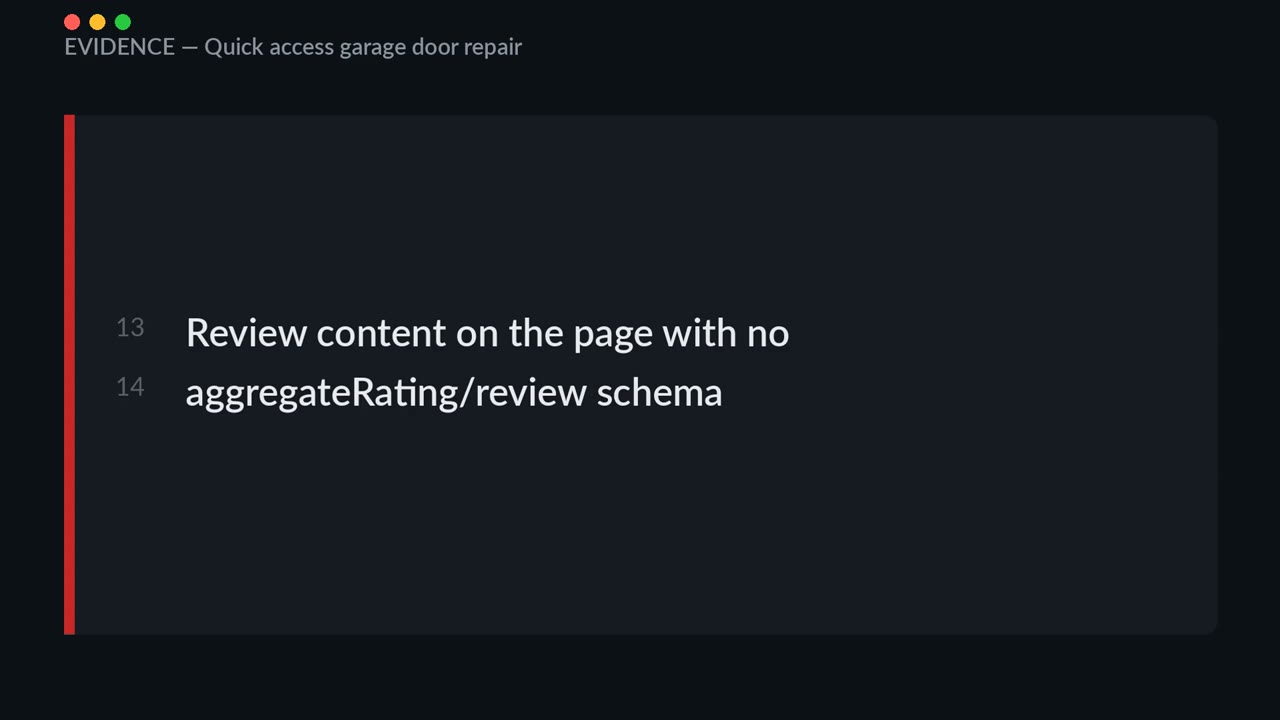
| Reviews shown but not marked up for Google | Review content on the page with no aggregateRating/review schema | Marked-up reviews can show star ratings directly in search results, which lifts click-through on a listing you already rank for — free clicks you’re currently leaving behind. |
| No LocalBusiness structured data | No LocalBusiness schema in the page’s JSON-LD | Structured data is how Google reads your hours, service area, phone and rating. Without it Google guesses — and competitors who publish it get the rich result instead. |
| No paid-ads tracking detected at all | No Google Ads conversion tag, no Meta pixel in the page source. | Either no paid acquisition, or ads running blind with no conversion measurement. |
| No Facebook/Meta pixel detected | No fbq(‘init’) / connect.facebook.net script found in the page source. | Without a pixel, there’s no way to retarget people who already visited the site — one of the cheapest ad channels available goes unused. |
| Multiple H1 tags on the homepage (2) | 2 <h1> tags found in the page source. | Multiple H1s dilute the page’s main topic signal instead of reinforcing one clear keyword focus. |
| No social media profile links found on the website | No Instagram or Facebook profile link found in the page source. | No easy path for a visitor to check recent activity or reviews on social — and no compounding organic reach being built. |
The reviews are the asset. The website is the bottleneck.
Reviews are the hardest thing to earn in local service marketing. You can’t fake 375 of them and you can’t buy them overnight. This company already did the hard part.
What’s left is making sure that trust turns into booked jobs. Every problem below sits between a homeowner who’s ready to call and the phone actually ringing.
A 35 out of 100 on mobile means lost calls
We ran the homepage through Google’s page speed test on mobile. It scored 35 out of 100. The main content took 26.9 seconds to appear.
Think about who’s searching for a garage door company. It’s someone at 7 a.m. with the door stuck halfway, the car trapped inside, already late for work, phone in hand. That person is not waiting 27 seconds. They tap back and call the next company on the list.
And if any ads point to this page, those paid clicks bounce too. You pay for the click, then lose the call to a slow page. In a trade where the customer needs help right now, speed is part of the service.
No review markup: the stars never reach the search results
The reviews do appear on the website, which is great. But in the page source, we found no review markup. That’s a bit of code that tells Google these are star ratings.
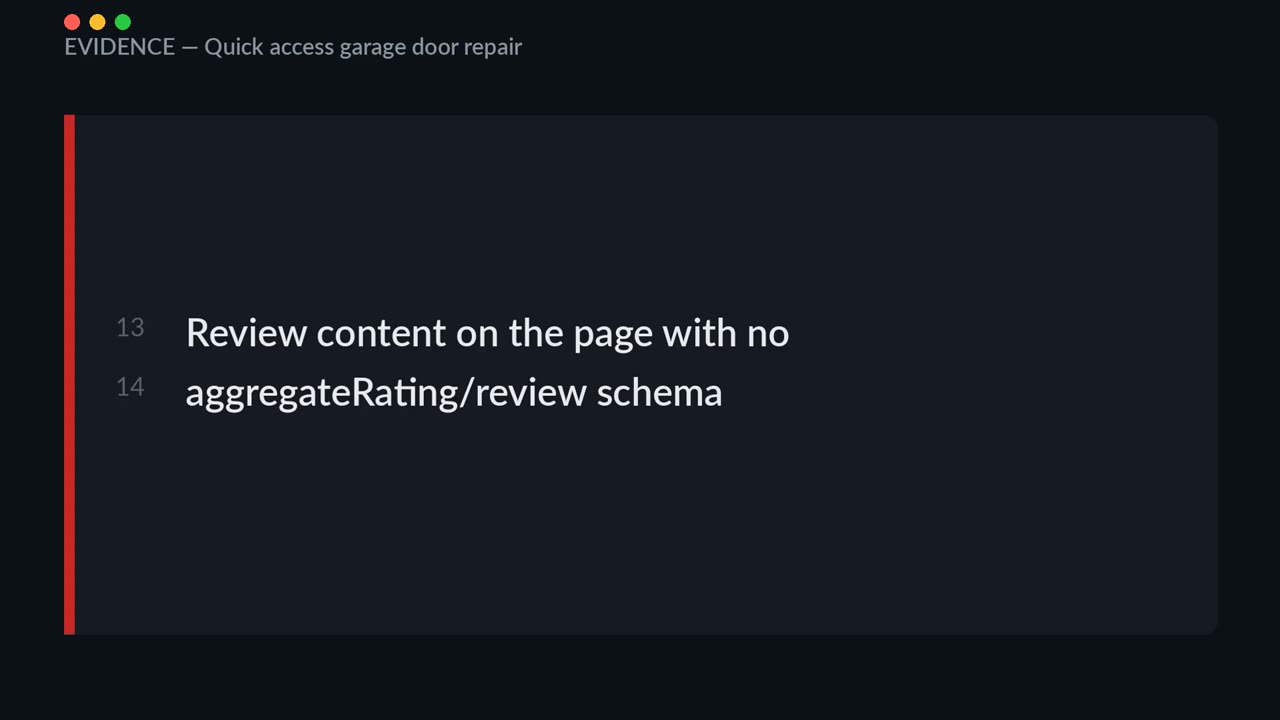
With it, stars can show up right in the search results. If this were my account, I’d want those five stars sitting next to the listing. Why? Because it lifts clicks on searches you already show up for. You don’t need new rankings. You just make the existing listing more attractive than the one next to it.
No local business structured data: Google has to guess
Along the same lines, there’s no local business structure data. Think of it as a label you hand Google with your hours, service area, phone number and rating.
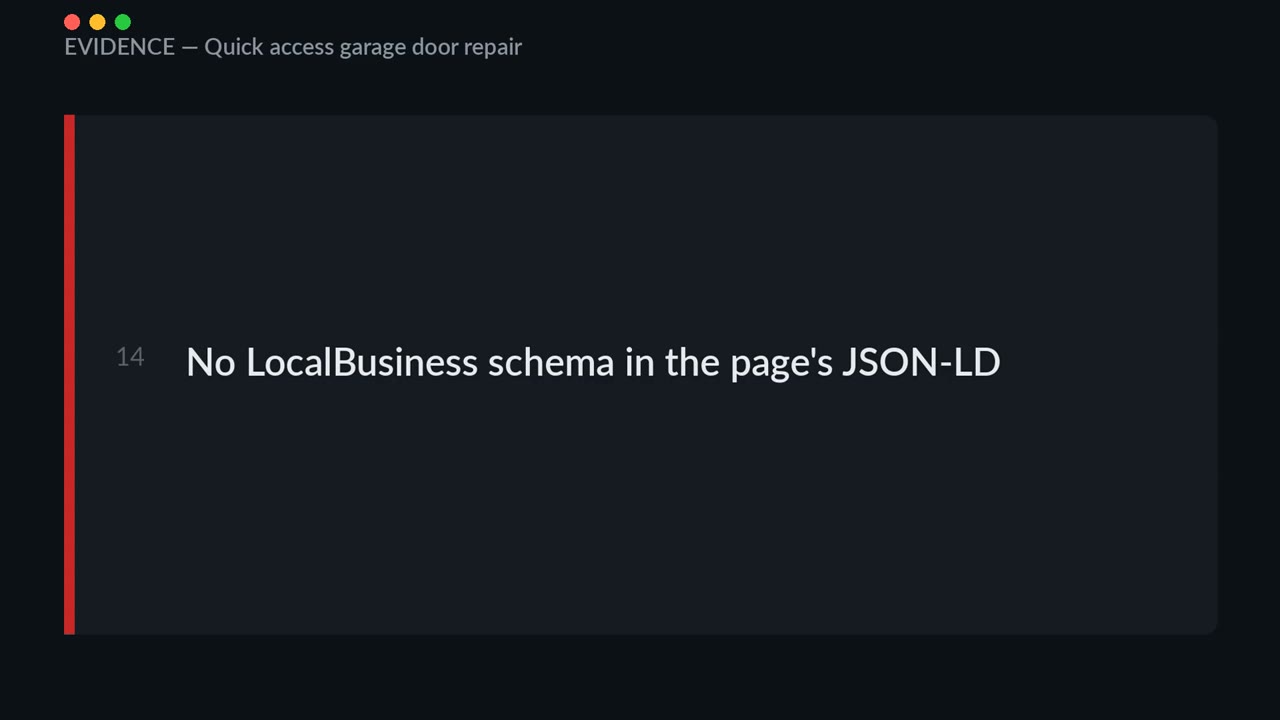
Without that label, Google has to guess. And a competitor who fills it out can end up with the richer result instead. It’s not glamorous work, but it’s the difference between telling Google who you are and hoping it figures it out.
No tracking: flying blind on ad spend
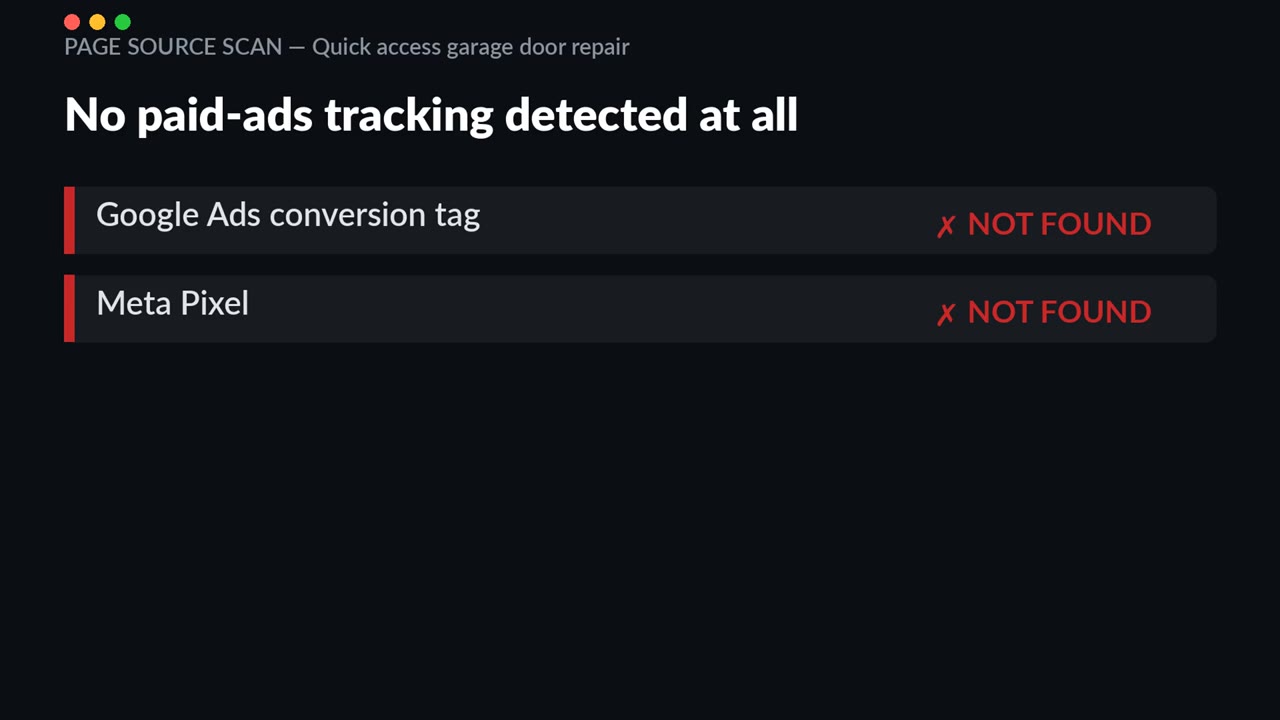
No Google Ads conversion tag
Next, we looked for ad tracking. There’s no Google Ads conversion tag in the page source. That tells me one of two things. Either there’s no paid advertising right now, or ads are running with no way to see which clicks actually book a job.
Two fixes worth knowing about here: call tracking software (click here) shows which ads and pages actually make the phone ring, and click-fraud protection software (click here) keeps junk clicks from draining the budget. (Affiliate links — we may earn a commission at no extra cost to you.)
If money is going into Google Ads, every call and every form needs to be counted. Otherwise you can’t separate the keywords bringing in work from the ones quietly burning budget.
No Meta pixel
It’s the same story on the Facebook side. There’s no Meta pixel. A pixel lets you show ads to people who already visited your site.
Picture a homeowner who got a quote and their spouse said, let’s sleep on it. Retargeting brings that person back a few days later. It’s one of the cheapest ad channels out there, and right now it’s switched off.
Tracking isn’t a nice-to-have. Without it you can’t tell what’s working, so you can’t cut waste or scale winners.
Two H1 tags and no social profile links
One more detail in the page code: the homepage has two H1 tags. The H1 is the main headline that tells Google what a page is about. Ideally there’s just one, so the topic signal stays clean. Two can blur that focus. It’s a small cleanup, but it’s the kind of thing that adds up.
Finally, we couldn’t find a link to a Facebook or Instagram profile anywhere on the site. With 375 five-star reviews, I’d want a visitor to hop over and see recent jobs and activity in one tap. Every post there also builds reach that compounds over time.
Why basics like this get missed

None of this is advanced. These are basics any marketing agency should catch.
After reviewing hundreds of local service accounts, I can tell you how it usually happens. Most agencies I’ve seen collect a monthly retainer while one junior person juggles 80 accounts, and nobody actually opens the page source. If someone’s being paid to run your marketing, they should have caught every item on this list.
That’s the gap between a typical home services marketing company running volume and someone who actually looks at your account. You’re not paying for a better rate. You’re paying for attention, and attention is exactly what gets spread too thin.
AI changes who can fix this
Here’s what most business owners don’t know yet. With AI, fixes like these can now run automatically. With a bit of guidance, you can run your marketing in-house, own the whole thing, and never depend on an agency again.

That’s the approach we teach at Local Service Mastery. You keep control of the accounts, the data and the results, instead of hoping someone else opens the page source.
If you’re ready to stop guessing where the leads are going, our Google Ads management for contractors service is built to catch exactly these kinds of gaps and keep every review, click and call actually working for the business.