 Local Service Mastery
A perfect five-star rating across 921 reviews. You don’t get that by accident. That’s years of showing up on time and doing the job right for people.
So I went through the marketing side of this garage door repair company. A reputation like that should be turning into every job it possibly can. Reviews like these are the hardest part of local marketing to earn, and they’ve already done it.
But when I checked the code, the website, the social presence and the YouTube channel, I found gaps that any decent audit would catch in minutes. Below is exactly what I found, why each one costs money, and what I’d fix first.
| Finding | What the audit found | Why it matters |
|---|---|---|
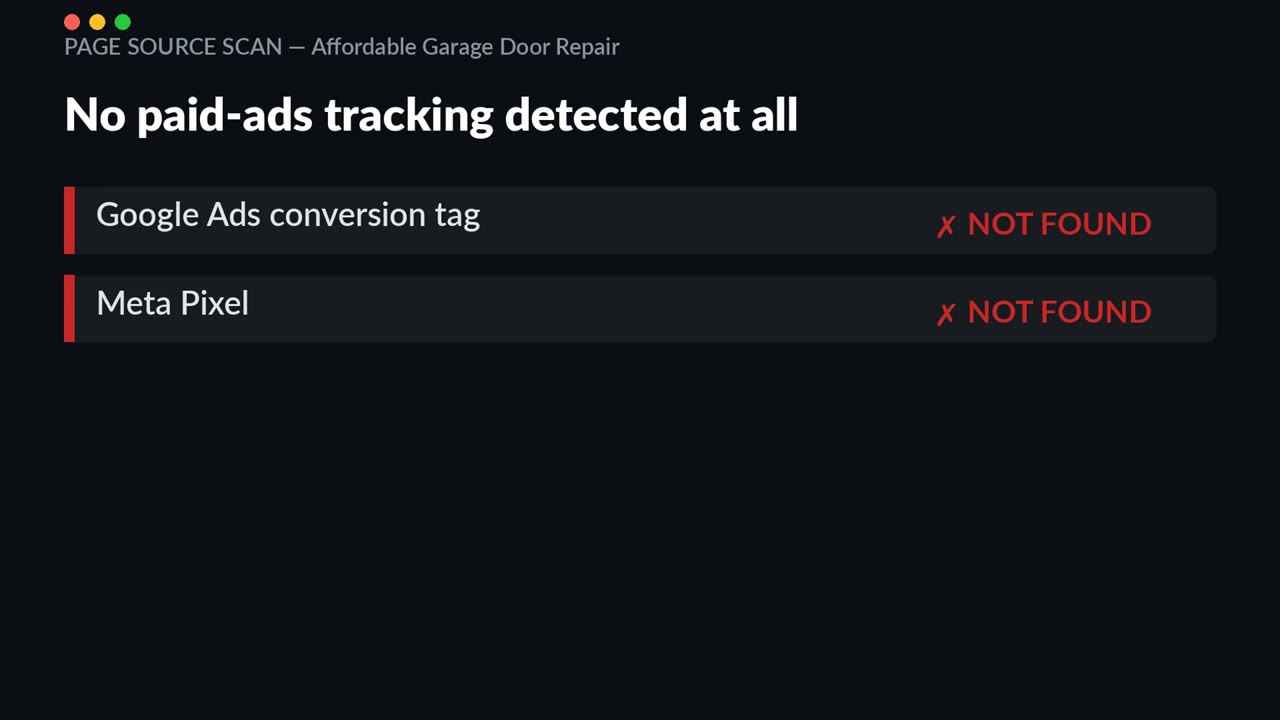
| No paid-ads tracking detected at all | No Google Ads conversion tag, no Meta pixel in the page source. | Either no paid acquisition, or ads running blind with no conversion measurement. |
| YouTube channel inactive (86 months since last upload) | Their YouTube channel’s most recent video was uploaded 2595 days ago. | An inactive channel signals to both viewers and Google that the business isn’t actively investing in content. |
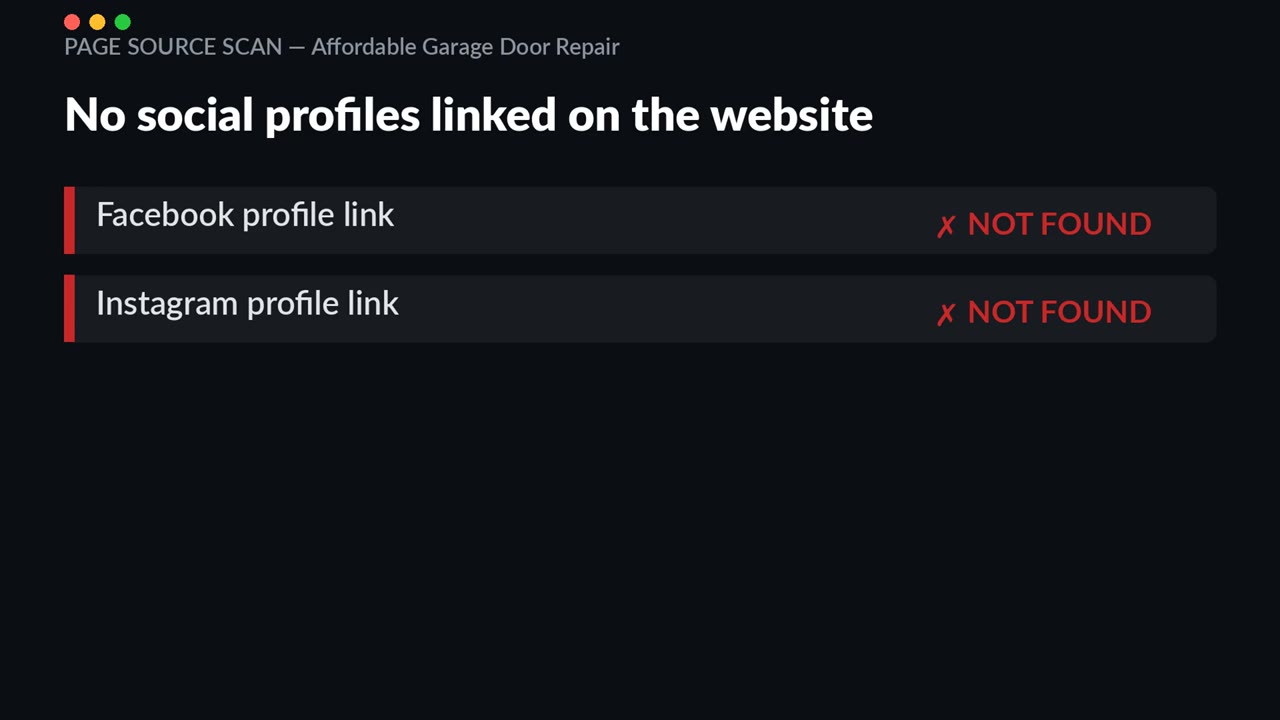
| No social media profile links found on the website | No Instagram or Facebook profile link found in the page source. | No easy path for a visitor to check recent activity or reviews on social — and no compounding organic reach being built. |
| Multiple H1 tags on the homepage (3) | 3 <h1> tags found in the page source. | Multiple H1s dilute the page’s main topic signal instead of reinforcing one clear keyword focus. |
| No LocalBusiness structured data | No LocalBusiness schema in the page’s JSON-LD | Structured data is how Google reads your hours, service area, phone and rating. Without it Google guesses — and competitors who publish it get the rich result instead. |
| No Facebook/Meta pixel detected | No fbq(‘init’) / connect.facebook.net script found in the page source. | Without a pixel, there’s no way to retarget people who already visited the site — one of the cheapest ad channels available goes unused. |
No Google Ads conversion tag: running blind
We checked the code on the website and found no Google Ads conversion tag. A conversion tag is what tells Google which clicks actually turned into calls.
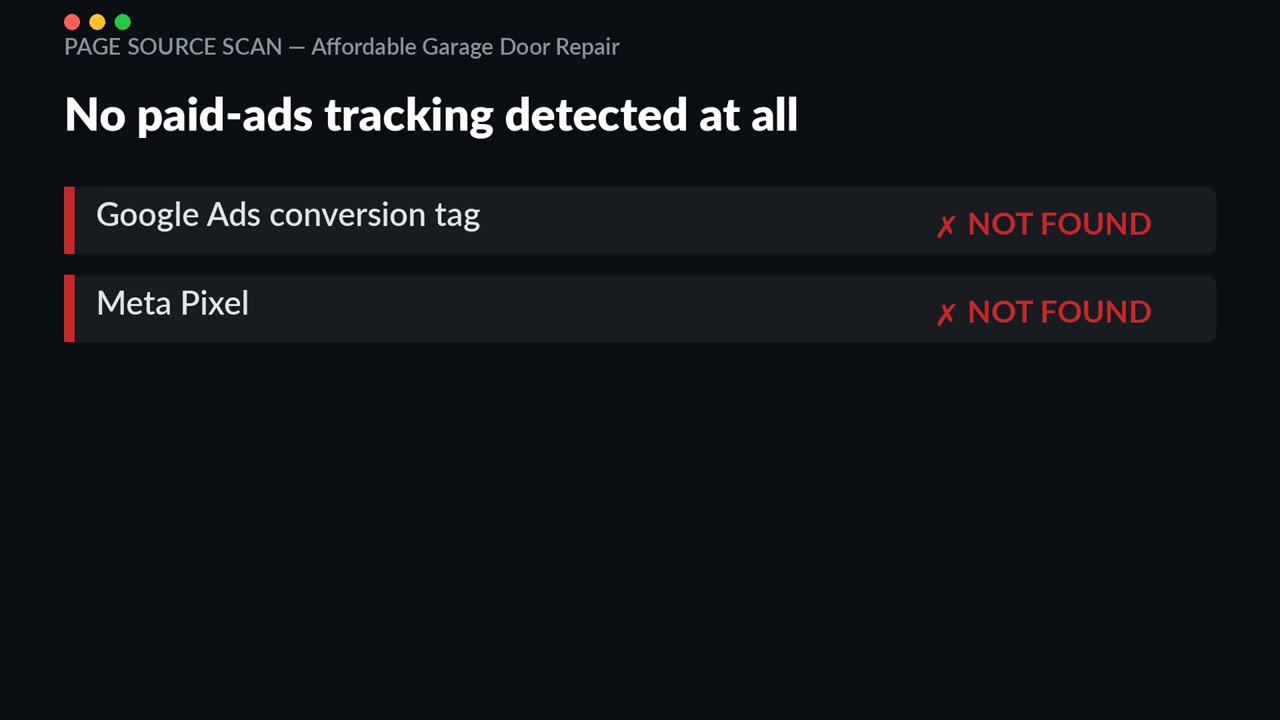
Without it, if ads are running here, they’re running blind. Nobody can say which searches are booking jobs and which ones are just burning budget.
That’s the real cost. Google Ads is a feedback machine. It gets better when you tell it what a good result looks like. No tag, no feedback. You can’t cut the keywords that waste money, and you can’t put more behind the ones that book work. Every dollar gets treated the same, and that’s how budgets leak.
If you can’t say which searches booked jobs last month, you don’t have a Google Ads strategy. You have a monthly expense.
No Meta Pixel: no second chance with the visitor who bounced
The missing Meta Pixel matters too. A pixel is what lets you show ads again to someone who already visited your site.
Picture a homeowner with their garage door stuck halfway open. They land on the site, the kids start yelling, they close the tab. This company never gets back in front of them.
That person had an urgent problem and was ready to buy. Maybe they got pulled away for ten minutes. Maybe they went to call a competitor next. Without a pixel there’s no way to follow up, because the business doesn’t know they were ever there.
If this were my account, I’d want that pixel in place. Retargeting is one of the cheapest ways to win that person back. You’re not paying to find a stranger. You’re paying to remind someone who already raised their hand.
A YouTube channel that went quiet more than seven years ago
Then there’s the YouTube channel. The most recent video went up 2,595 days ago. That’s over seven years.
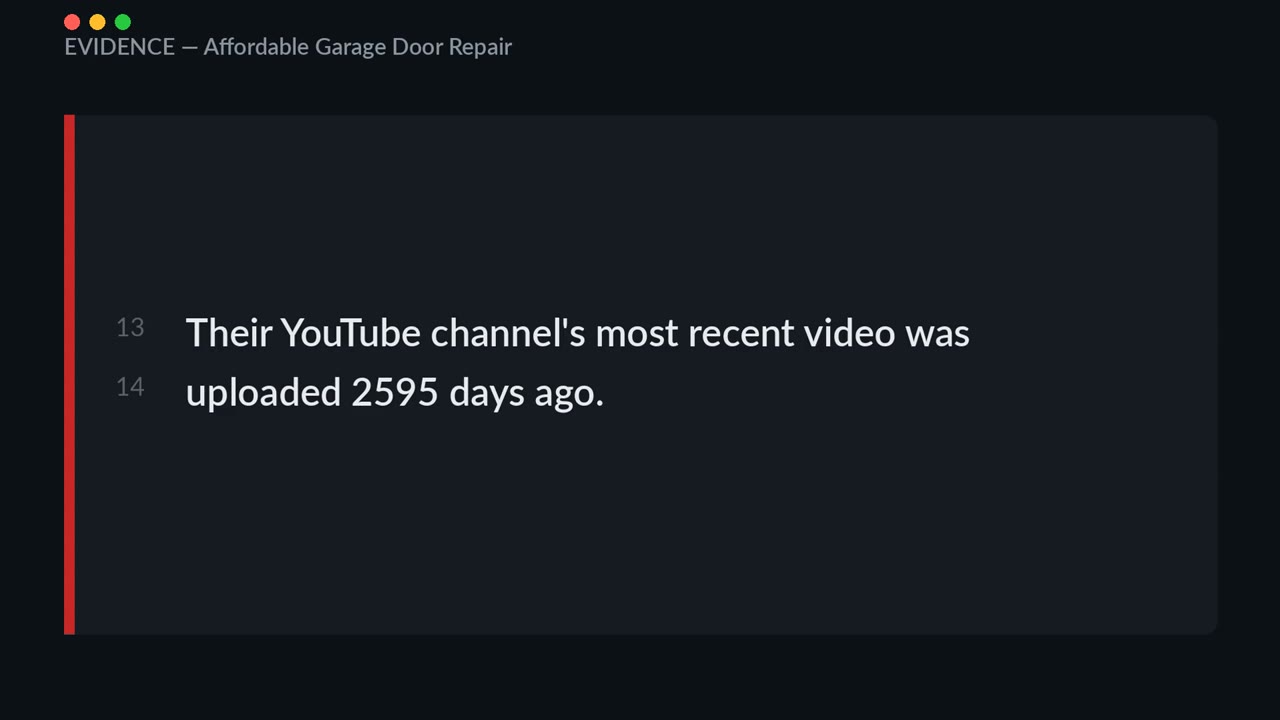
To a viewer and to Google, a channel that quiet reads like the business stopped investing in content. That’s a shame for a company with this many happy customers. Those customers are proof, and proof makes great content.
A dead channel doesn’t help the brand. A homeowner who clicks through to see who they’re about to let into their home gets a signal that nothing has happened in years.
No Instagram or Facebook links on the website
On the website itself, we didn’t find a link to an Instagram or Facebook profile. Plenty of people want to check recent activity before they call.
Maybe it’s not even the homeowner. Maybe it’s their spouse doing the homework. These are the people who quietly decide who gets the call, and you never see them in your analytics.
I’d want to give them an easy path to do that. A link costs nothing. It’s one small way to turn a hesitant visitor into a caller.
Three H1 tags on the homepage
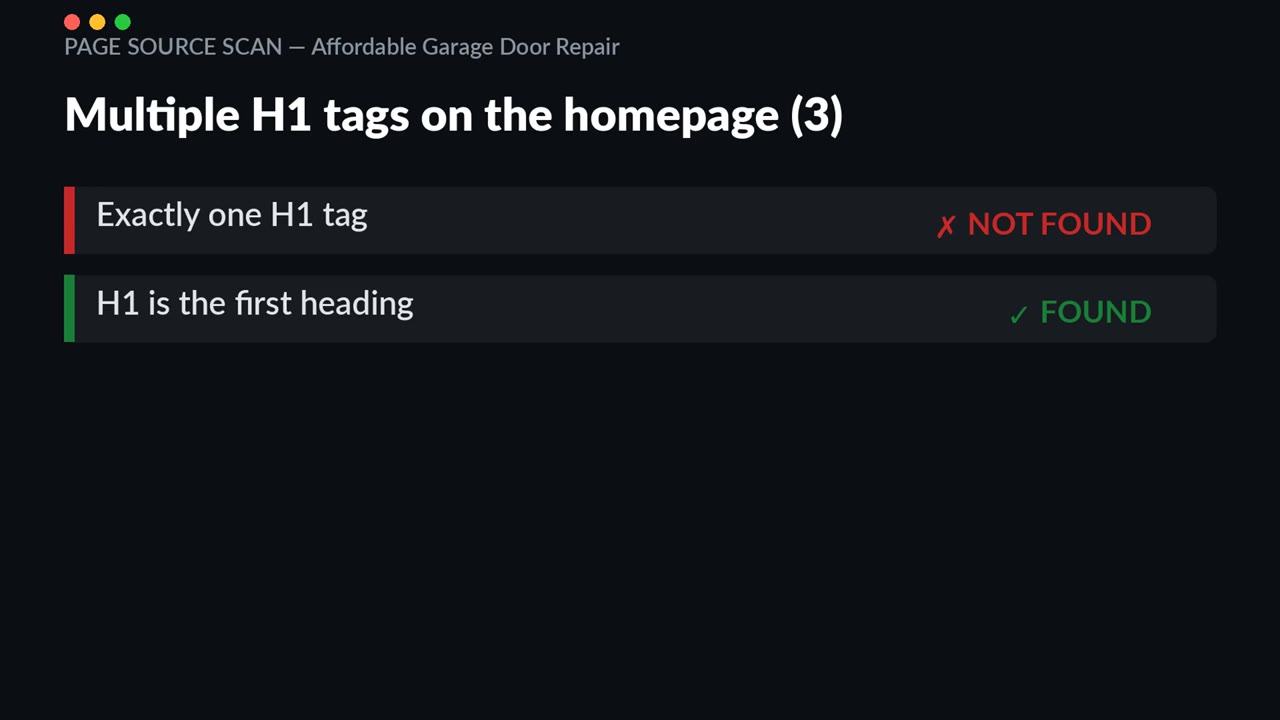
Why one clear headline matters
The homepage has three H1 tags. The H1 is the page’s main headline for Google.
Three of them blur the message. One clear headline would tell Google exactly what the page is about. This is a basic on-page fix that doesn’t require a rebuild or a big budget. It just requires someone to look.
No local business structured data: the one I’d fix first
This is the one I’d fix first. There’s no local business structure data. That’s hidden code that hands Google your hours, phone number, service area and rating directly.
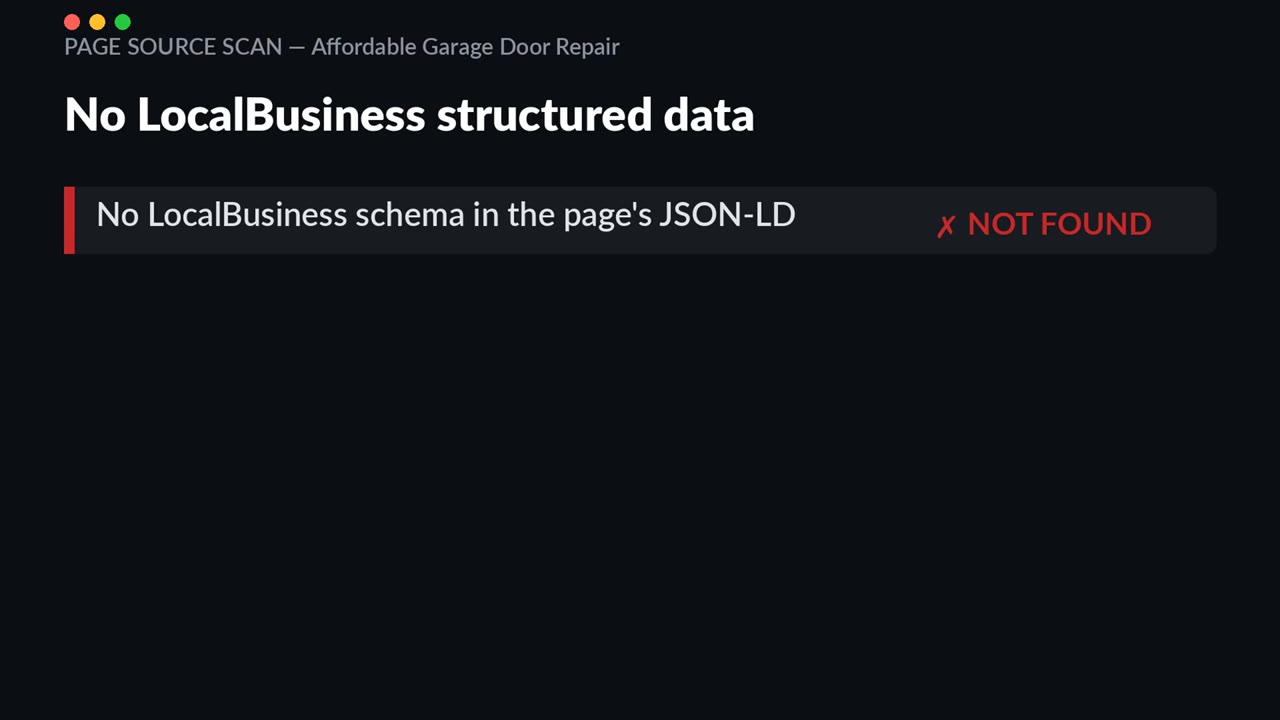
Without it, Google has to guess. Competitors who publish it can get the richer search result instead.
With 921 five-star reviews, I’d want that rating spelled out for Google, not left to chance. This business has the strongest asset in local marketing, and the website isn’t explaining it to the search engine in a language it reads natively.
A reputation like this should be turning into every job it possibly can.
Why basics like these get missed
After reviewing hundreds of local service accounts, I can tell you these are basic things. If someone is being paid to run this, they should have caught it.

Here’s what I’ve seen over and over. Most agencies collect a monthly retainer while junior staff juggle 80 accounts, and nobody actually looks. That’s not a conspiracy, it’s the business model. A retainer pays the same whether anyone opens your account or not, so the missing tag stays missing.
If you’re shopping for a home service marketing agency, ask who will actually look at your tracking, your code and your account, and how often. If the answer is vague, you already know what happens.
The shift most owners don’t know about yet
With AI, fixes like these can now run automatically. Adding tracking, cleaning up page structure and publishing structured data used to be tedious technical work. Now they don’t have to be.

And with a bit of guidance, you can run your marketing in-house, own the whole thing and never depend on an agency again. That’s what we teach at Local Service Mastery, and it’s why more contractors are taking the wheel themselves. If you want the full playbook on marketing for garage door companies and other trades, that’s where to start.