LSM Video · Marketing ROI

Marketing ROI For Contractors: 5 Steps to Cut or Add Budget

  • ✓Track the first and last touchpoint of every lead, not just the last click
  • ✓Know the dollars back for every dollar spent, measured in net profit
  • ✓Wait a month or two before judging when jobs close slowly
  • ✓Work out the cost per lead and cost per closed job you can afford
  • ✓Judge the whole business before you cut any single platform
See the 5 steps →

Watch the full video, then read the breakdown below.

“I spend on Google, Facebook, Yelp and magazines. How do I decide which platforms to cut or put more money into?” A home service owner asked me exactly that on one of our weekly group calls, and if it sounds like your business, this article is for you.

I’m Lior Vaknin. I’ve spent 15 years running marketing for home service businesses, and every week I answer questions like this one live with our members. I’ll give you five steps that work for any mix of platforms, and the last one decides whether you should cut anything at all.

Asked on our weekly group call: “I spend on Google, Facebook, Yelp and magazines. How do I decide which platforms to cut or put more money into?”

Short answer: judge your overall marketing ROI, not each platform alone. Track where every lead comes from, work out what you can afford to pay per lead and per closed job, and give it time. If the overall ROI is positive, don’t touch it.

Why one platform can look better or worse than it really is

Before the steps, a quick reminder of how reporting works. Last click reporting gives all the credit to the final ad that was clicked. Google puts the weakness plainly in its own help pages: “However, this ignores the other ad interactions customers may have had along the way.”
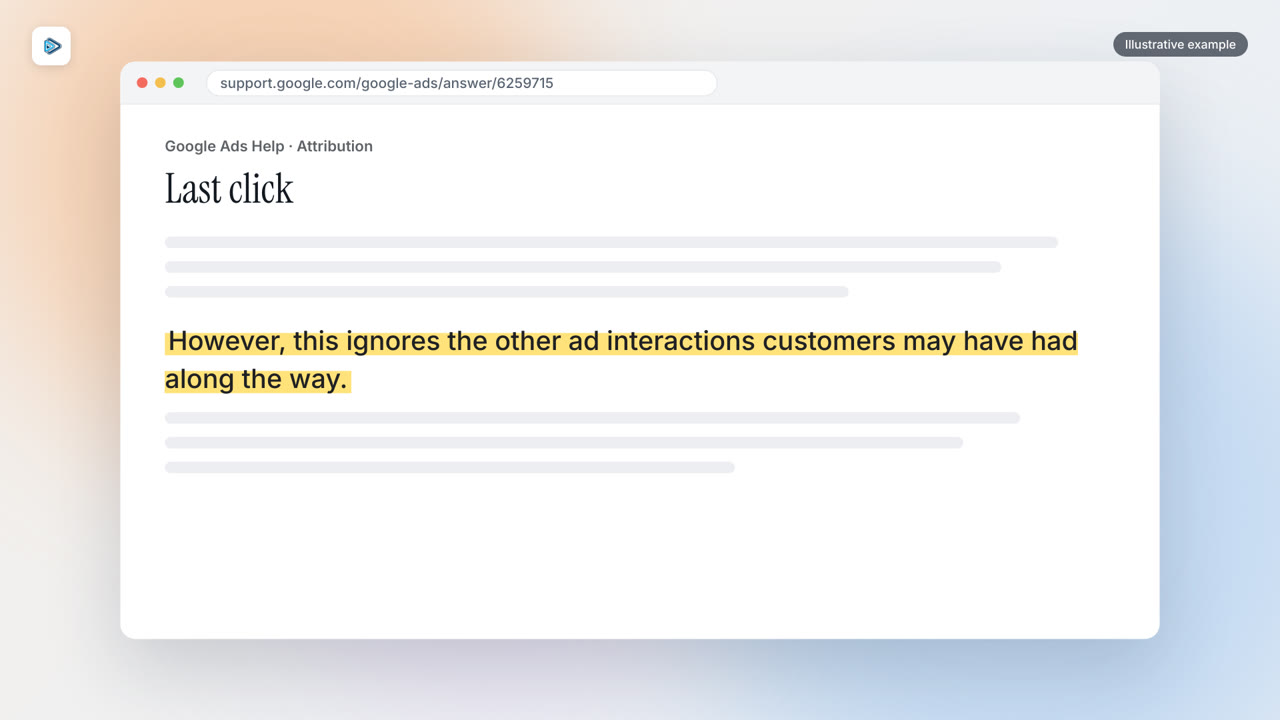
How it works: Google's own help page: Last click (from the video)
First, a quick reminder of how it works: last click reporting gives all the credit to the final ad clicked, and ignores every earlier touch.

In a home service business that happens all the time. Someone may see your Facebook ad, never contact you there, and later call after seeing a magazine promotion. On paper, Facebook looks useless and the magazine gets all the credit. If you cut Facebook based on that report, you may be cutting the thing that started the job.

Step 1: Track every lead

This is the step most owners skip. Many owners don’t track the first touchpoint versus the last touchpoint, so every budget decision turns into a guess.
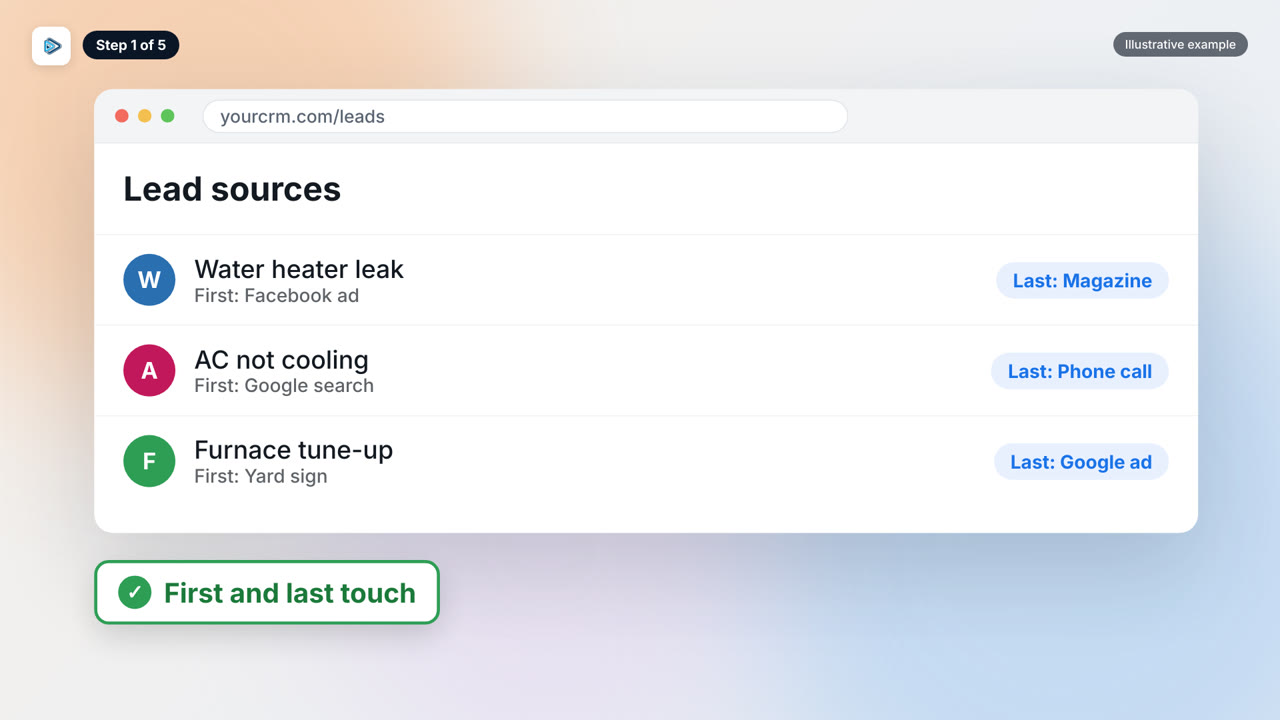
Track every lead: the Lead sources screen (from the video)
Step one is simple and the one most owners skip: track where each lead comes from, and write down the first touchpoint and the last touchpoint.

For every new lead, write down two things: where the person first came across your business, and what they touched last before they called or filled in a form. A simple column in a spreadsheet or your CRM is enough. Do it for every platform you pay for, including Yelp and the magazine.

Go back to the Facebook example. With only a last touch column, Facebook shows zero and the magazine looks like a hero. With both columns, you can see that Facebook started the conversation and the magazine finished it. Tracking where each lead comes from is the base for every other step, and without it you are deciding in the dark.

Step 2: Know how many dollars come back

Step two is knowing how many dollars come back for every dollar you spend. That single number tells you whether your marketing is paying for itself.
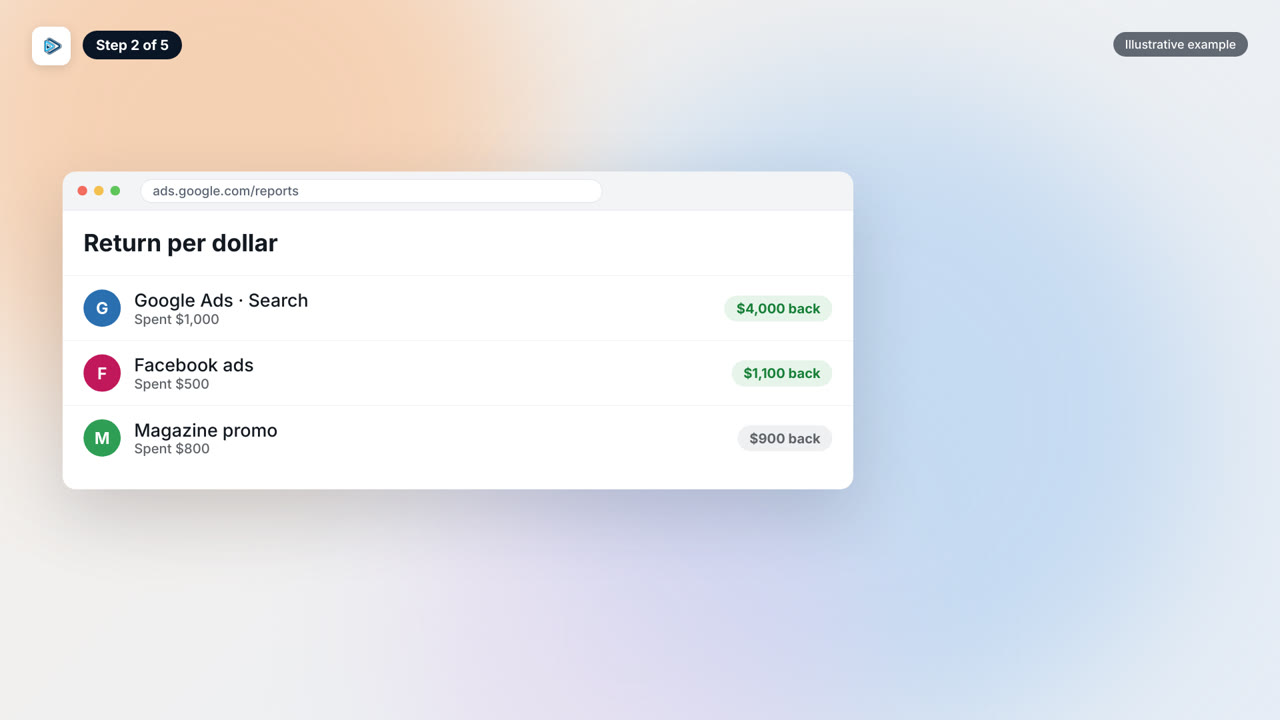
Dollars back: the Return per dollar screen (from the video)
Step two is knowing how many dollars come back for every dollar you spend, because that single number tells you whether your marketing is paying for itself.

Google calls it return on ad spend, or ROAS: “ROAS is the overall measure of attributed conversion value divided by total spend”. It is a useful starting point, and I’d go one step further.

Don’t stop at revenue. Look at net profit after the costs of your technicians, the office and so on. A job that brings in good revenue but leaves almost nothing after labor is not a win, and a channel that feeds you those jobs deserves a hard look. Judge it at the level of the business’s overall marketing ROI, not each platform on its own.

Step 3: Wait for the jobs to close

Step three is patience. If your jobs take weeks to close or come with big deposits, judging your results after a few days will mislead you. The money simply hasn’t shown up in the numbers yet.
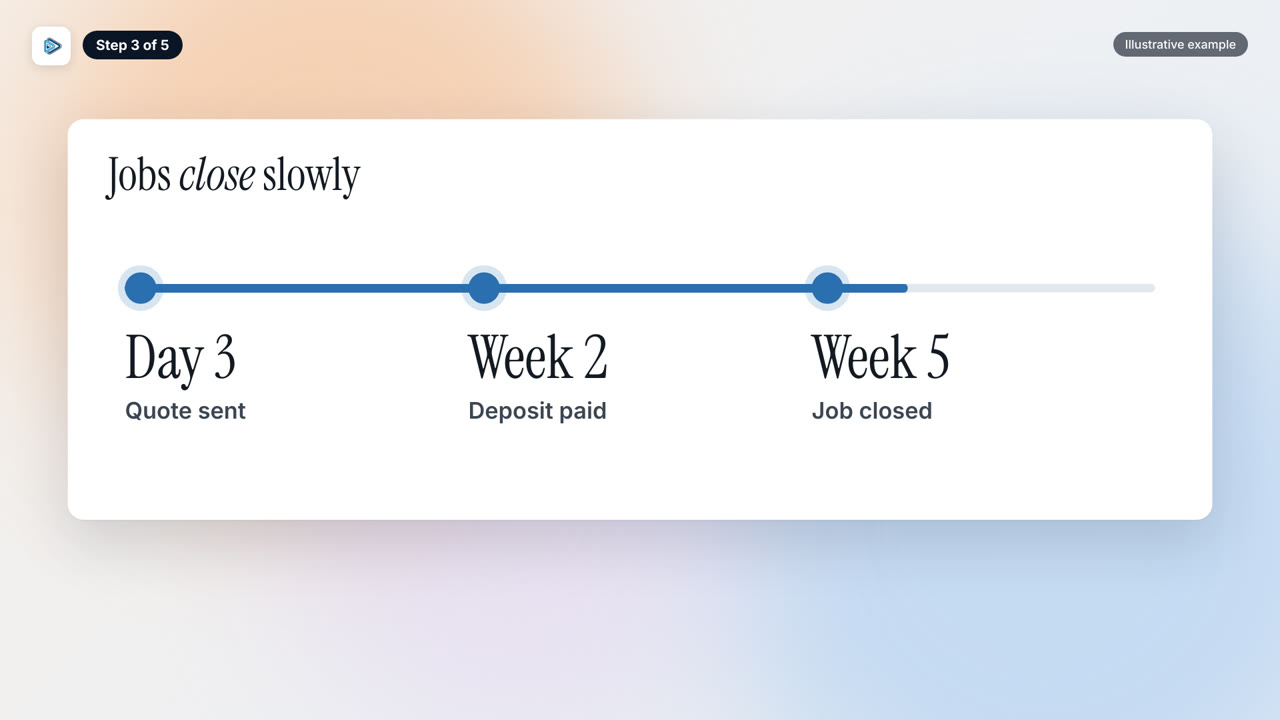
Wait for jobs: the dates of the change (from the video)
Step three is patience, because if your jobs take weeks to close or come with big deposits, judging your results after a few days will mislead you.

Google says the same thing about reading results: “Ensure the time frame of ROAS evaluation excludes the most recent conversion delay period to get an accurate view of campaign performance.” In plain words, leave out the most recent days, when jobs haven’t closed yet.

My rule for slow jobs is to wait a month or two, then check your average ticket and your profit. A channel that looks weak in week one may look very different once the estimates turn into signed work. Cutting early means you are cutting on incomplete numbers.

Step 4: Find your cost limits

Step four answers the question of how much you can spend per lead. Work out the cost per lead and the cost per closed job at which you are still profitable. Once you know those two numbers, you know how much you can spend.
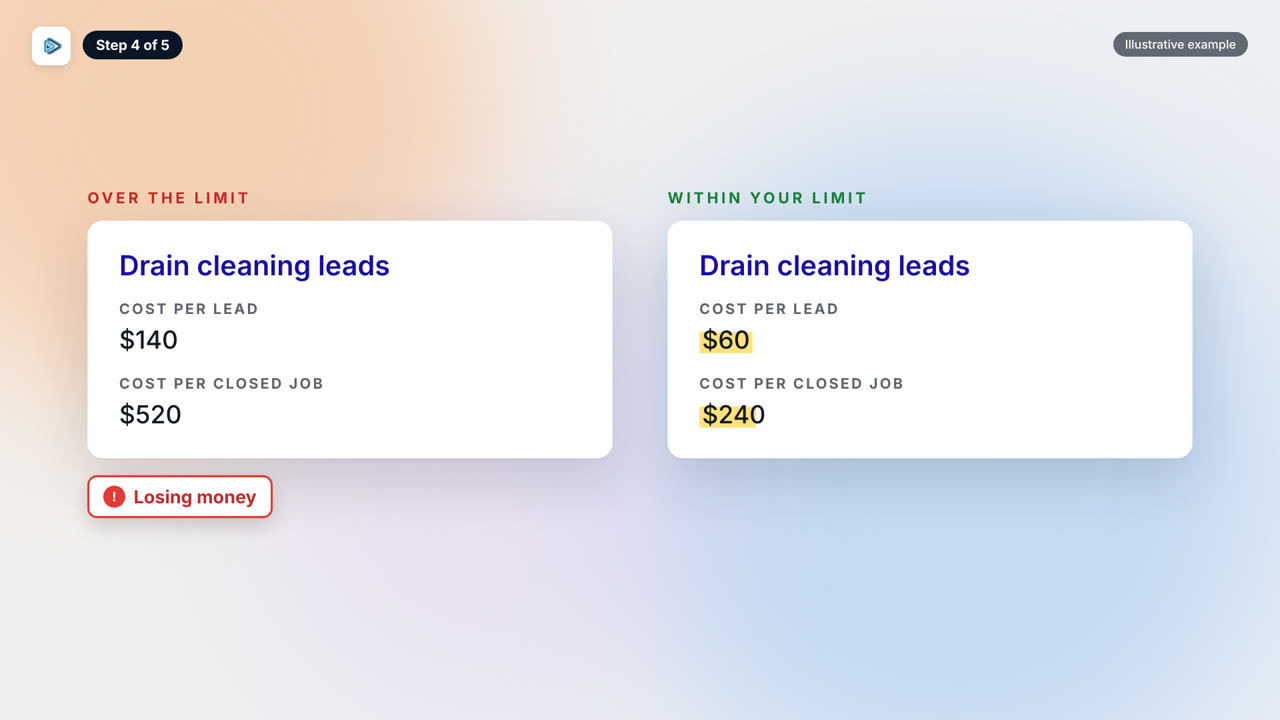
Your cost limits: before and after, side by side (from the video)
Step four answers how much you can spend per lead: work out the cost per lead and the cost per closed job at which you're still profitable.

This even shapes your budget on Google. With Local Services Ads, “Set an average weekly budget based on the average number of leads you want to receive in any given week.” Your target cost per lead and the number of leads you want decide the spend.

To see cost per real customer instead of cost per lead, Google lets you import offline conversions, like closed jobs, back into Google Ads. As Google puts it, “By importing offline conversions, you can measure what happens in the offline world after your ad results in a click or call to your business.”

Step 5: Look at the whole business before you cut

Now the step I promised. If your overall marketing ROI is positive, don’t touch it, and don’t spend less.
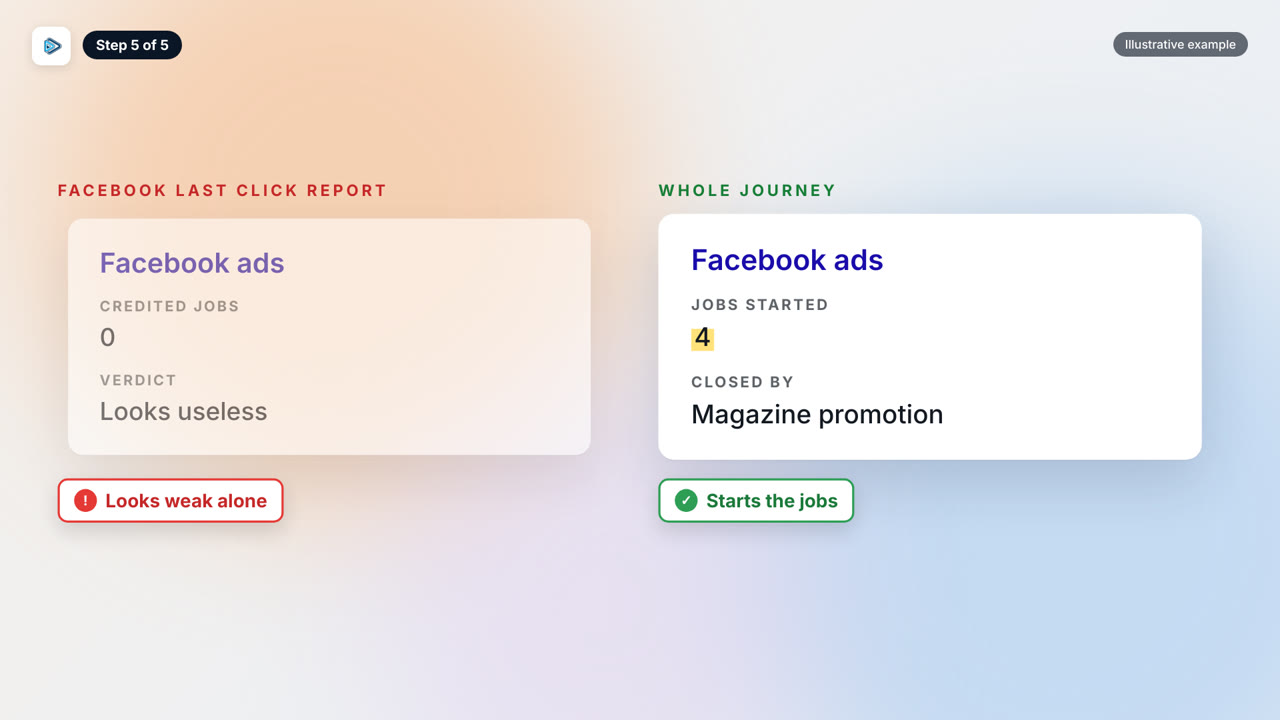
The whole business: before and after, side by side (from the video)
The reason is that your platforms work together, so a channel that looks weak on its own report may be the one starting the jobs that another channel closes.

The reason is that your platforms work together. A channel that looks weak on its own report may be the one starting the jobs that another channel closes. Google’s attribution reports can show a keyword or campaign that rarely gets the last click but often helps a sale happen, and Google’s suggestion is that “you may choose to test increasing investment for these keywords to check whether you can drive more conversions for your business.”

So if one channel is clearly working, put more money into it, but don’t cut the others. And if results dip, test new creatives and new offers instead of cutting the budget. Cutting only gives you fewer leads and fewer jobs.

One more thing: check how your closed jobs reach Google

If a CRM or an agency sends your closed jobs to Google, check how it does it. Google has announced a change to the route those uploads take. Its help page says: “Starting June 15, 2026, offline conversions import and enhanced conversions for leads uploads will be migrated to the Data Manager API and blocked in the Google Ads API.”
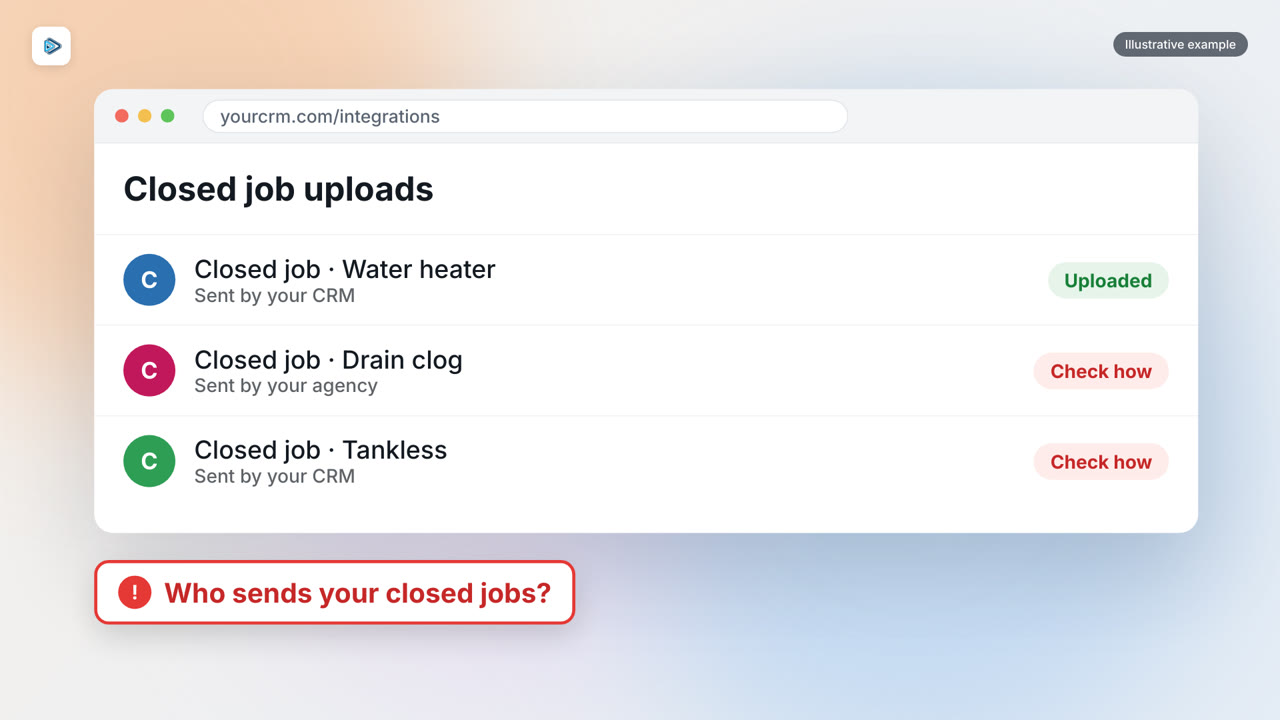
What's changing: the Closed job uploads screen (from the video)
One more thing you need to know: if a CRM or agency sends your closed jobs to Google, check how it does it.

If your closed job data goes to Google through the old route, ask whoever sets it up whether it has been moved. Without that data, you lose the cost per real customer view from Step 4, and that is the view that makes your cut or add decisions reliable.

Real owners · Real results

Don't take my word for it.

See it in action

How LSM AI Works

Still got questions?

Let's find the right fit for you.

Answer a few quick questions about your business. If it's a fit, we'll get you on a call with me. If not, I'll point you to what actually makes sense for where you're at.

— Lior

Free · Real Google data · 60 seconds

How many calls can your market get?

Real numbers — pulled straight from Google Ads. Not an agency pitch. 🎯

$ /mo

No credit card  ·  No commitment  ·  We verify your details before showing results

The honest truth

Agency vs. owning it.

The agency model
  • ✗ $2,000–$5,000/month in fees just to manage your account
  • ✗ They own your Google Ads account — you start from zero when you leave
  • ✗ Random results. No explanation of why.
  • ✗ Zero visibility into what they're actually doing
The LSM way
  • ✓ Costs less than one missed job
  • ✓ Your Google Ads account. Your campaigns. Your data — always.
  • ✓ AI manages it daily. Full transparency — you see every decision.
  • ✓ Cancel anytime. Your campaigns stay yours forever.
The LSM way

How it works.

The opposite of an agency. We build it inside your accounts. You own it all.

1

Pick your coverage

One city or your whole service area. The free audit tells you exactly what to expect in your market.

2

Your LSM AI builds everything

Your AI marketing manager builds your Google Ads, call tracking, fraud protection, and landing page — inside your accounts. You approve before a single dollar is spent.

3

Your phone starts ringing

Most clients are live within 48 hours. Your AI optimizes bids and keywords daily — results compound over time.

✓ Google Ads campaign (your account) ✓ Call tracking setup ✓ Competitor click blocking ✓ High-converting landing page ✓ Daily bid & keyword optimization ✓ Monthly performance report ✓ You own every account, always ✓ Personal LSM AI manager ✓ 24/7 Q&A in Lior's voice ✓ 7-day money-back guarantee
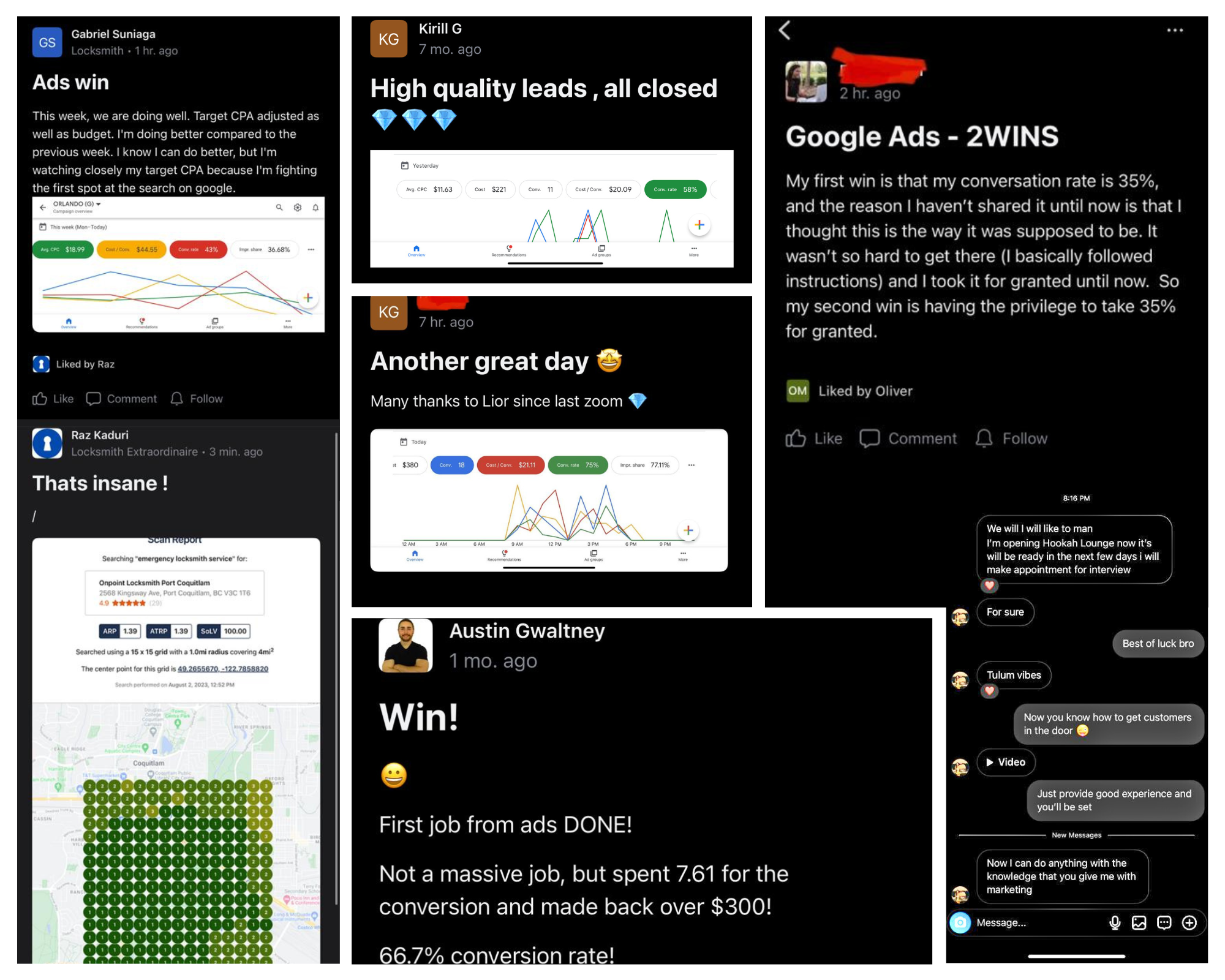
Real client wins and results using LSM
Included in every plan

Your own AI account manager.

Built on 8,600+ real LSM coaching sessions. Trained in Lior's exact voice.

⚡ Powered by LSM AI · Trained on 8,600+ real LSM coaching sessions
🔐

It already knows everything about you

The moment you sign up, your LSM AI knows your plan, your city, your service. No setup call. No briefing a stranger.

🏗️

Builds your entire setup — while you watch

Google Ads. Call tracking. Fraud protection. Your landing page. Built inside your accounts, step by step.

✅

Nothing goes live without your sign-off

Before a single dollar is spent, your AI walks you through everything it built. You approve. Then it goes live.

💬

On call 24/7 — in Lior's exact voice

Ask it anything, anytime. 8,600+ real LSM coaching answers. Available instantly.

► claude
✓ Membership verified — Growth plan · Dallas TX
✓ Client profile loaded — HVAC, 3 cities
Building your Google Ads campaign…
✓ Campaign created (PAUSED for review)
✓ 47 keywords added across 3 ad groups
✓ 3 responsive ads created
Setting up call tracking…
✓ 4 tracking numbers created
✓ Call tracking installed on your site
✓ Competitor click blocking active
Building landing page…
✓ Site backed up · Page builder detected
✓ Landing page live at dallas-hvac.yourdomain.com
Everything looks good. Budget: $75/day · Targeting: Dallas 25mi · Ready to go live?
You: Yes, turn it on.
✓ Campaigns activated. Your phone should start ringing.
Real session · Google Ads + Call Tracking + Landing Page built in one go
Free · 2 minutes · No call required

See what your market can do.

Real estimate — pulled directly from Google's own data. Not a made-up projection. 🎯

No credit card  ·  No call  ·  Results in 30 seconds

If this sounds familiar…

You've been burned before.

🔒

They own your accounts. Not you.

The day you leave an agency, your Google Ads account, tracking numbers, and landing page are gone. You spent $30,000 building their asset.

💸

The reports look great. The phone doesn't ring.

Impressions. Clicks. CTR. Beautiful PDF every month. But when you ask how many jobs you closed — nobody has a straight answer.

🤷

You ask a question. You get an email 48 hours later.

You need answers now. A human account manager you can never reach isn't service — it's a subscription to uncertainty.

Lior Vaknin
Who's behind this

I'm Lior. 15 years making sure you never get locked out of your own marketing again.

I built Local Service Mastery because I watched too many great contractors get burned by agencies — overcharged, locked out, left with nothing. So I flipped the model: your accounts, your data, your asset. We build it. You own it.

500+owners coached
$20M+revenue generated
15+years in the game

Peace,
Lior Vaknin

Good questions

Questions,
answered.

How do contractors measure marketing ROI?

Track where every lead comes from, then work out how many dollars come back for every dollar you spend. Use net profit after technician and office costs, not just revenue, and judge the business’s overall marketing ROI rather than each platform alone.

Should I cut a platform that looks weak in my reports?

Not on that report alone. Last click reporting gives all the credit to the final ad clicked, so a channel that starts the jobs can look useless while another channel gets the credit.

How long should I wait before judging a channel?

If your jobs take weeks to close or come with big deposits, wait a month or two and then check your average ticket and profit. Google also says to leave out the most recent days, when jobs haven’t closed yet.

How much can I spend per lead?

Work out the cost per lead and the cost per closed job at which you are still profitable. Once you know those two numbers, you know how much you can spend.

What should I do if one platform is clearly working?

Put more money into it, but don’t cut the others. Your platforms work together, so the others may be starting jobs that the winning channel closes.

What changes on June 15, 2026 for closed job uploads to Google?

Google says offline conversion import and enhanced conversions for leads uploads move to the Data Manager API and are blocked in the Google Ads API. If a CRM or agency sends your closed jobs to Google, check how it does it.

Which plan should I pick?

Start with Starter if you want to get your phone ringing in one city and grow from there — one new campaign gets added each month. Go with Growth if you're ready to cover your full service area right away. Pro adds local SEO, Facebook Ads, and weekly coaching with me directly. If you're still not sure, run the free audit — it'll tell you what to expect in your market.

How fast will my ads go live?

Most clients are live within 48 hours of completing setup. Your LSM AI builds everything, you review and approve, then it goes live. The only exception is if Google requires advanced verification for your category (locksmith, garage door) — that's a direct process between you and Google, and we walk you through it.

What results can I expect?

Depends on your trade, your city, and your ad budget. The free audit gives you a real estimate pulled directly from Google's own Ads data — not a made-up projection. In a medium-to-large market with a $1,000/month ad budget, most clients get 15–40 qualified calls per month. Run the audit first to see what's realistic in your specific area.

Do I really own everything?

Yes. The Google Ads account, the call tracking numbers, the landing page — all built inside your accounts, in your name. If you ever cancel, you walk away with everything you paid to build. That's not a policy. That's the whole point.

Is there a contract?

No contract, ever. Every plan is month-to-month. Cancel anytime — if we stop earning your business, you should stop paying.

What if I already have my own call tracking or fraud protection?

No problem. You can connect your existing accounts, or we set everything up fresh for you. Your call — you pick during onboarding.

I'm a locksmith or garage door company. Anything I should know?

Yes — Google requires advanced verification for locksmith and garage door services before ads can run. We build your campaign and all your keywords, but you'll need to complete that verification with Google directly (we walk you through it). If for any reason you can't complete it, you're covered by our full 7-day refund.

Do you work with my trade?

We specialize in home and local services — HVAC, plumbing, electrical, roofing, locksmith, garage door, pest control, carpet cleaning, water damage, tree service, and more. Run the free audit and you'll instantly see if we're a fit.

What exactly is my LSM AI account manager?

It's your personal AI marketing manager — trained on 8,600+ real LSM coaching sessions. Sign up and it's ready to go: builds your full campaign setup inside your accounts, reviews everything with you before anything goes live, and stays on 24/7 to answer any question about your campaigns, leads, or marketing strategy. In Lior's exact voice.

What's the 7-day money-back guarantee?

If you sign up and decide within 7 days that this isn't right for you — for any reason — you get a full refund. No hoops. We'd rather lose a bad fit early than keep a client who isn't seeing value.

The bottom line

Don’t cut by guessing, decide by the numbers

Track the first and last touchpoint of every lead, know the dollars that come back in net profit, and give slow jobs a month or two to close. Then work out the cost per lead and cost per closed job you can afford.

If your overall marketing ROI is positive, don’t touch it and don’t spend less. Add money to what is clearly working, keep the other channels running, and test new creatives and offers when results dip.

Rather not keep track of all this yourself?

LSM AI connects to your Google Ads, Google Business Profile, Facebook ads and website, finds what costs you leads and makes the fixes in your own accounts once you approve them.

Answer 5 quick questions to see if it’s a fit →

Stop renting leads.

Check your market, pick your plan, or grab 15 minutes with me. Let's get your phone ringing.

See what your market can do

Your trade