 Local Service Mastery
A great reputation does not equal a great marketing setup. I found that out again while auditing Desert Ridge Family Physicians. Right out of the gate, the reputation is excellent: a 4.6 rating across more than 610 reviews. That is a lot of people who took the time to say good things.
So the trust is real. The problem is the marketing setup wrapped around it.
Yes, this is a family medicine practice, not an HVAC or plumbing company. It doesn’t matter. The mechanics are identical. Someone picks up their phone, lands on a website, and decides in seconds whether to call you or the next business. Every leak I’m about to walk through can hit a contractor’s site just as easily.
| Finding | What the audit found | Why it matters |
|---|---|---|
| Site looks abandoned — copyright still says 2020 | Footer copyright reads 2020; current year is 2026 | It is the first thing a careful customer checks to see if you are still in business. A stale year quietly tells them the site — and maybe the company — is neglected. |
| No reviews or testimonials shown on the site | No review/testimonial content detected on the homepage | The reviews exist on Google but never reach the page where the decision is made. Proof has to be where the buying happens. |
| The phone-number link on the homepage isn’t tap-to-call | The one phone number on the homepage that is a link is coded <a href=”http://408-607-0060″>480-607-0060 — a web address, not a tel: link, and with the area code typed 408 instead of 480; no <a href=”tel:”> link anywhere on the homepage. | Most people looking for a family doctor are on a phone. Tapping the number should dial; here it tries to open a web page that doesn’t exist, so patients have to copy the number by hand or leave. |
| Analytics is the retired Universal Analytics tag | Homepage loads Google’s legacy Universal Analytics script (ga.js, property UA-24400914-1); no GA4 or Google Tag Manager script on the page. | Google stopped processing Universal Analytics data in 2023, so there’s no working way to see which marketing brings in patients. |
| No paid-ads tracking detected | No Google Ads conversion tag and no Meta pixel found on the homepage, in the page source or in the rendered page’s network requests. | Either no paid acquisition, or ads running blind with no conversion measurement and no retargeting audience. |
| No LocalBusiness structured data | No LocalBusiness schema in the page’s JSON-LD | Structured data is how Google reads your hours, service area, phone and rating. Without it Google guesses — and competitors who publish it get the rich result instead. |
| No video content on the homepage | No YouTube/Vimeo/Wistia embed found in the page source. | Video builds trust fastest and keeps visitors on the page longer — a homepage with zero video is a missed, low-cost opportunity. |
The easy one to spot: a footer stuck in 2020
The copyright at the bottom of the page still says 2020, and we’re in 2026. It’s a small detail, but it does real work on a visitor’s brain.
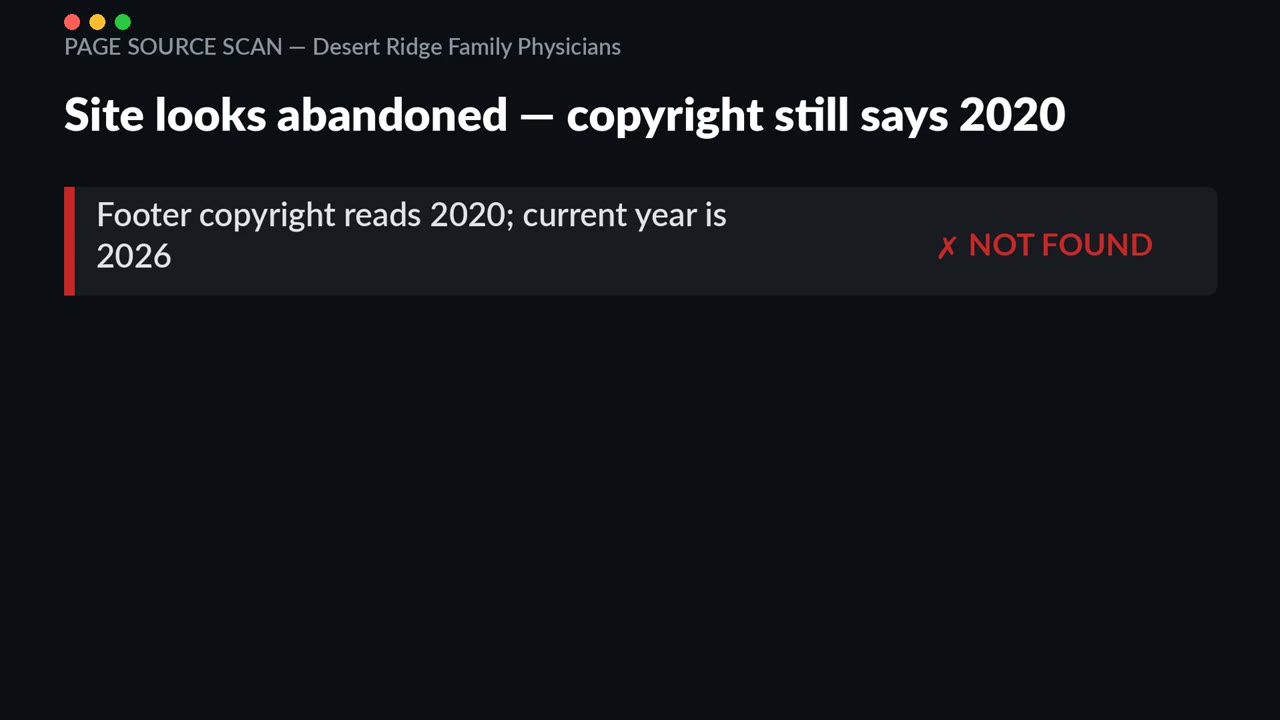
I know they’re open and busy. A careful patient doesn’t know that. When someone is choosing a doctor for their family, one of the first things they check is whether the site looks current. A stale year quietly says nobody is minding the store. For a practice that is clearly thriving, that’s a bad first impression.
The same applies to your business. If a homeowner is about to let a stranger into their house, they are looking for any sign you’re still active and paying attention.
610 reviews that the website visitor never sees
This one ties straight back to their biggest strength. Those 610 reviews live on Google. None of them show up on their own website.
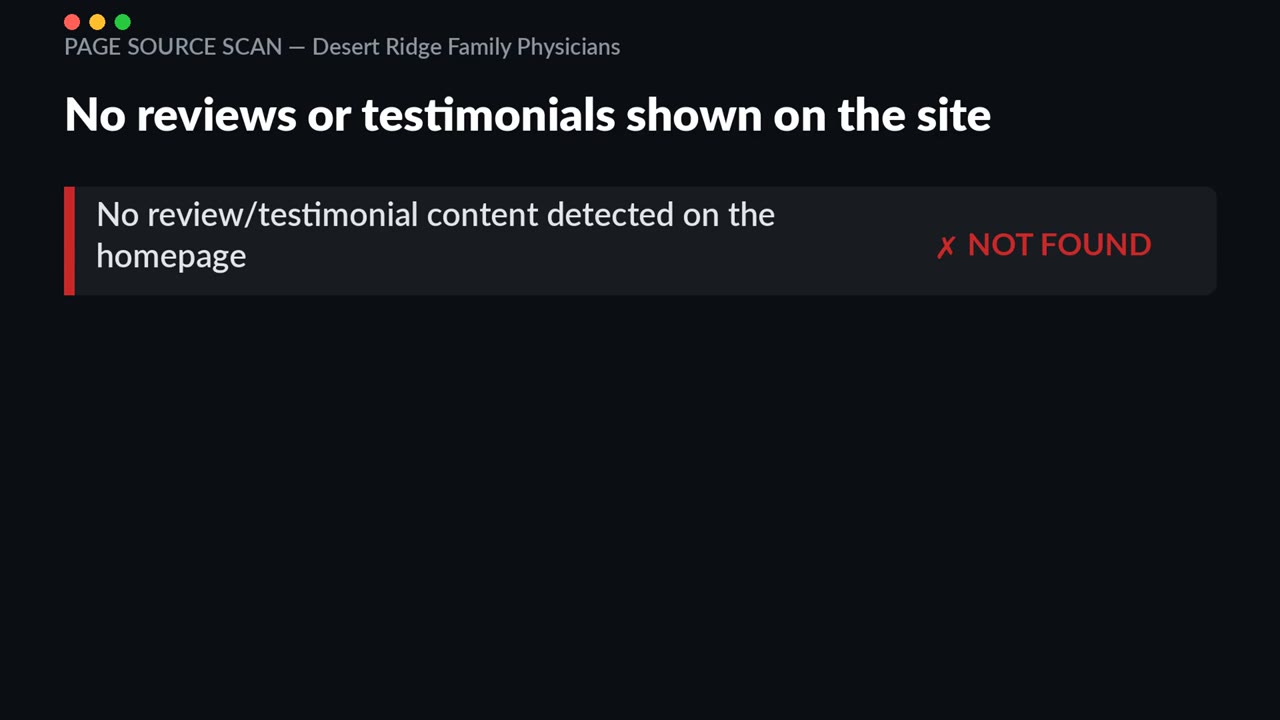
Think about where the decision actually happens. Someone lands on the homepage and is deciding whether to pick up the phone. That is exactly where the proof needs to be. Right now, all that goodwill is sitting on another page, and the visitor never sees it at the moment they’re deciding.
Reviews are only an asset if they work for you at the point of decision. Having them is step one. Putting them in front of the visitor is step two, and plenty of businesses never take it.
A phone number that doesn’t dial
This is the one that costs real phone calls, and it’s kind of a funny one. There’s a phone number on the homepage that’s set up as a link. But look at how it’s coded. It points to a web address, not a phone link. On a phone, tapping it doesn’t dial anything.
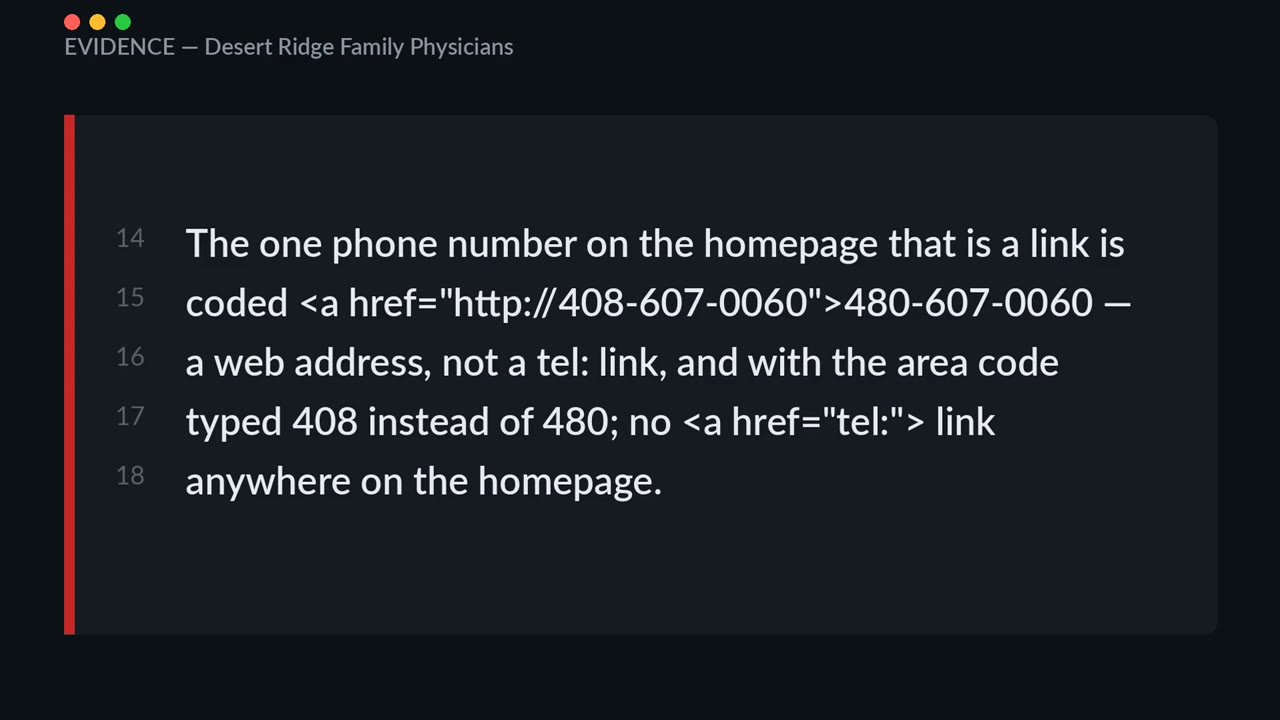
On top of that, the area code in that link is typed 408 instead of 480.
Here’s why it matters. Most people looking for a family doctor are on their phone. If tapping the number doesn’t call, a lot of them won’t bother copying it down. They’ll back out and call the next clinic that made it easy. That’s the same behavior you see when someone’s AC is dead or a pipe is leaking. Nobody wants to work for the phone call. Make it one tap, or lose it.
Test your own site on your phone today. Tap every number. If one of them doesn’t dial the right line, you’ve been paying for traffic that can’t reach you.
Analytics that stopped working in 2023
Now let’s talk about what’s happening behind the scenes. The only analytics code we found on the site is Google’s old Universal Analytics tag. Google stopped collecting data through those back in 2023. The code is still sitting there, but it does nothing.
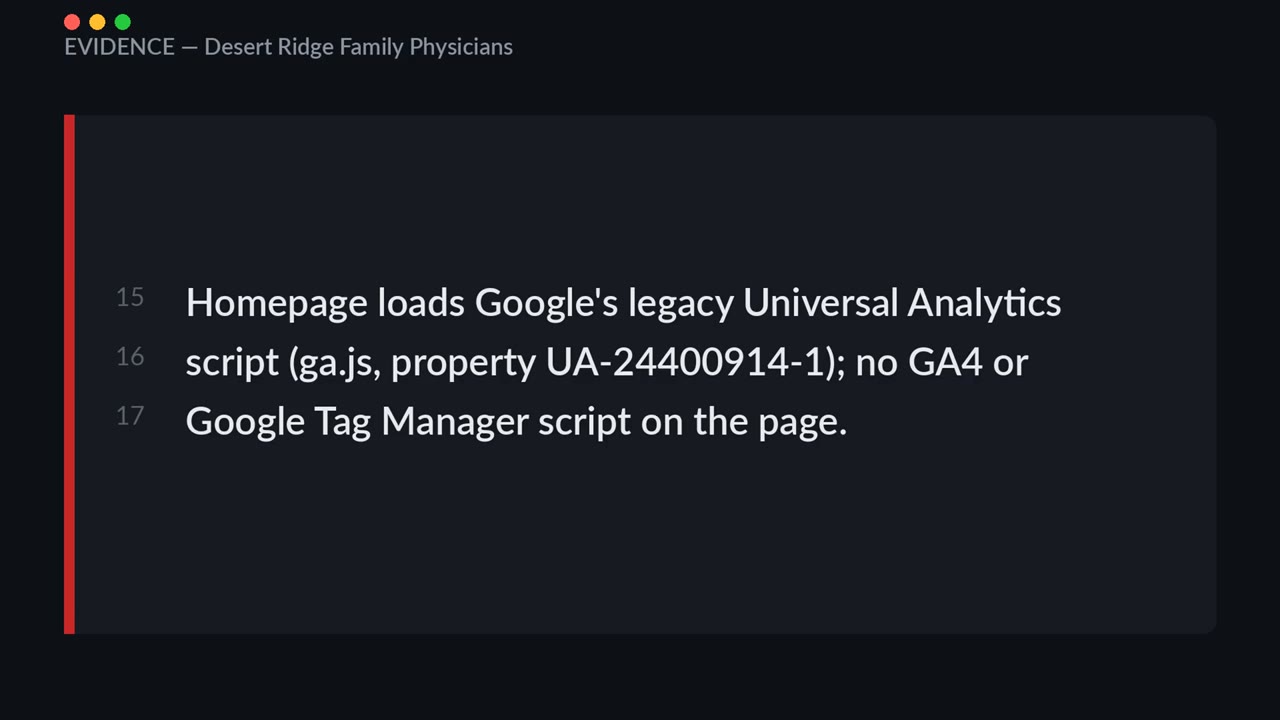
That means there’s no working way to see where patients come from or which marketing actually brings them in. You can’t decide what to double down on if you can’t see what’s working. You’re running blind, and every marketing dollar becomes a guess.
No ad tracking and no retargeting
It goes further. We found no advertising tracking either. No Google Ads conversion tag, and no retargeting pixel in the code.
That means one of two things. Either they aren’t running ads at all, or ads are running with no way to measure a single patient they produced. Both are bad. If you’re spending on ads with no conversion tracking, you can’t tell a winning campaign from a money pit. Proper Google Ads management for contractors starts with tracking, because without it nobody can optimize anything.
And without a retargeting pixel, every person who visits the site and leaves is gone for good. Retargeting is one of the cheapest ways to advertise, and it’s sitting unused. Most visitors don’t convert on the first visit. A pixel gives you a second chance at the people who already showed interest.
Nothing telling Google it’s a local business
Here’s a quieter one that search engines really care about. The site has basic structured data, but nothing that tells Google it’s a local business.
Structured data is the hidden code that hands Google your hours, your location and your phone number in a format it trusts. Without it, Google is left guessing. Competitors who do publish it can earn the richer search result with the details right there, while this clinic gets a plain blue link. It’s invisible to the visitor, but it affects how you show up before they ever click.
No video on the homepage
One last opportunity. There’s no video anywhere on the homepage. For a doctor’s office, video is the fastest way to build trust. Thirty seconds of a physician saying hello and explaining how they care for patients does more than three paragraphs of text. It helps a nervous new patient picture the visit before they ever call.
Swap the physician for you or your lead technician and the logic holds. People hire people they feel like they’ve met.
Why these basics get missed

Every single thing on this list is basic. Any competent marketing agency should catch these in the first week.
So why don’t they? Usually because agencies collect a monthly retainer while junior staff juggle 80 accounts, and nobody actually opens the site and looks. A typical home service marketing agency is stretched thin, and the boring fundamentals fall through the cracks while the report still goes out on time.
What’s different now: AI can run these fixes
Here’s what most owners don’t know yet. With AI, these exact fixes can now run almost automatically. Updating a footer, wiring up a click-to-call link, installing tracking, adding local business data: none of it is rocket science anymore.

With a little guidance, you can take control, run your marketing in-house, and own the whole thing instead of depending on an agency forever. That’s the whole idea behind what we teach at Local Service Mastery.