 Local Service Mastery
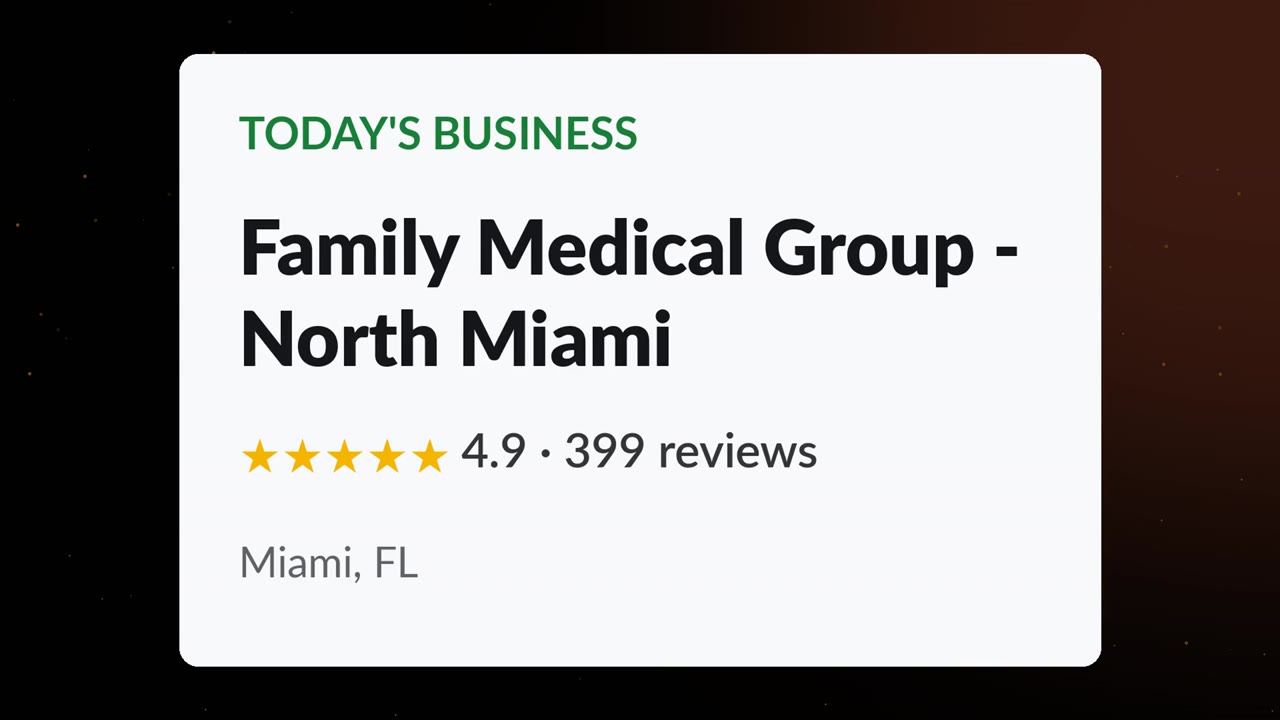
Before anything else, look at the reviews. A 4.9-star rating across 399 Google reviews. That doesn’t happen by accident. Patients clearly feel taken care of at Family Medical Group, and that is the hardest thing in this business to earn.
So this breakdown is only about the online marketing: the stuff around the front door. Where is the practice leaking, and where could it bring in even more of those patients? The gaps here are not exotic. They are basics. And they show up in service businesses of every kind, whether it’s a medical group, an HVAC company or a plumber.
| Finding | What the audit found | Why it matters |
|---|---|---|
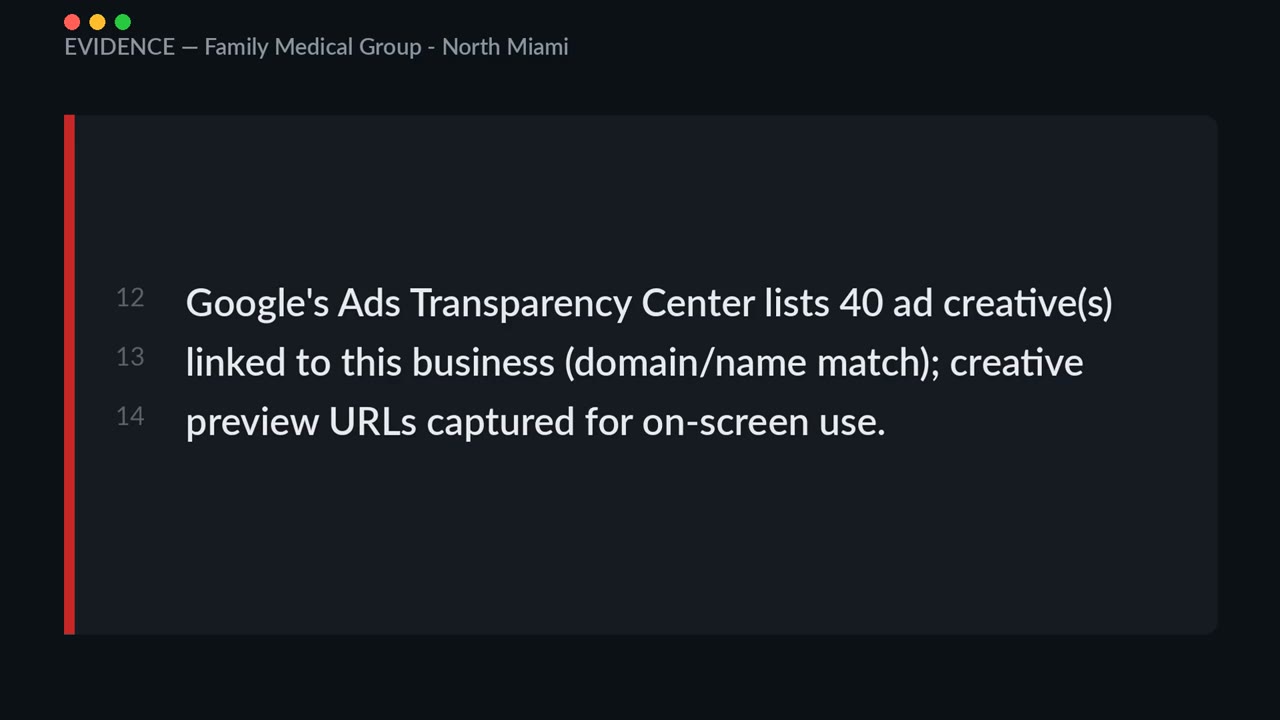
| Live Google ads are publicly visible — and auditable | Google’s Ads Transparency Center lists 40 ad creative(s) linked to this business (domain/name match); creative preview URLs captured for on-screen use. | Their actual running ads are public record — reviewable on screen in the video. |
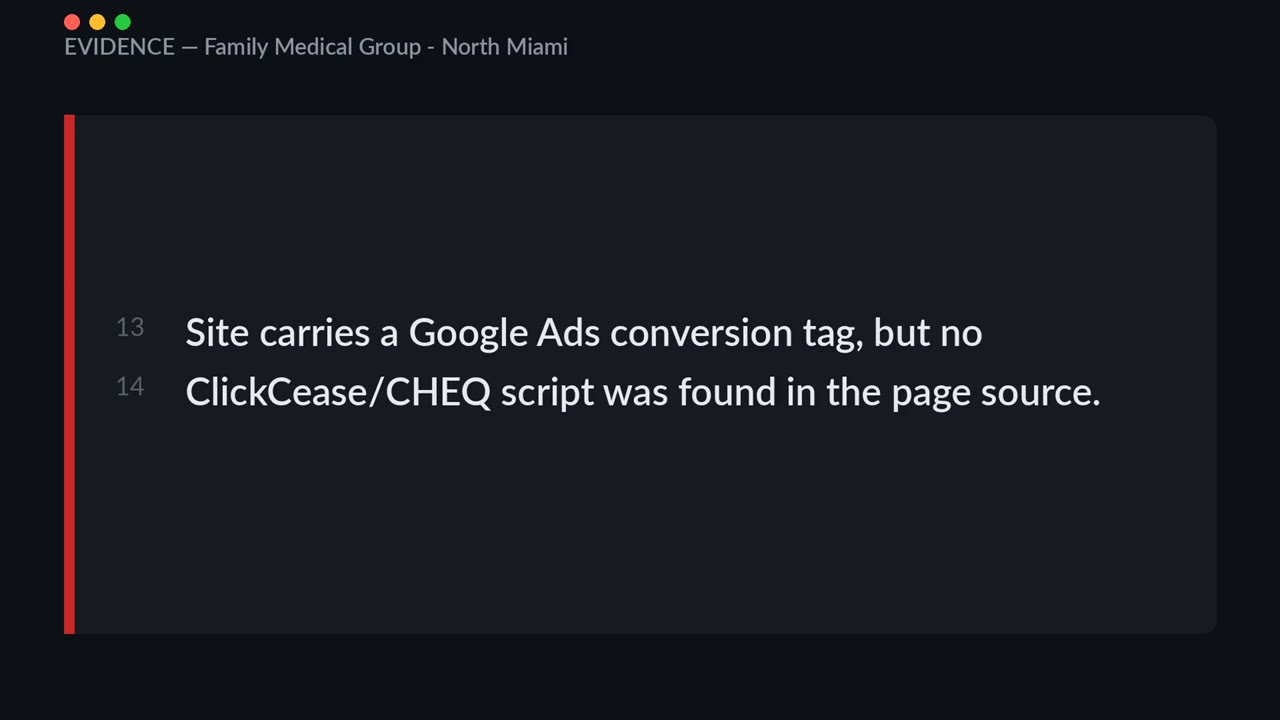
| No click-fraud protection (click here) detected alongside Google Ads | Site carries a Google Ads conversion tag, but no ClickCease/CHEQ script was found in the page source. | Competitors and bots clicking ads burns budget with zero leads — typically 10-20% of local-service ad spend. |
| No call tracking (click here) detected | Site carries a Google Ads conversion tag, but no call-tracking/DNI script was found on the site. | Most local-service leads CALL. Without call tracking, Google can’t optimize for the calls that actually book jobs. |
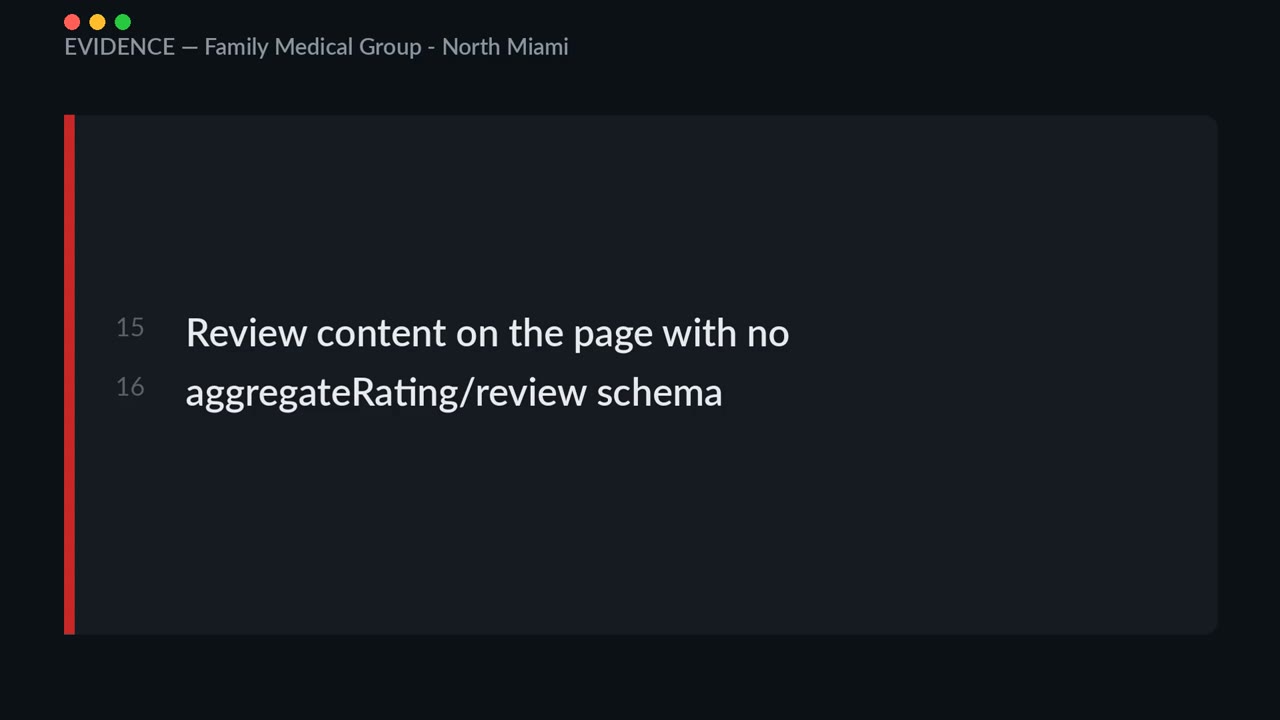
| Reviews shown but not marked up for Google | Review content on the page with no aggregateRating/review schema | Marked-up reviews can show star ratings directly in search results, which lifts click-through on a listing you already rank for — free clicks you’re currently leaving behind. |
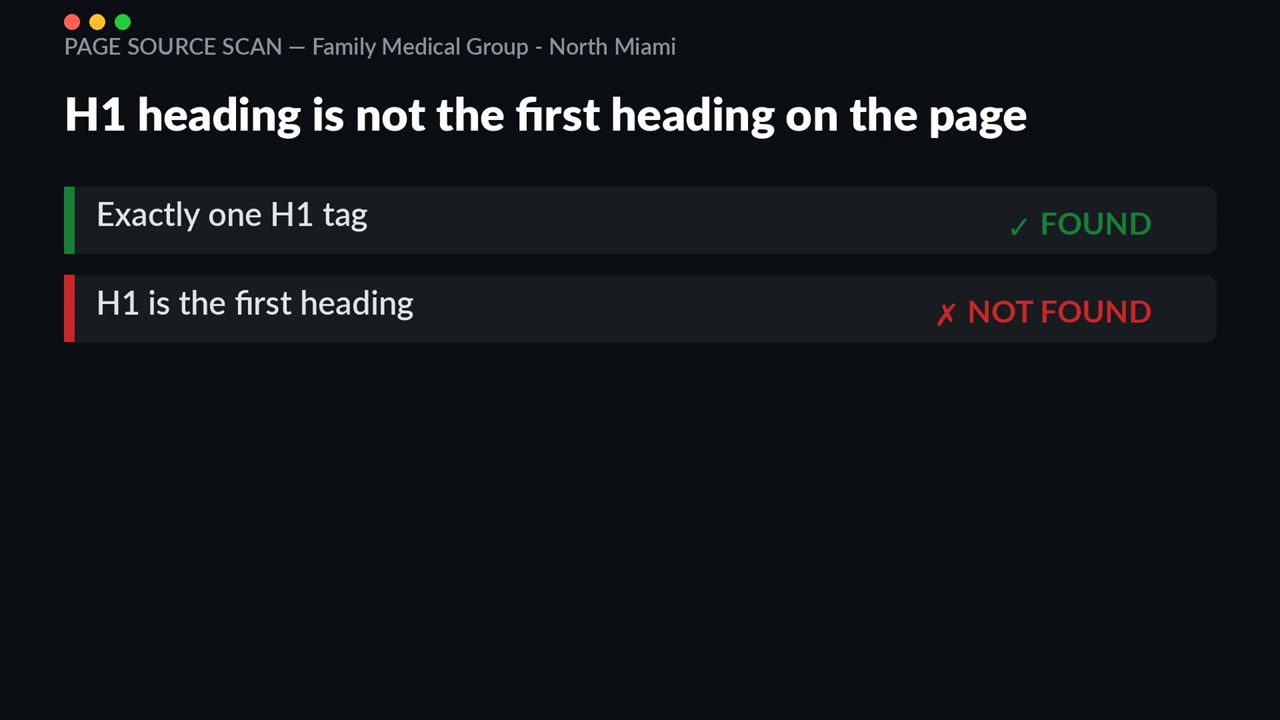
| H1 heading is not the first heading on the page | A lower-level heading (H2/H3) appears in the HTML before the page’s own H1 tag. | Search engines weight heading order — burying the H1 under other headings weakens it as a ranking signal. |
The strongest asset is already earned
Most businesses would kill for this review profile. Reviews are trust, and trust is what turns a search into a booked appointment. Marketing can’t manufacture that. Patients here are clearly getting great care, so the marketing job is simple: make sure every person searching sees that proof and has an easy path to act on it.
That is where the gaps start to matter.
They’re spending on Google Ads, and that’s smart
Here is something most owners don’t realize is public. Google Ads has an Ads Transparency Center, and it lists 40 ad creatives linked to this business. So real money is going into Google Ads. That is a smart move for a practice that people search for by need, in the moment.
But once you’re paying for clicks, the setup behind those ads decides how much of that money turns into patients. The site carries a Google Ads conversion tag, which is a good start. What’s missing around it is the problem.
Gap 1: No click fraud protection
We didn’t find any click fraud protection software in the page source. That is software that spots and blocks fake clicks. Every time a bot or a competitor taps one of those ads, the practice pays for it, and nobody walks through the door.
With this many ads live, I’d want that protection running from day one. You don’t wait until the budget is big. The leak exists the moment the first ad goes live.
Gap 2: No call tracking
This is the one I’d fix next. We found no call tracking on the site. Call tracking is software that shows which ad made the phone ring.
Picture who is searching for a doctor. It’s a mom at seven in the morning with a feverish kid on her hip and her phone in her other hand. She’s not filling out a form. She’s calling.
Without call tracking, Google can’t see which ads led to that call, so it can’t learn to send more people like her.
That is the real cost. It’s not only that you can’t report on calls. The ad platform is learning from incomplete data, so it optimizes toward form fills while your best patients are picking up the phone. In healthcare, you’d want a privacy-compliant setup, but you definitely want one.
Fixing the front door on the website
The ads bring people in. The website decides what happens next. Three smaller gaps showed up here, and none of them is hard.
Gap 3: Review content with no review schema
This one stood out because the reviews are already this practice’s strongest asset. The page shows review content, but it isn’t marked up with review schema. Review schema is a bit of code that tells Google these are star ratings. With it, those stars can show up right in the search results.
When you’ve earned 4.9 stars, you want every searcher to see them before they even click. Right now that proof may be sitting on the page where only people who’ve already clicked can find it.
Gap 4: Heading order in the page code
In the page’s code, a lower-level heading shows up before the main H1, which is basically the page’s headline for Google. Search engines pay attention to that order. The fix is to move the H1 to the top and let it do its job. It’s a smaller issue, but it’s easy.
Gap 5: No video on the homepage
We didn’t find any video on the homepage. Choosing a family doctor is personal. I’d want a short clip of a real face saying hello before anyone books.
Maybe it’s not even a doctor. Maybe it’s the front desk team who will answer when you call. Either way, people want to see who they’re trusting with their family. For a practice with this much patient love, a face on the homepage turns reviews into a relationship.
None of these five fixes is complicated. That’s the point. They are basic checks that get missed when nobody is really looking.
Why basics like these get missed
After reviewing hundreds of local service accounts, these are basics any marketing agency should catch. When they get missed, the reason is usually structural. Most agencies I’ve seen collect a monthly retainer, while one junior person juggles 80 accounts and nobody really looks. If someone is being paid to run this, they should have caught it.

That is why the right home service marketing agency or in-house setup is one that actually audits the account instead of just billing for it. Owners don’t need more reports. They need someone checking the tracking, the protection and the page code.
The shift: run it yourself with AI
Here is what most owners don’t know yet. With AI, fixes like these can now run automatically. With a bit of guidance, you can take control, run your marketing in-house, own the whole thing, and never depend on an agency again.

That is the whole idea behind Local Service Mastery. You don’t have to hand your lead generation to a retainer and hope. You can own the accounts, understand what is leaking and fix it yourself.