 Local Service Mastery
Most HVAC owners would love to have what Southwest Heating and Air Conditioning has: a 4.8-star rating across 366 Google reviews. That’s real trust, earned one customer at a time. You can’t fake it, and you can’t buy it.
So when I looked at their online marketing, I wasn’t looking at the work. I was looking at how well the website turns that reputation into calls. The answer is: not well. And the problems I found aren’t exotic. They’re basics.
This is a breakdown of what we found, why each issue matters, and what I’d fix first if this were my account. If you run an HVAC, plumbing, electrical or any other local service business, check your own site against this list.
| Finding | What the audit found | Why it matters |
|---|---|---|
| Reviews shown but not marked up for Google | Review content on the page with no aggregateRating/review schema | Marked-up reviews can show star ratings directly in search results, which lifts click-through on a listing you already rank for — free clicks you’re currently leaving behind. |
| No LocalBusiness structured data | No JSON-LD structured data at all | Structured data is how Google reads your hours, service area, phone and rating. Without it Google guesses — and competitors who publish it get the rich result instead. |
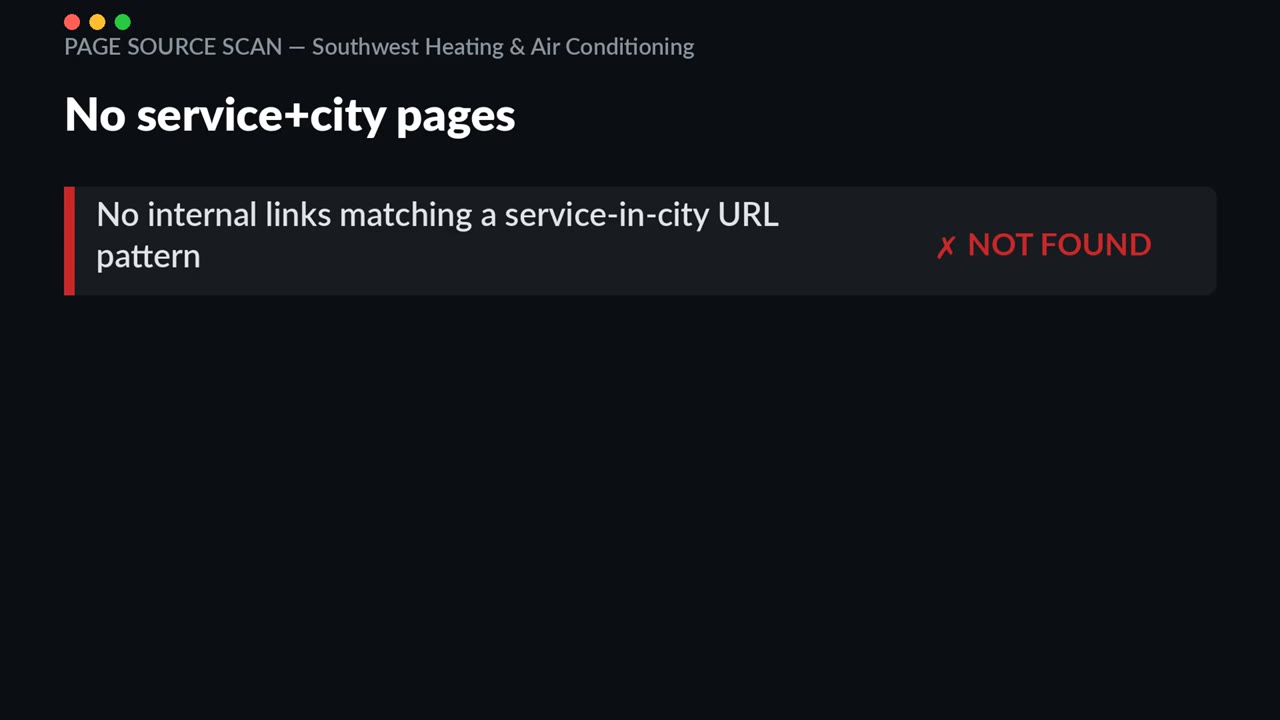
| No service+city pages | No internal links matching a service-in-city URL pattern | People search “emergency plumber in <city>”, not “Southwest Heating & Air Conditioning”. With one generic services page there’s nothing for Google to rank against those searches, and paid clicks land somewhere too generic to convert. |
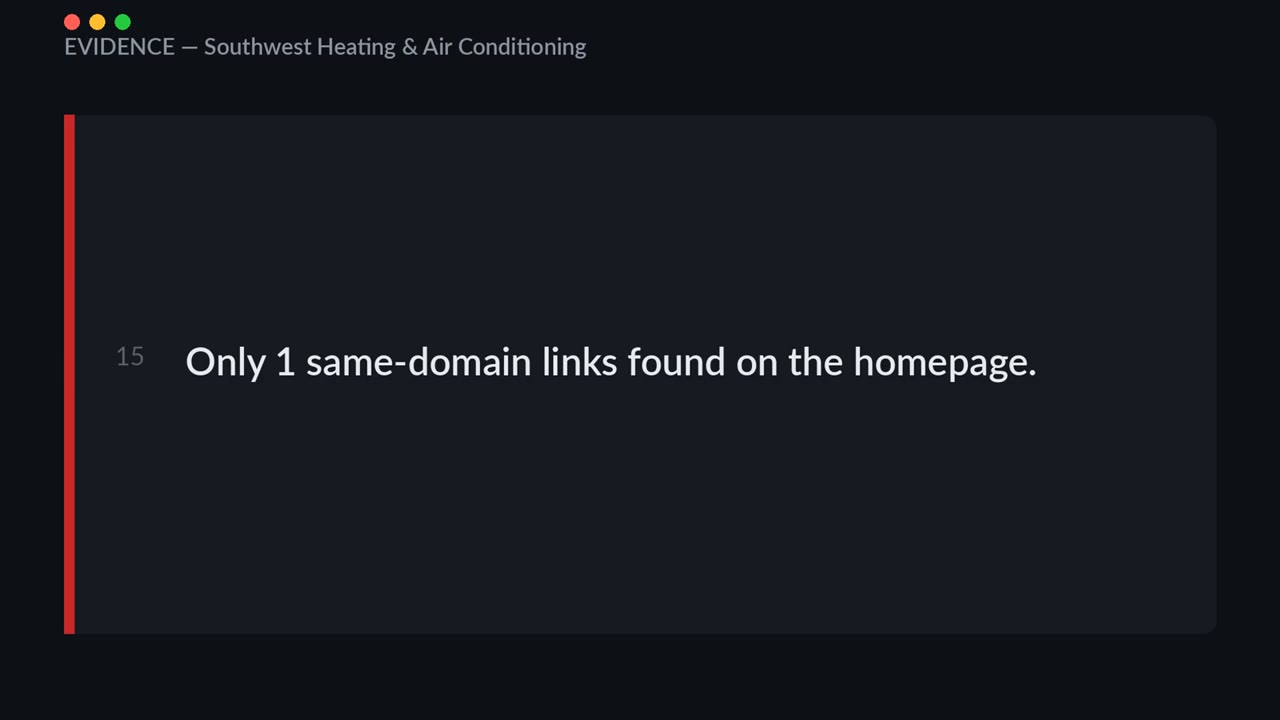
| Very little internal linking (1 links found) | Only 1 same-domain links found on the homepage. | Internal linking is as important as backlinks for spreading authority across a site’s other pages — a homepage with almost none is leaving easy SEO value on the table. |
| Missing meta description | No <meta name=description> tag on the homepage. | Google writes its own snippet — usually worse at turning searches into clicks. |
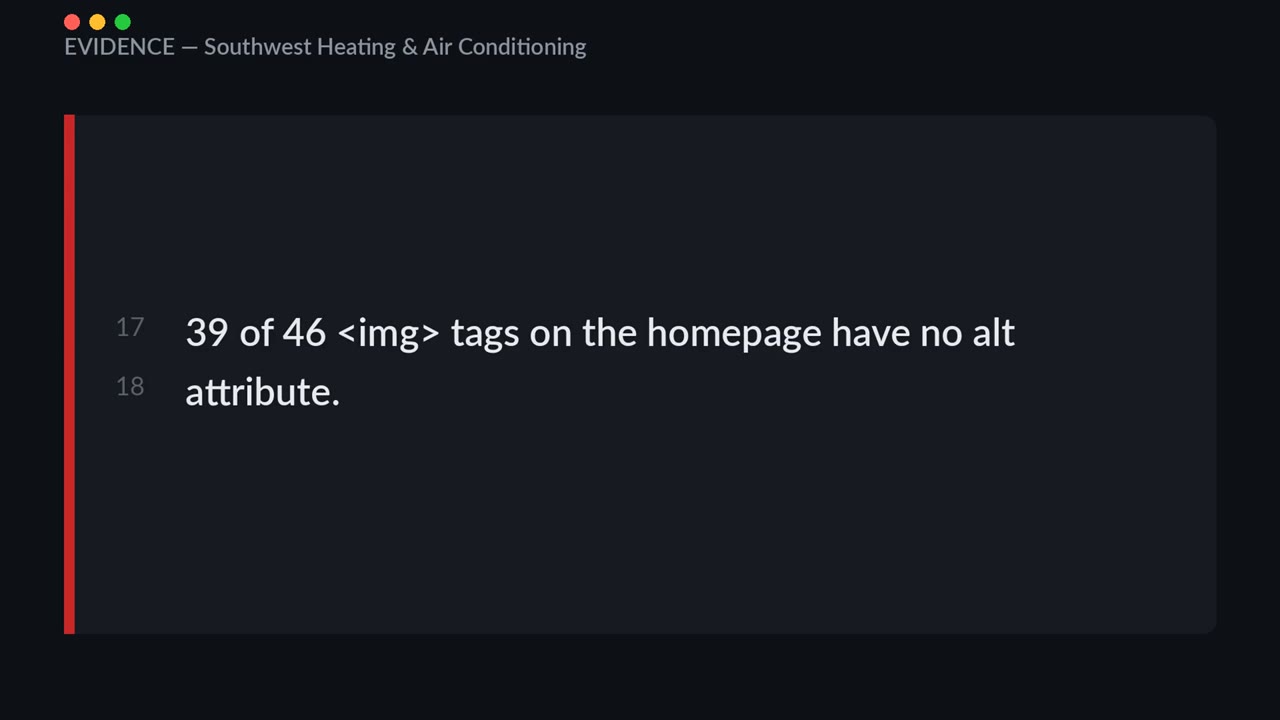
| Most images missing alt text (39/46) | 39 of 46 <img> tags on the homepage have no alt attribute. | Alt text is a direct on-page SEO signal for image search — and it’s what screen readers use for accessibility. |
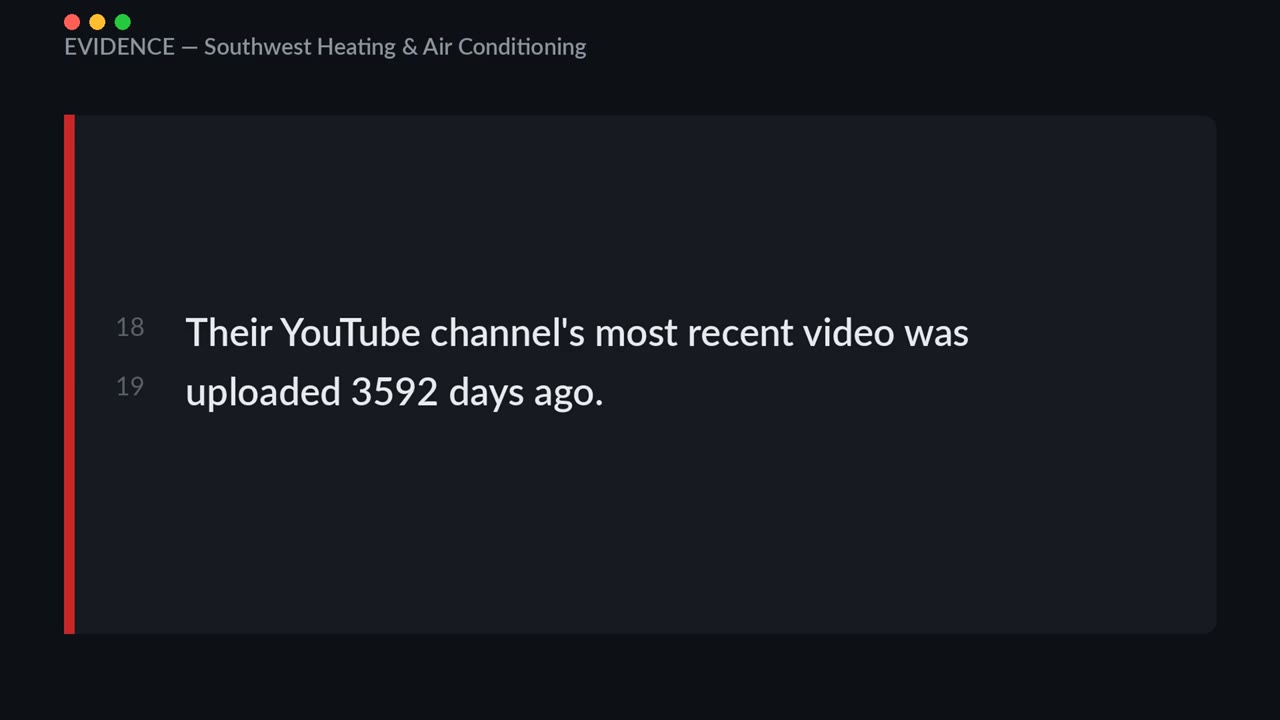
| YouTube channel inactive (119 months since last upload) | Their YouTube channel’s most recent video was uploaded 3592 days ago. | An inactive channel signals to both viewers and Google that the business isn’t actively investing in content. |
| Multiple H1 tags on the homepage (6) | 6 <h1> tags found in the page source. | Multiple H1s dilute the page’s main topic signal instead of reinforcing one clear keyword focus. |
| No social media profile links found on the website | No Instagram or Facebook profile link found in the page source. | No easy path for a visitor to check recent activity or reviews on social — and no compounding organic reach being built. |
The reviews are great. The code behind them isn’t.
The homepage already shows review content, which is smart. But we found no review markup in the code behind it.
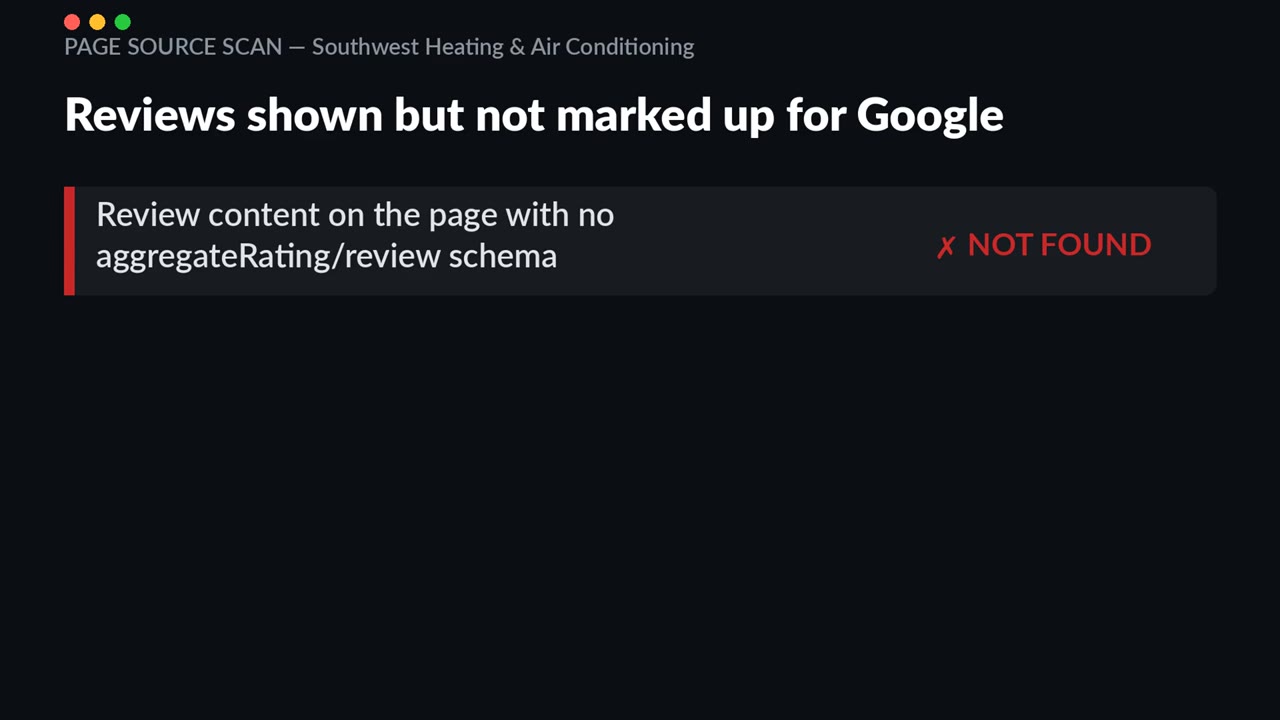
Markup is just a label that tells Google what something is. Without it, Google sees text on a page and has no clear signal that it’s a set of customer reviews. The result is that those stars have no way to show up next to the listing in search results.
That’s why I’d fix this first. Those are free clicks on a listing they already earn. They’ve done the hard part by getting the reviews. The missing piece is a label that costs almost nothing compared to what the reviews took to build.
No structured data anywhere on the homepage
It goes beyond reviews. We found no structured data on the homepage at all.
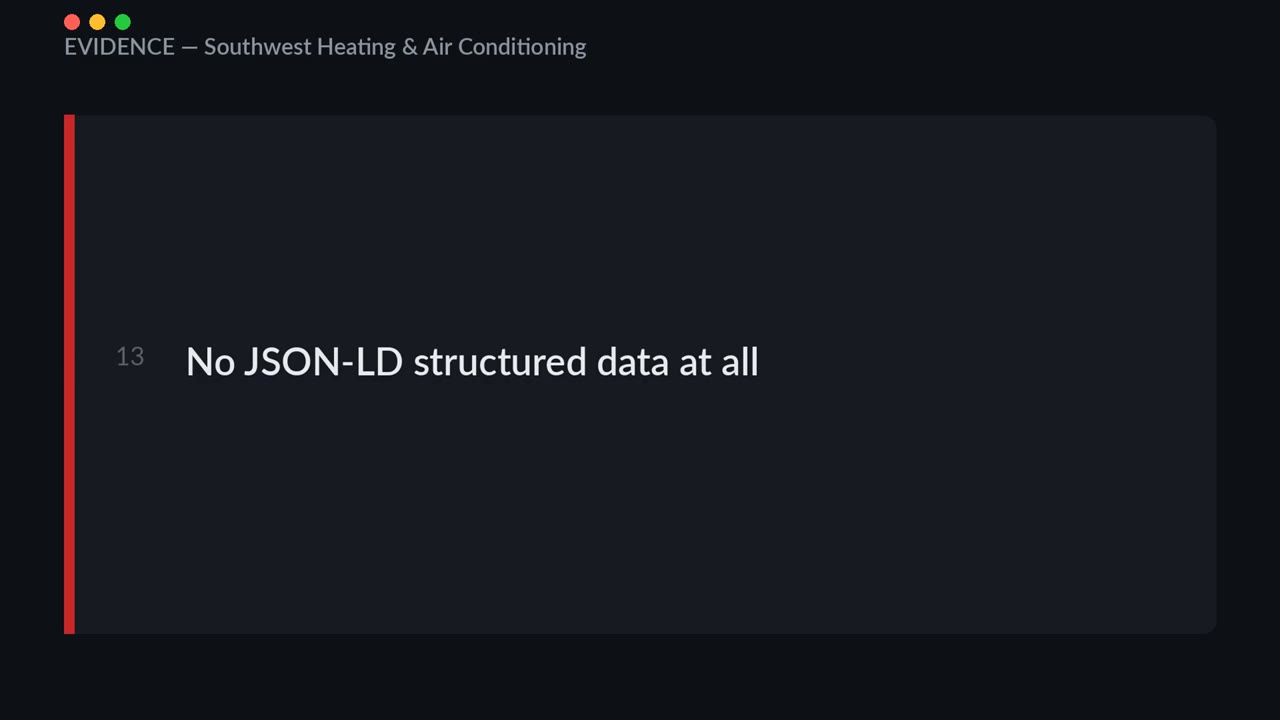
Structured data is how Google reads your hours, your phone number and your service area. When you spell those out clearly, Google doesn’t have to interpret anything. When you don’t, Google has to guess.
And here’s the part that matters competitively. A competitor who spells it out clearly gets the richer result. Two companies can have similar rankings and similar services, but the one that communicates clearly to Google gets the better-looking listing.
The biggest opportunity: pages for a service in a specific city
This is where I think the real money sits. We didn’t find any pages built around a specific service in a specific city.
Picture someone in a hot apartment in July. Phone in one hand, fanning themselves with the other, typing “AC repair” followed by the name of their city. They’re not typing the company name. They don’t know it yet. They need someone, and they need someone now.
Without a page made for that exact search, Google has nothing of theirs to put in front of that person. It doesn’t matter how good the reviews are. If there’s no page that matches what the customer is searching for, the business doesn’t show up for the search that turns into a booked job.
For any HVAC company, that means a dedicated page for each core service in each area you serve. Not one generic page that tries to cover everything.
Why this matters more than the homepage
Your homepage is built to introduce the brand. But the people ready to hire aren’t searching for the brand. They’re searching for the problem and where they are. A page built around that search is the one that gets matched to the customer.
One internal link on the whole homepage
Connected to that, the homepage has just one link pointing to another page on their own site. One.
Internal links are how the strength of your best page flows to the rest of the site. Your homepage is usually your strongest page. Right now all of that strength is stuck there, because there’s nowhere for it to go.
Once you build service and city pages, the homepage should link to them. That passes strength to the pages that need it and helps Google understand how the site is organized. It also gives visitors an easy path to the exact service they came for.
No meta description
There’s also no meta description. That’s the short summary under your link in Google.
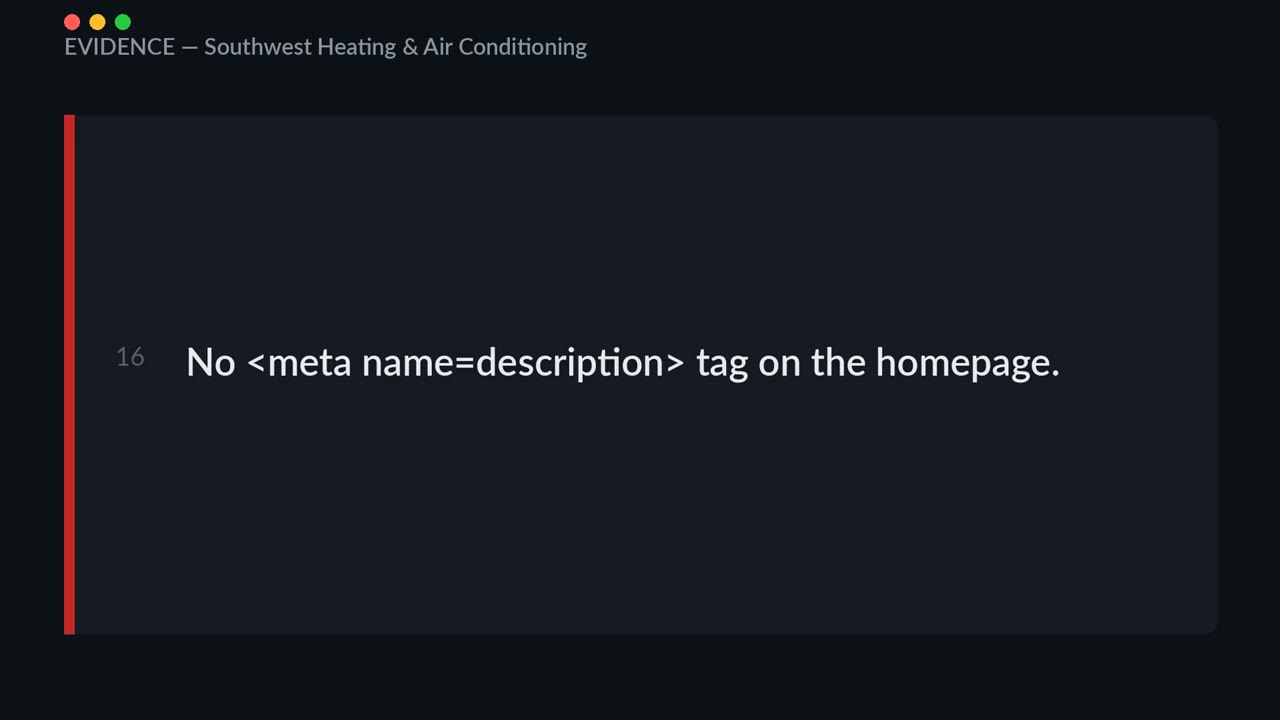
When you don’t write one, Google writes its own snippet from whatever it pulls off the page. I’d much rather write the sentence that convinces a homeowner to book a job. It’s a small piece of text, but it sits right in front of a buyer at the moment they’re deciding which link to click.
39 of 46 images have no alt text
Alt text is a short written description of each picture. On the homepage, 39 of the 46 images don’t have it.
That costs them in two ways:
- Image search visibility. Without descriptions, those images can’t be understood or found properly.
- Accessibility. Without it, those visitors get nothing.
It’s tedious to do by hand across a whole site, which is exactly why it gets skipped.
A YouTube channel that’s been silent for almost 10 years
Their YouTube channel’s most recent video went up 3,592 days ago. That’s close to 10 years.
A quiet channel tells both viewers and Google that nobody’s investing there. It doesn’t need to be a production. I’d want to see even a few short videos answering the questions customers already ask on the phone. You already know those questions. You answer them every day. Filming the answers turns that routine into content that works for you.
None of this is advanced. These are basics, and if someone’s being paid to run this, they should have caught it.
Why basics like these slip through at agencies
In most agencies, I’ve seen things like this slip because the retainer comes in every month while a junior person juggles 80 accounts, and nobody actually looks. The money arrives whether or not the site gets fixed, so there’s no pressure to dig into the details.

That’s the real problem for owners. You assume somebody is watching your marketing. In many cases, nobody is. If you’re comparing options, any serious home service marketing agency should be able to show you exactly what it checked on your site and what it fixed.
The shift: these fixes can now run automatically
Here’s what most owners don’t know yet. With AI, fixes like these can now run automatically.

With a bit of guidance, you can take control, run your marketing in-house, own the whole thing, and never depend on an agency again. That’s the direction Local Service Mastery is built around, and it’s why the basics shouldn’t be a mystery or a monthly invoice for you.
Most local service sites miss several of them.
If you’re looking for marketing for HVAC contractors that starts with these fundamentals instead of skipping them, this is where to begin.