 Local Service Mastery
A 4.8-star rating across 215 Google reviews is hard to earn. Customers built that reputation for Flowtech Air Conditioning one job at a time. It’s the kind of social proof most HVAC owners would kill for.
So here’s the real question. Is the online marketing keeping up with the reputation? We looked at this one purely as a marketing setup, never the work itself. What we found is exactly what I see over and over when I review local service accounts. Strong business, strong reviews, and a website quietly leaking leads.
| Finding | What the audit found | Why it matters |
|---|---|---|
| Running Meta ads but no Google Ads conversion tag found | Meta pixel/active Meta ads detected (0 active ads matching the business name in Meta’s public Ad Library); no AW- conversion tag on the site. | People who NEED a contractor search Google; Meta interrupts people who weren’t looking. Highest-intent channel appears unused. |
| Slow mobile site (35/100 Google PageSpeed) | Google PageSpeed mobile performance score 35/100, LCP 17.2 s. | Homeowners on phones bounce before the page loads — paid clicks included. |
| H1 heading is not the first heading on the page | A lower-level heading (H2/H3) appears in the HTML before the page’s own H1 tag. | Search engines weight heading order — burying the H1 under other headings weakens it as a ranking signal. |
| No LocalBusiness structured data | No LocalBusiness schema in the page’s JSON-LD | Structured data is how Google reads your hours, service area, phone and rating. Without it Google guesses — and competitors who publish it get the rich result instead. |
| No service+city pages | No internal links matching a service-in-city URL pattern | People search “emergency plumber in <city>”, not “Flow -Tech Air Conditioning Corp.”. With one generic services page there’s nothing for Google to rank against those searches, and paid clicks land somewhere too generic to convert. |
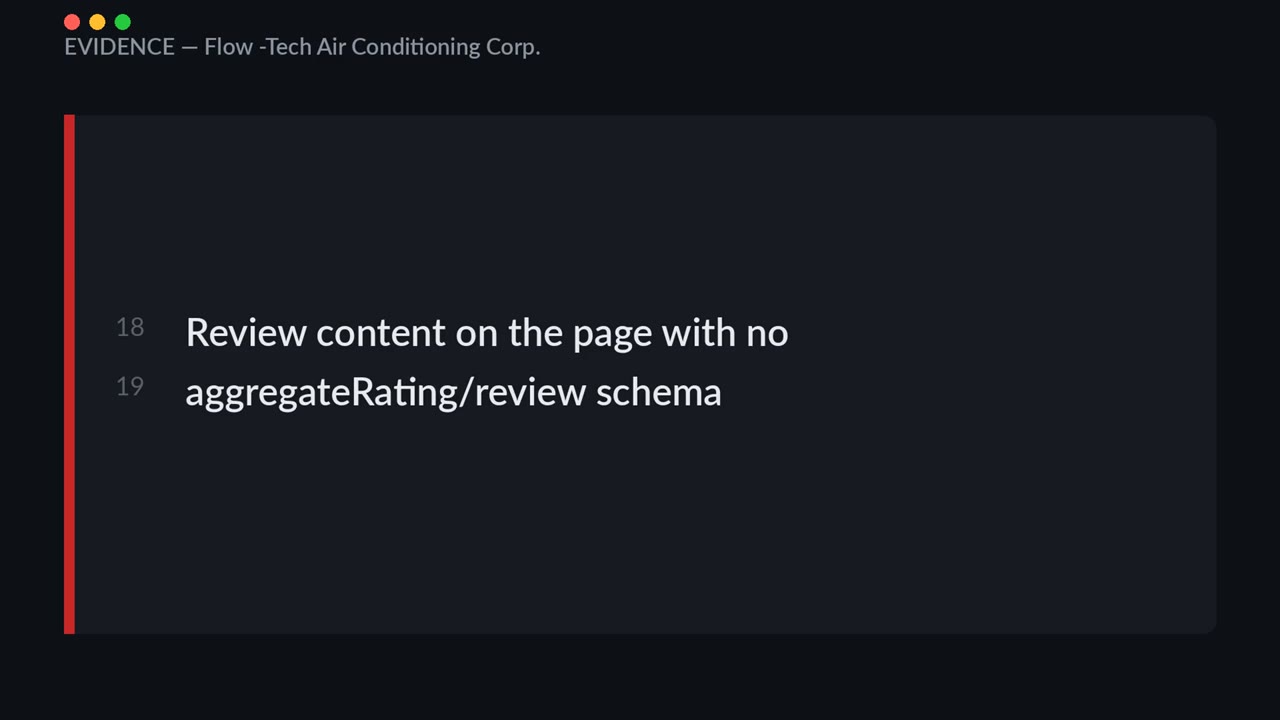
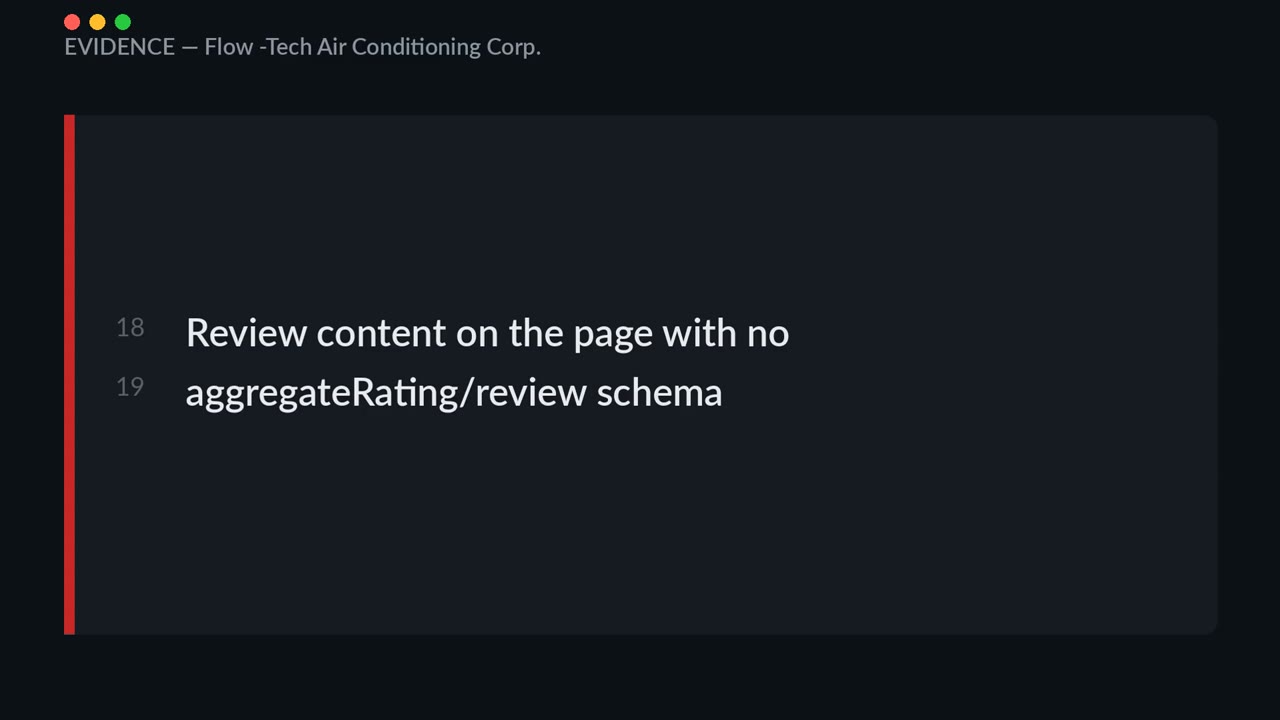
| Reviews shown but not marked up for Google | Review content on the page with no aggregateRating/review schema | Marked-up reviews can show star ratings directly in search results, which lifts click-through on a listing you already rank for — free clicks you’re currently leaving behind. |
| No sitemap.xml | /sitemap.xml does not return a valid file | A sitemap is how Google finds every page you have. Without one, deeper service pages can sit undiscovered for months. |
The 17-second problem
We started with Google’s own speed test on mobile. The score came back 35 out of 100. The main part of the page took 17.2 seconds to show up.
Now picture the actual customer. Someone’s AC just died. They’re sweating in the kitchen with their phone in their hand. They are not waiting 17 seconds. They hit back and call the next company on the list.
If that visit came from a paid ad, it gets worse. The click still costs money, and you got nothing for it. Slow pages don’t just lose organic traffic. They burn ad budget on people who never even see your offer.
No service-plus-city pages
Next, we looked for pages built around a service plus a city, something like “AC repair in [city].” We didn’t find any.
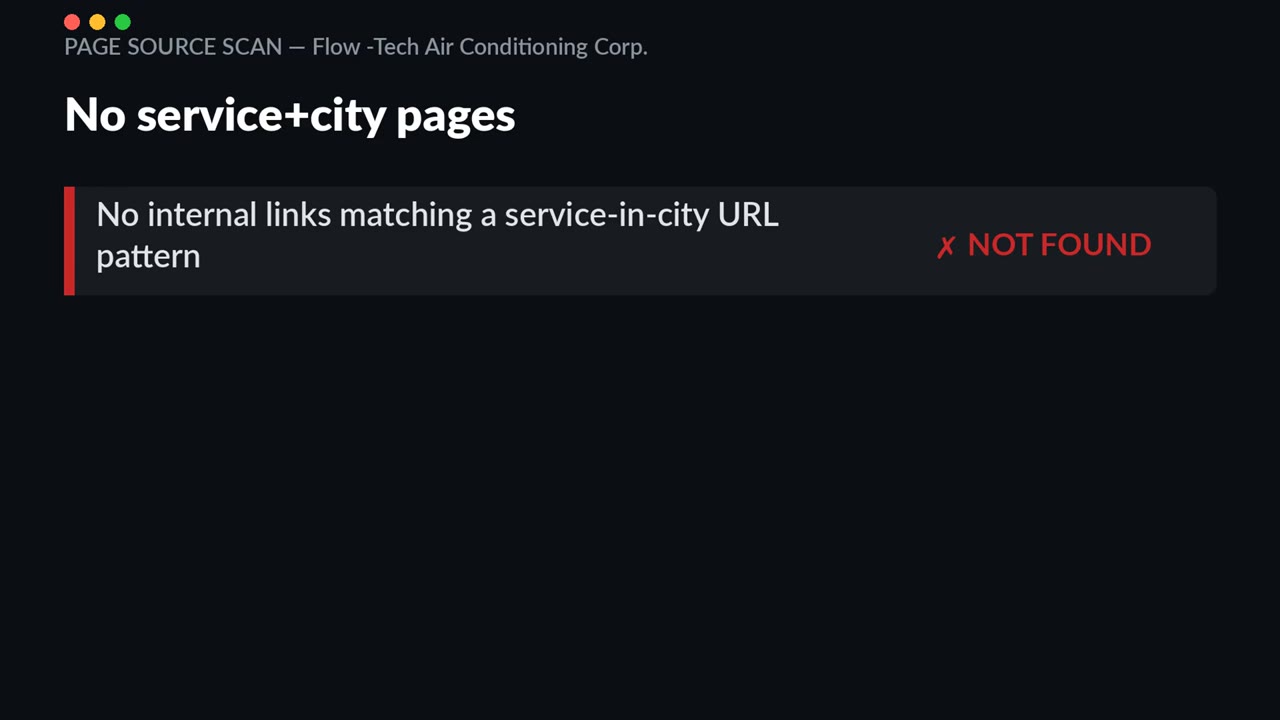
This matters because of how people actually search. They search the problem and the place, not the company name. Without a page built around that combination, Google has nothing specific to rank for those searches.
It hurts paid traffic too. When ads send clicks to a page that’s too general, the visitor has to hunt for what they came for. A general page rarely turns into a booked job. A page that matches the exact search does.
No working sitemap
There’s also no working sitemap. Think of it as the table of contents Google uses to find every page on your site. Without one, deeper pages can sit undiscovered for months.
You can build the right pages, but if Google doesn’t know they exist, they don’t rank. It’s a small technical piece with a big downstream effect.
The one that stings: reviews with no markup
Here’s the finding that stings a little. The reviews show up on the site, but they aren’t marked up in the code Google reads. That markup is what can put star ratings right in the search results.
With 4.8 stars, I’d want those stars showing everywhere they possibly can.
That’s the whole point. The company already did the hard part and earned the reputation. Not making it visible where people are choosing who to call is leaving the best asset on the table.
No local business structured data either
It’s a similar story with the business details. There’s no local business structured data. Those are hidden labels that tell Google your hours, phone number and service area.
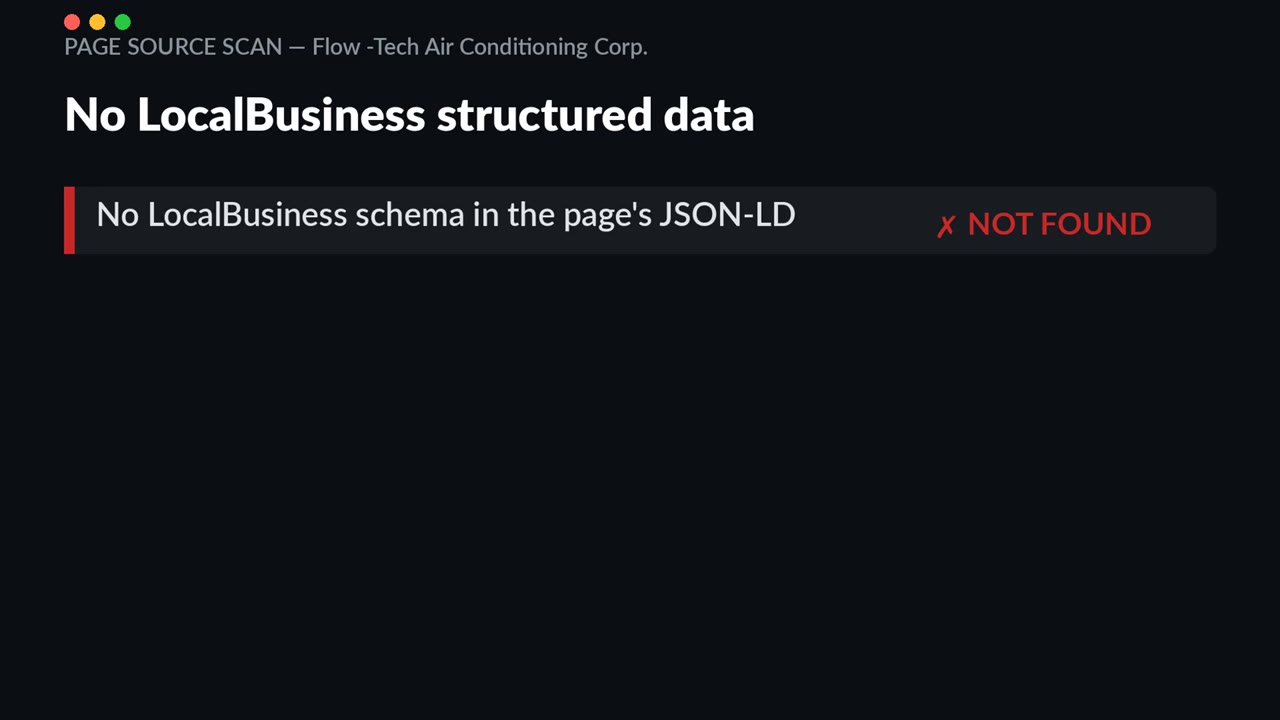
Without them, Google has to guess. Competitors who publish them can win the richer listing. You don’t want to hand that to the next HVAC company just because a label was missing.
A Meta pixel, but no Google Ads conversion tag
We did find a Meta tracking pixel on the site. But there was no Google Ads conversion tag.
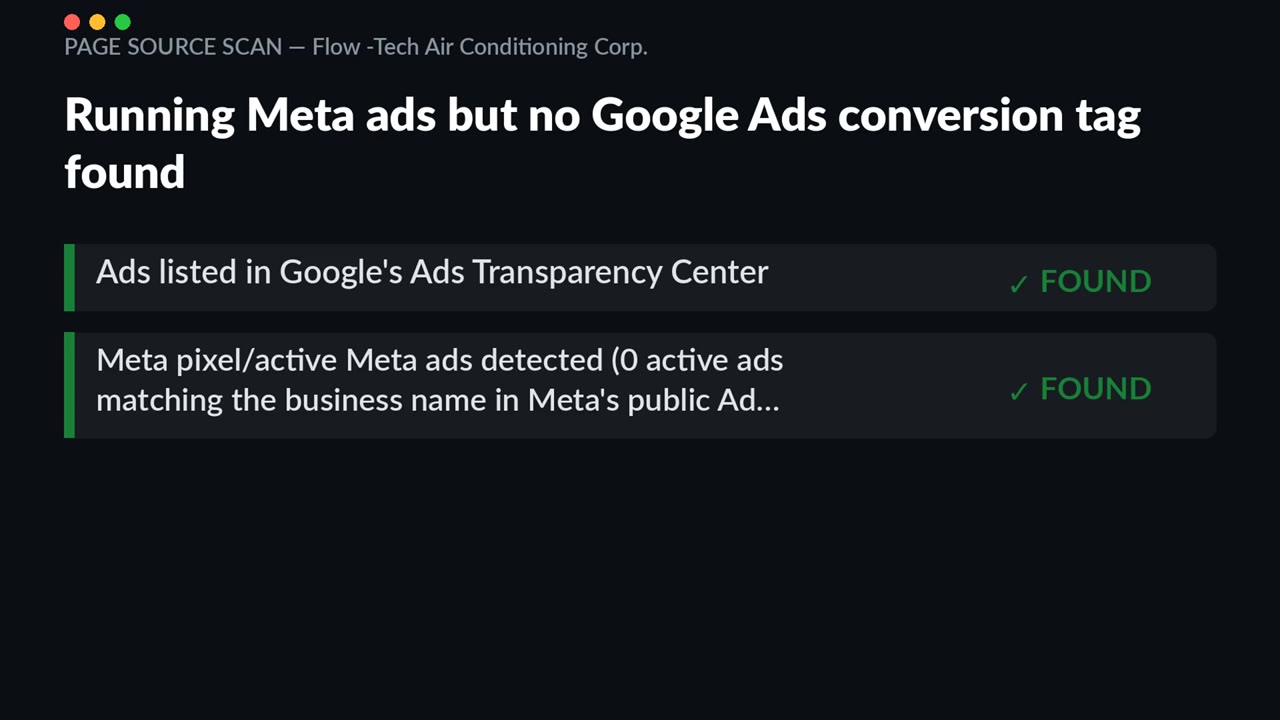
Here’s why that matters. Facebook and Instagram reach people who weren’t looking for you. Google is where someone goes the minute the AC quits. That’s the high-intent channel, and if this were my account, I’d want it set up and measured first.
Without a conversion tag, you can’t see which clicks turn into calls or booked jobs. You’re spending, or planning to spend, without knowing what’s working. That’s how budgets get wasted for months. It’s the kind of gap that a serious home service marketing agency should catch in the first week.
No video on the homepage
There’s also no video on the homepage. A short clip of the team on a real install builds trust faster than any paragraph. It also keeps visitors on the page longer.
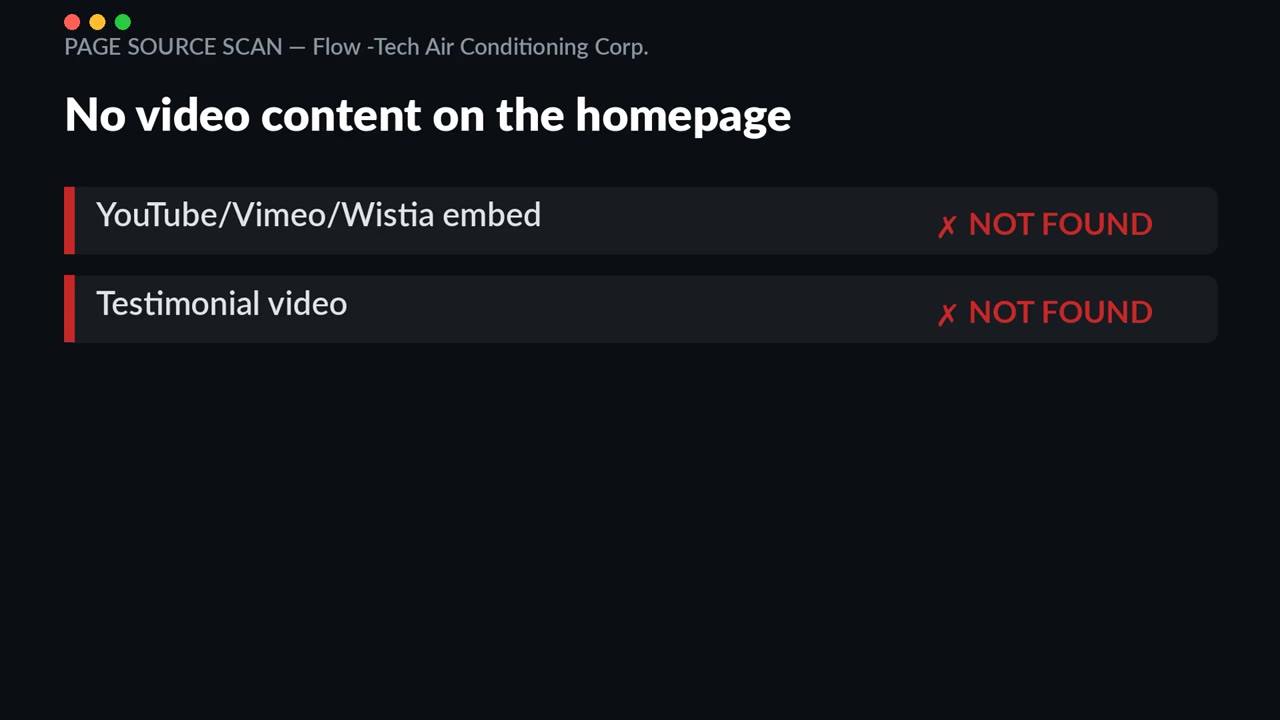
For a service business, trust is the product before the technician ever shows up. A homeowner is letting a stranger into their house. Showing real people doing real work removes friction.
None of this is advanced
I want to be clear. None of this is advanced. After reviewing hundreds of local service accounts, I can tell you these basics get missed constantly.

Most agencies I’ve seen collect a monthly retainer while a junior staffer juggles 80 accounts, and nobody actually looks. If someone’s being paid to run your marketing, they should have caught every item on this list. If they didn’t, you’re paying for activity, not results.
The shift owners don’t know about yet
Here’s what most owners don’t know yet. With AI, fixes like these can now run automatically. With a bit of guidance, you can run your marketing in-house and own the whole thing without depending on an agency ever again.

That’s exactly what we build and teach at Local Service Mastery. The goal is for you to understand your marketing, control it and stop renting it from someone else. That’s the foundation of real lead generation for local service businesses.