 Local Service Mastery
I reviewed SN Cleaning, a carpet and upholstery cleaning company, and one number stopped me cold. 1,328 reviews. A perfect 5-star rating.
That is not easy. You don’t fake your way to 1,300 reviews. The customers clearly love the work, so everything in this breakdown is about the online marketing wrapped around that work. Never the work itself.
And that is the story. A business that has done the hardest part, earning real trust at scale, is leaking leads on the easy part. Here is exactly where, and why it matters to any service business owner.
| Finding | What the audit found | Why it matters |
|---|---|---|
| Slow mobile site (41/100 Google PageSpeed) | Google PageSpeed mobile performance score 41/100, LCP 24.3 s. | Homeowners on phones bounce before the page loads — paid clicks included. |
| No LocalBusiness structured data | No LocalBusiness schema in the page’s JSON-LD | Structured data is how Google reads your hours, service area, phone and rating. Without it Google guesses — and competitors who publish it get the rich result instead. |
| Reviews shown but not marked up for Google | Review content on the page with no aggregateRating/review schema | Marked-up reviews can show star ratings directly in search results, which lifts click-through on a listing you already rank for — free clicks you’re currently leaving behind. |
| No service+city pages | No internal links matching a service-in-city URL pattern | People search “emergency plumber in <city>”, not “SN Cleaning – Carpet & Upholstery Cleaning”. With one generic services page there’s nothing for Google to rank against those searches, and paid clicks land somewhere too generic to convert. |
| No video content on the homepage | No YouTube/Vimeo/Wistia embed found in the page source. | Video builds trust fastest and keeps visitors on the page longer — a homepage with zero video is a missed, low-cost opportunity. |
| H1 heading is not the first heading on the page | A lower-level heading (H2/H3) appears in the HTML before the page’s own H1 tag. | Search engines weight heading order — burying the H1 under other headings weakens it as a ranking signal. |
The mobile site is costing them money right now
We ran the site through Google’s own speed tool. The mobile score came back at 41 out of 100. The main content takes over 24 seconds to load.
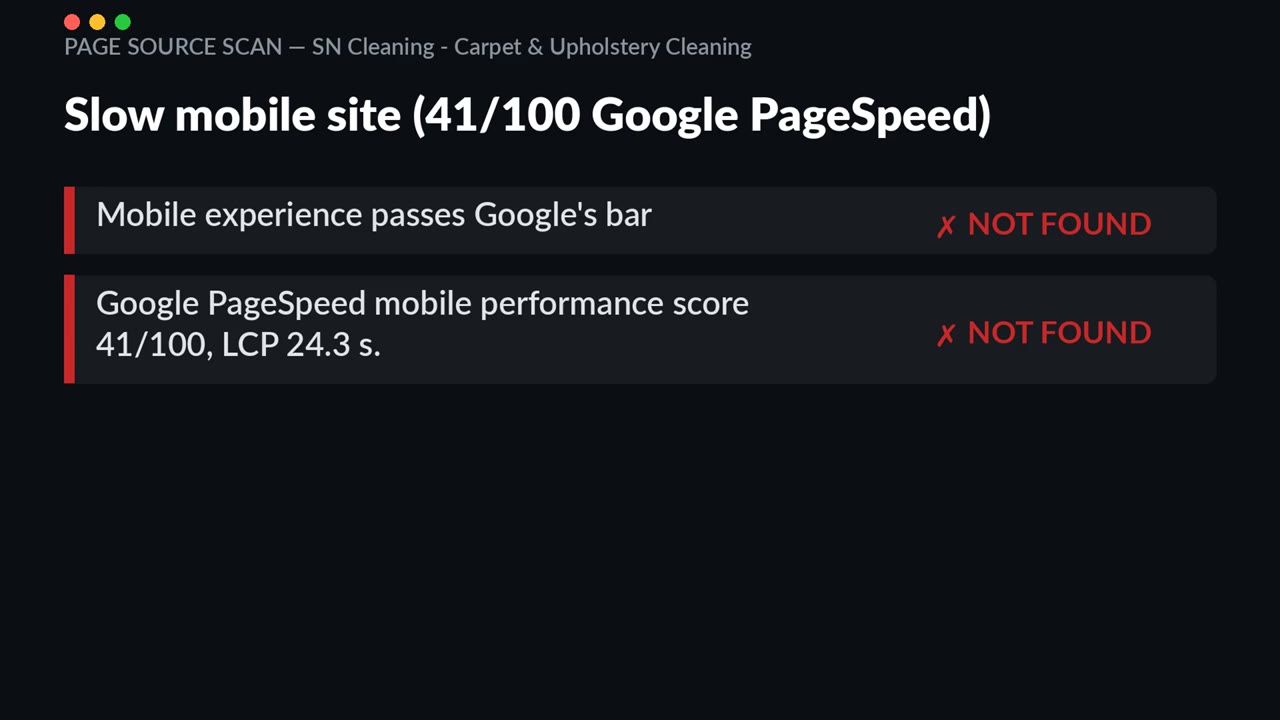
Think about who is searching for carpet cleaning. Someone is staring at a stain on their living room rug, phone in hand, wanting it gone today. That is a high-intent, impatient buyer. If your page makes them wait 24 seconds, they are already back on Google clicking the next company.
If any of those clicks were paid, you paid for that bounce.
This is the part owners miss. Slow mobile speed is not a technical nerd problem. It is a leaking bucket under every dollar you spend on ads and every ranking you earn. You can have the best offer in your market and lose the job before the page even appears.
No local business structured data
Next is something invisible but important. There is no local business structured data on the site.
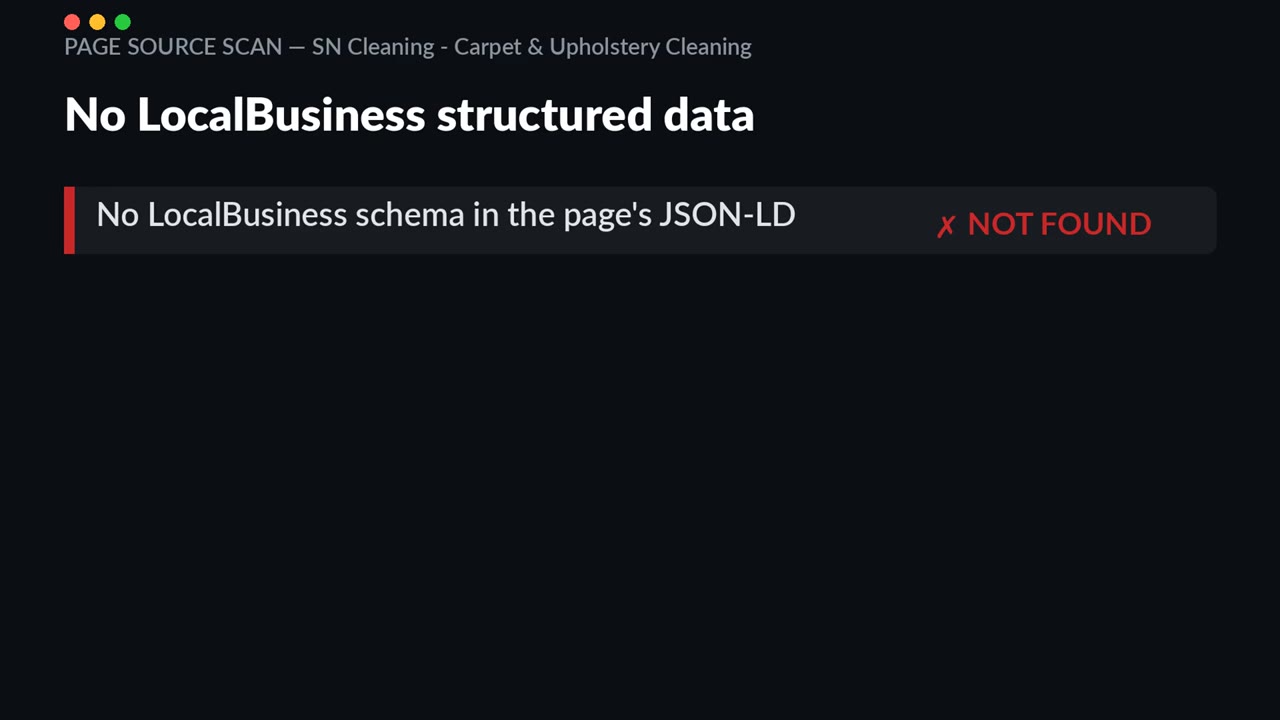
That is the hidden code that hands Google your hours, your service area, your phone number and your rating on a silver platter. Without it, Google is guessing. A competitor who does publish it can get the richer listing with the details filled in, while SN Cleaning gets a plain blue link.
You never see this code on the page, which is exactly why it gets skipped. But Google reads it, and it shapes how your business shows up when someone searches.
The review stars they have earned but cannot show
This one genuinely stings given what they have built. The reviews are right there on the page, but they are not marked up for Google. If they were, Google could show those gold stars directly in the search results.
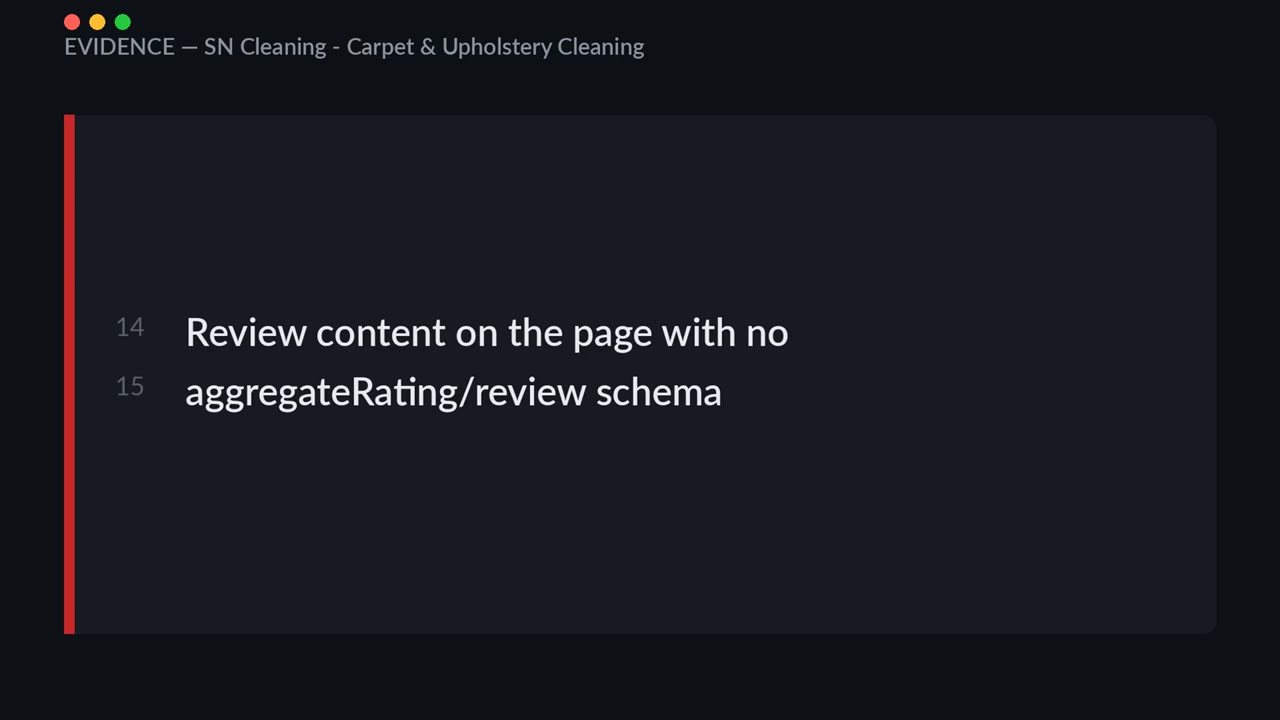
1,300 reviews, a perfect rating, and none of it appears as stars where it would actually pull clicks. That is free attention they have earned and are leaving on the table. Most businesses would give a lot to have that review profile. This one has it and is not using it.
No service-plus-city pages
Here is a bigger one. There are no service-plus-city pages.
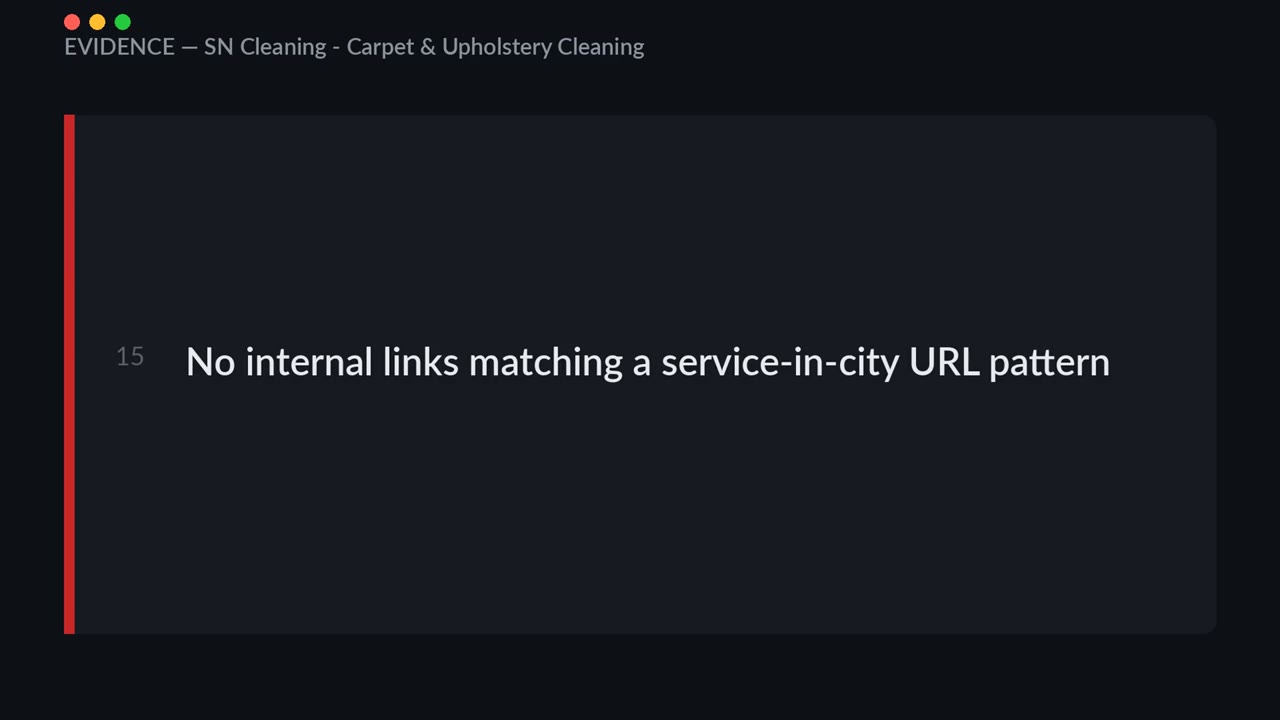
With just one generic services page, there is nothing for Google to rank against those local searches.
It also hurts paid traffic. When a paid click does land, it drops people somewhere too broad to turn them into a booking. A visitor searching for one specific service wants a page about that service in their area, not a general overview of everything the company does. The more specific the page, the easier the booking.
No video on the homepage
A quick one that is low cost and high trust. There is no video anywhere on the homepage.
Video is the fastest way to build trust and keep someone on the page. For a cleaning company, a 30-second before and after would do a ton of work. A stained rug turning clean says more than a paragraph of copy ever could. Right now that spot is empty.
These are basics, not exotic fixes
Here is what I want you to notice. None of this is exotic. Speed, structured data, review stars, local pages. These are the basics any home service marketing agency should catch in week one.

When they get missed, it is usually because most agencies I have seen collect the monthly retainer while junior staff juggle 80 accounts and nobody actually opens yours and looks. You are paying for attention that never arrives, and the gaps just sit there month after month.
The reviews prove this business delivers. The leaks are all in the online layer: speed, markup, local pages and trust-building content. That is fixable, and it is not about the quality of the work.
The shift: AI makes these fixes doable in-house
Here is what most owners do not know yet. With AI, these exact fixes can now run almost automatically. With a little guidance, you can take the wheel, run this in-house, and own your marketing instead of renting it from someone who never checks.

That changes the math for a local service business. You no longer have to choose between paying a retainer and hoping, or ignoring the problem. The audit tells you what is leaking, and the tools now exist to close those gaps without waiting on someone else’s queue. At Local Service Mastery, this is exactly the approach we teach.
What to check on your own site this week

- Mobile speed: run your site through Google’s speed tool and look at the mobile score and how long the main content takes to load.
- Structured data: confirm your site publishes local business data with your hours, service area, phone number and rating.
- Review markup: if you have strong reviews, make sure they are marked up so Google can show stars in search results.
- Local pages: check that each core service has its own page tied to the cities you serve.
- Video: put a short before-and-after clip on your homepage.
If you are weighing options for local service business marketing, use that list as your first test. Whoever runs your marketing should be able to tell you the status of every item in week one.