 Local Service Mastery
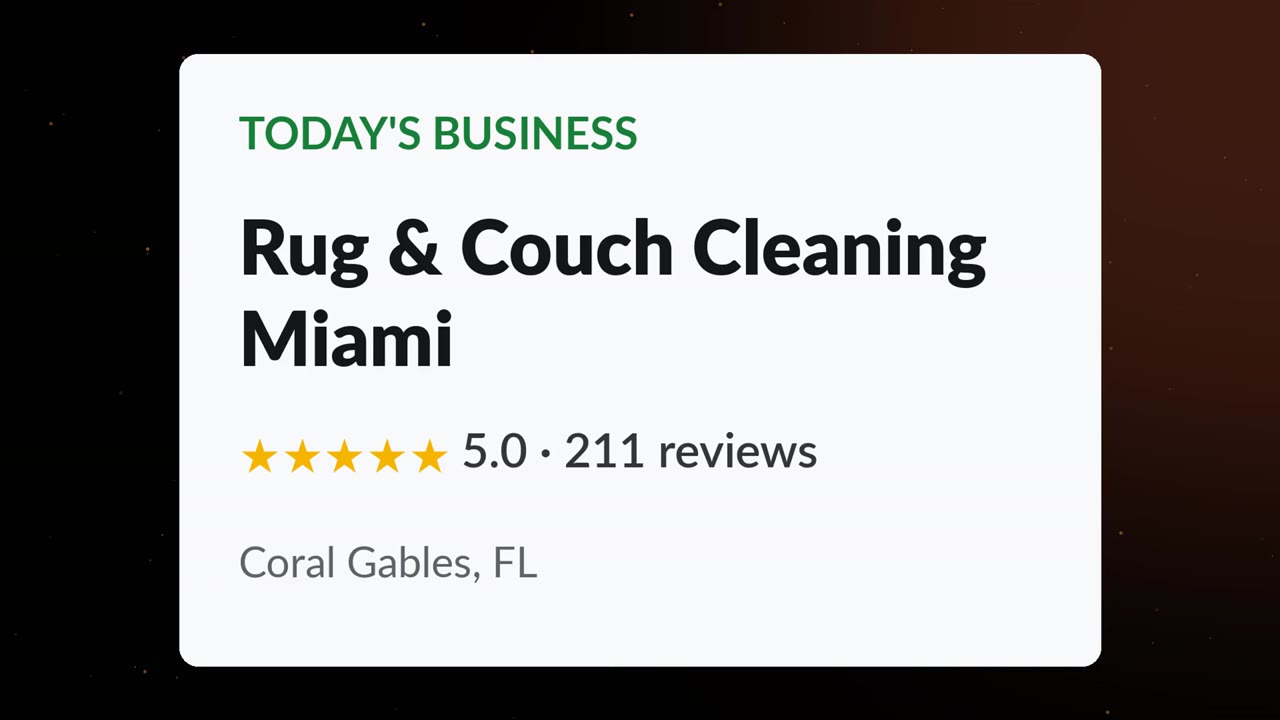
A rug and couch cleaning company in my review queue has something most service businesses would kill for: a perfect five-star rating across 211 Google reviews. That doesn’t happen by accident. It tells you the customers are genuinely happy and the work is good.
But I review hundreds of local service accounts, and a great reputation doesn’t mean the marketing around it is doing its job. In this case, a handful of basic website problems are quietly holding that reputation back. None of them are exotic. Any marketing agency should have caught every one of them.
| Finding | What the audit found | Why it matters |
|---|---|---|
| Reviews shown but not marked up for Google | Review content on the page with no aggregateRating/review schema | Marked-up reviews can show star ratings directly in search results, which lifts click-through on a listing you already rank for — free clicks you’re currently leaving behind. |
| No contact form on the homepage | Zero <form> elements found in the page source | Anyone who isn’t ready to call has no way to reach you. That’s the entire after-hours and comparison-shopping audience gone. |
| No analytics detected | No GA4/Google Tag Manager script found in the page source. | No way to know which marketing produces leads and which burns money. |
| No paid-ads tracking detected at all | No Google Ads conversion tag, no Meta pixel in the page source. | Either no paid acquisition, or ads running blind with no conversion measurement. |
| No LocalBusiness structured data | No JSON-LD structured data at all | Structured data is how Google reads your hours, service area, phone and rating. Without it Google guesses — and competitors who publish it get the rich result instead. |
| No social preview tags (OpenGraph) | No og:title / og:image meta tags in the page source | Every time someone shares your link in a text, Facebook or a group chat, it renders as a bare URL with no title or photo — the least clickable thing on the screen. |
| Missing meta description | No <meta name=description> tag on the homepage. | Google writes its own snippet — usually worse at turning searches into clicks. |
| No Facebook/Meta pixel detected | No fbq(‘init’) / connect.facebook.net script found in the page source. | Without a pixel, there’s no way to retarget people who already visited the site — one of the cheapest ad channels available goes unused. |
| Multiple H1 tags on the homepage (8) | 8 <h1> tags found in the page source. | Multiple H1s dilute the page’s main topic signal instead of reinforcing one clear keyword focus. |
| No video content on the homepage | No YouTube/Vimeo/Wistia embed found in the page source. | Video builds trust fastest and keeps visitors on the page longer — a homepage with zero video is a missed, low-cost opportunity. |
| No social media profile links found on the website | No Instagram or Facebook profile link found in the page source. | No easy path for a visitor to check recent activity or reviews on social — and no compounding organic reach being built. |
The good news: the reputation is already built
Start with what’s working. Earning a perfect rating across 211 reviews is the slowest, hardest part of local marketing. Most contractors struggle to get a few dozen. This business has done the heavy lifting.
That’s why the problems below are so frustrating. The asset is already there. The website just isn’t turning it into booked jobs.
Review markup: free clicks they’re not getting
The homepage shows customer reviews. But the code never tells Google that’s what they are. There’s no review markup, which is a small label that points Google to your ratings.
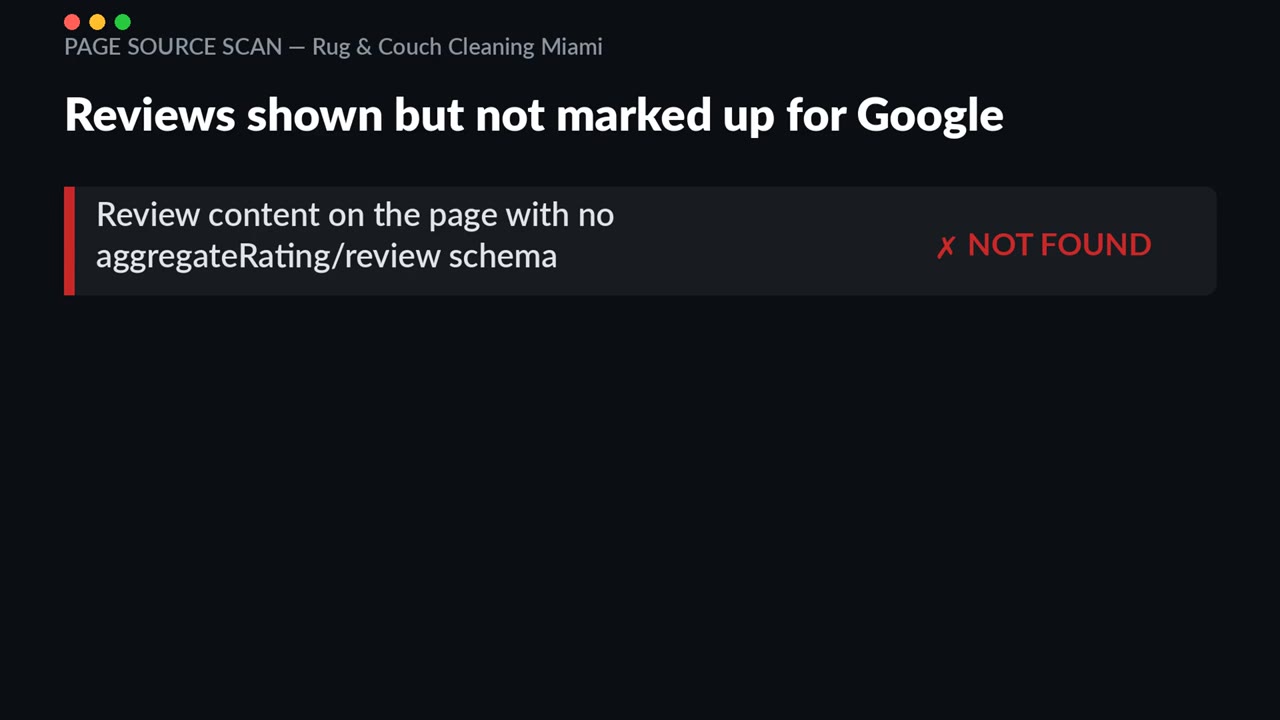
With it, those gold stars can appear right next to your link in search results. If I had that many five-star reviews, I’d want those stars on every search I show up in. That’s free clicks on a listing you already rank for. No extra ad spend, no new content. Just a label in the code.
No contact form: you lose the late-night customer
We found zero contact forms on the homepage. Think about when people actually look for a rug or couch cleaner. Picture someone at 11 at night, red wine on the white couch, kids finally asleep. They’re not making a phone call.
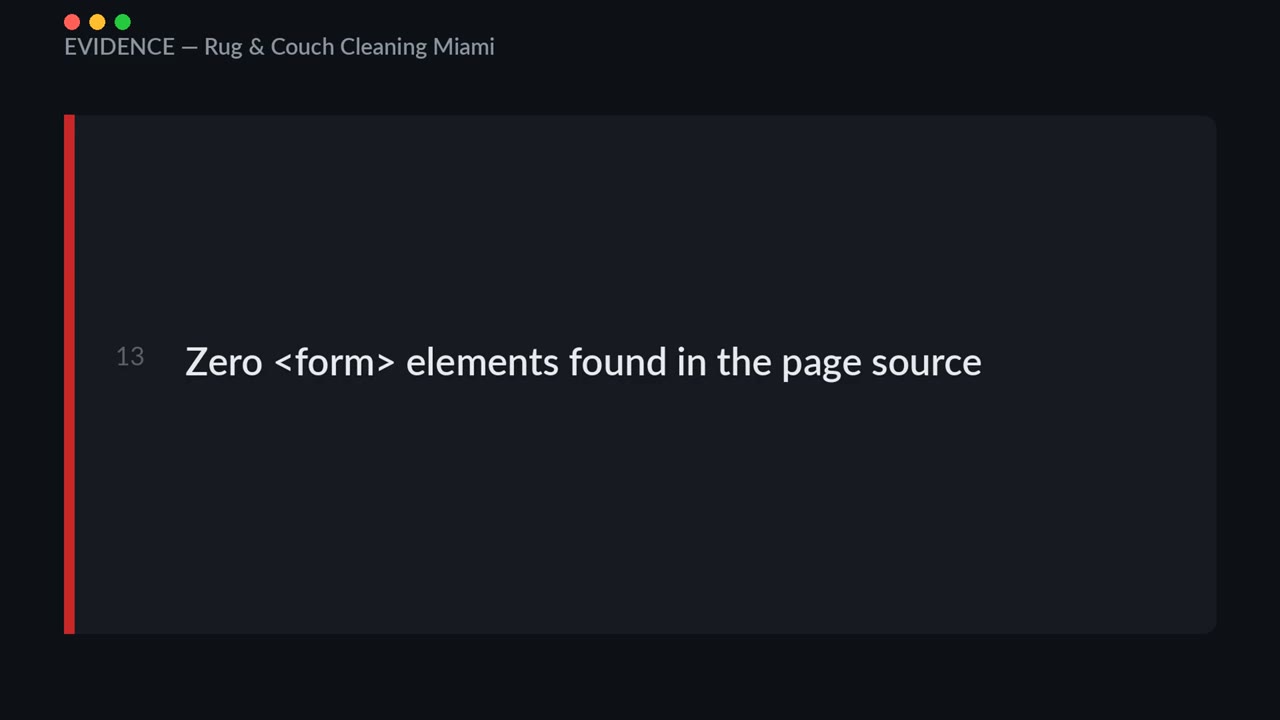
Right now, there’s nowhere for them to do that. So they book whoever gave them a form. You did the work to earn the ranking and the reviews, and the job goes to a competitor because of a missing box on a page.
If your only way to contact you is a phone call, you lose everyone who isn’t ready to talk.
No analytics: you can’t see what makes money
We also found no website analytics installed. That means there’s no way to see which searches, pages or campaigns actually turn into booked jobs, and which ones just burn money.
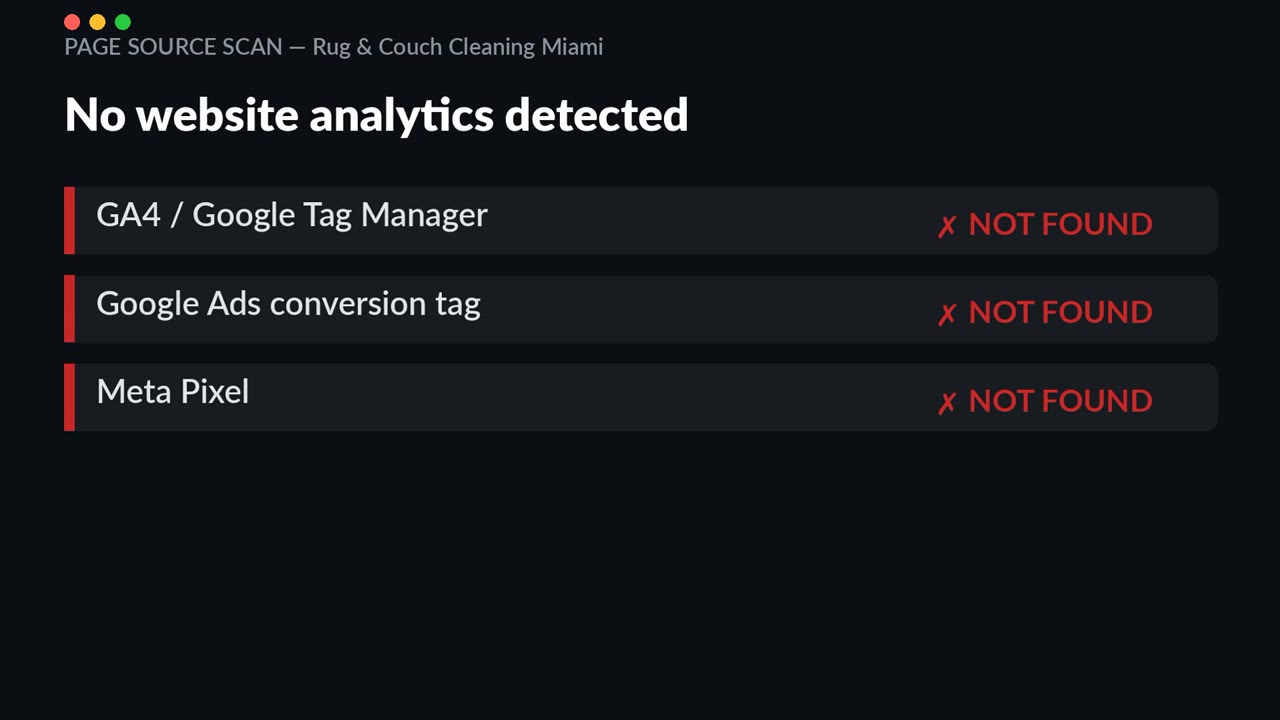
If you can’t see where your jobs come from, you can’t double down on what works or cut what doesn’t. You’re guessing with real budget.
No conversion tag, no pixel: ads running blind
The ad side tells a similar story. There’s no Google Ads conversion tag and no Facebook pixel either. If ads are running, they’re running blind. Nothing reports back on which clicks became customers. Two inexpensive tools close most of that gap: call tracking software (click here) shows which ads actually make the phone ring, and click-fraud protection software (click here) stops you paying for clicks that were never real customers.
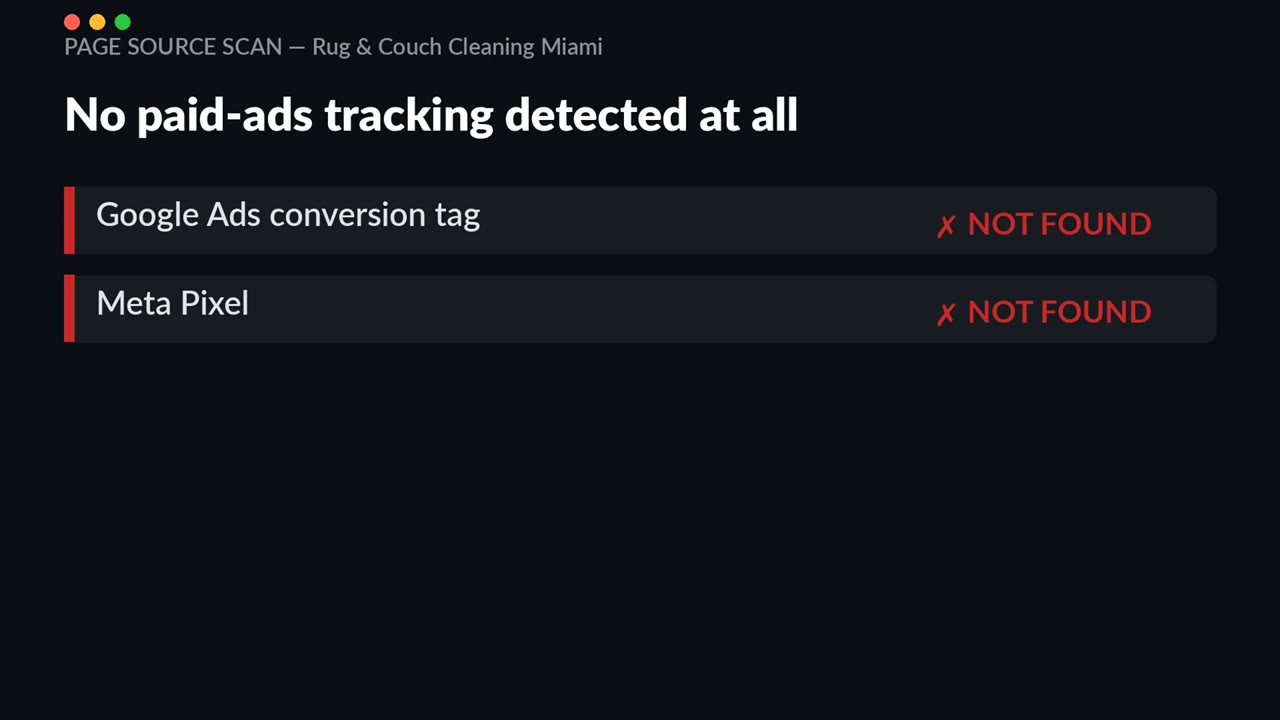
Without that pixel, you also can’t show a follow-up ad to someone who already looked at your rug-cleaning page and left. In my experience, that’s usually one of the cheapest leads you can buy. Someone who already visited and showed interest is far warmer than a stranger. Skipping that audience is like walking past money on the floor.
No structured data: Google has to guess
There’s also no structured data on the site at all. That’s the code that hands Google your hours, phone number and service area directly. Without it, Google has to guess, and competitors who publish it can get the richer result instead.
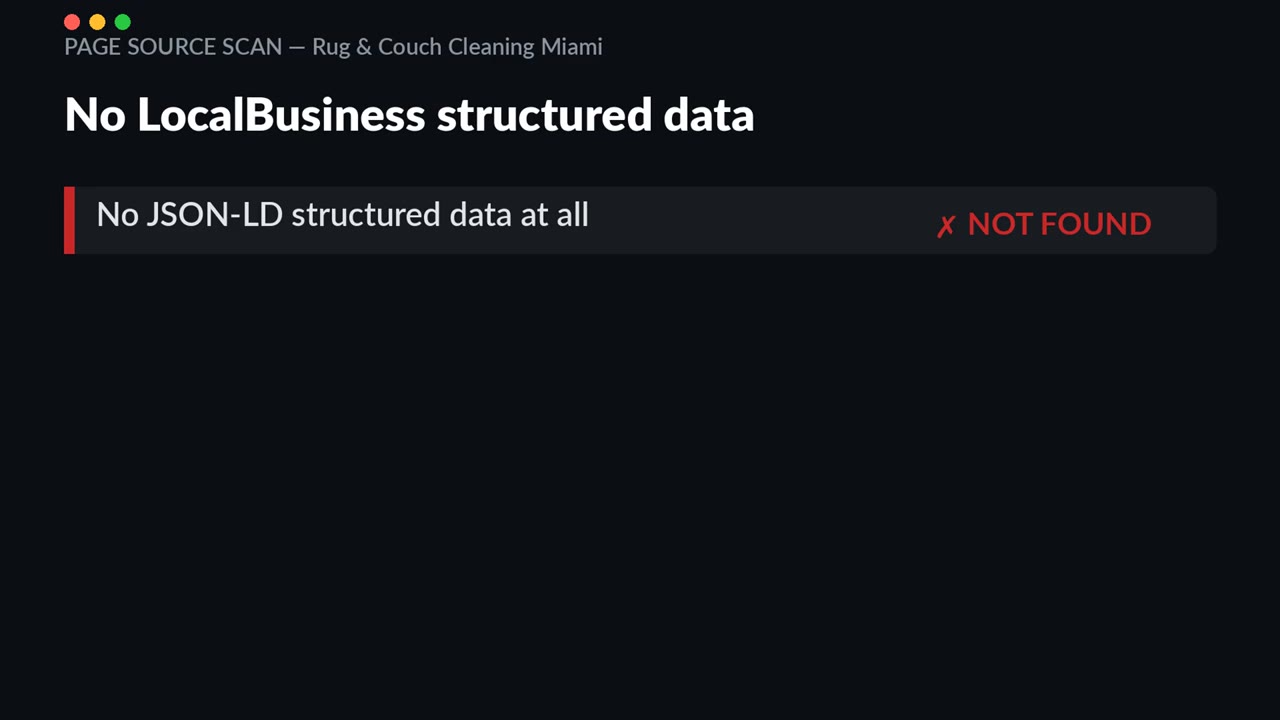
You want Google to be certain about who you are, when you’re open, how to reach you and where you work. Don’t leave that to interpretation when a competitor is spelling it out.
No social preview tags: warm referrals look cold
When a happy customer texts your link to a friend, there are no social preview tags, so it shows up as a bare web address. No photo, no title. Maybe it’s going to their sister. Maybe it’s the whole building’s group chat.
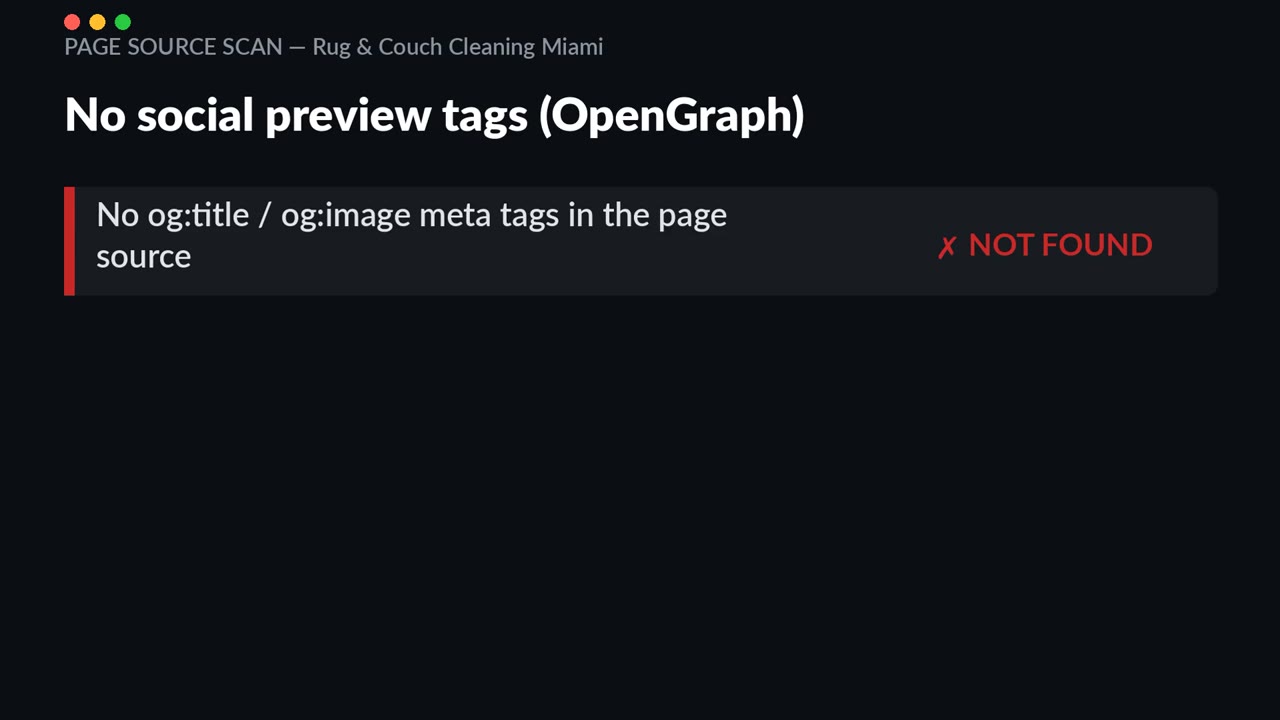
Either way, a warm referral ends up looking like the least clickable thing on the screen. With 211 five-star reviews, this business clearly generates word of mouth. The link people share should look as good as the work does.
No meta description: Google writes a worse one
Last one: there’s no meta description on the homepage. That’s the short summary under your link in Google. Without it, Google writes its own, and it’s usually worse at earning the click.
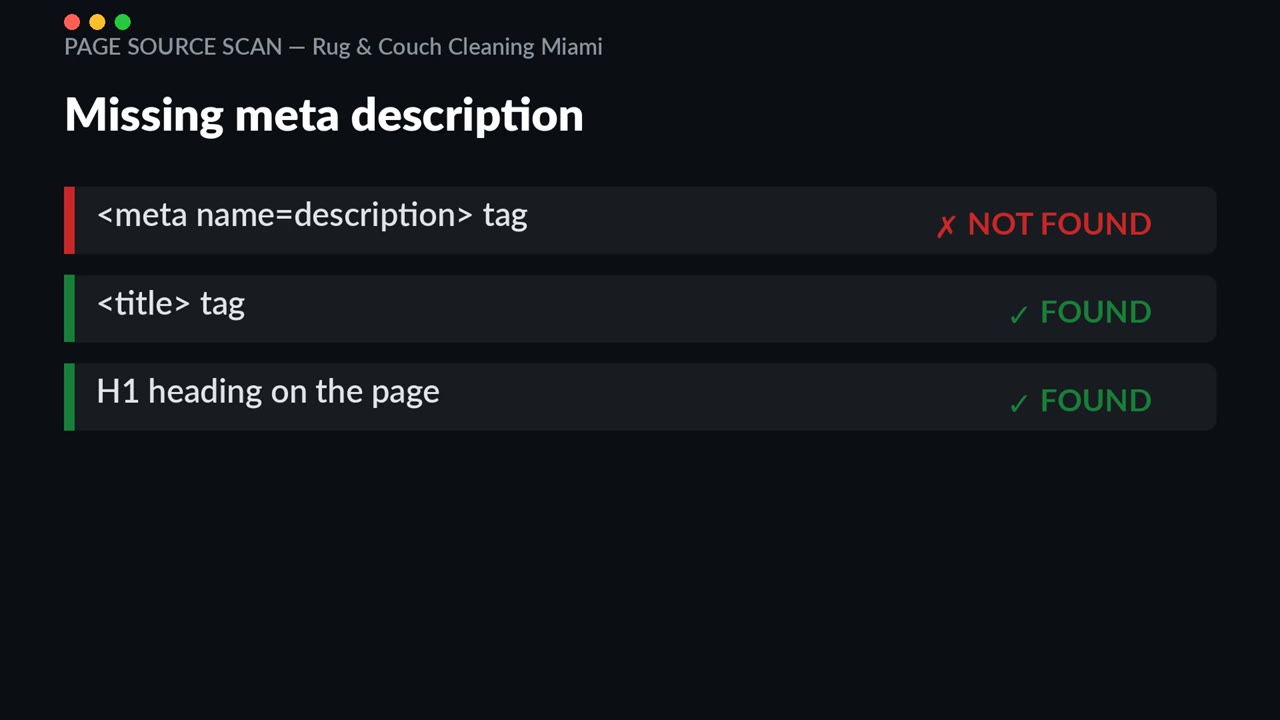
It’s a few lines of text, and it’s your chance to tell a searcher why to choose you before they ever hit your site.
Why these basics get missed
After reviewing hundreds of local service accounts, I can tell you these are basic. Any marketing agency should catch them. When they get missed, it’s usually because of how most agencies operate. They collect a monthly retainer while a junior person juggles 80 accounts, and nobody actually looks.

If someone’s being paid to run this, they should have caught it. If you’re paying a home services marketing company or any other agency, ask them directly whether your site has review markup, a contact form, analytics, conversion tracking and structured data. If they can’t answer, you have your answer. And if you’re still choosing a home service marketing agency, that checklist is a good way to separate the ones who look from the ones who don’t.
Quick checklist: review markup, a contact form, analytics, a Google Ads conversion tag, a Facebook pixel, structured data, social preview tags and a meta description. Each takes little effort and each affects how many jobs you book.
The part most business owners don’t know yet
Here’s what most owners haven’t realized. With AI, fixes like these can now run automatically. With a bit of guidance, you can run your marketing in-house and own the whole thing, without ever depending on an agency again.

That’s the approach we teach at Local Service Mastery. You don’t need to hand your marketing to someone juggling dozens of accounts. You need to know what to look for and have the tools to fix it.