 Local Service Mastery
A 4.9 star rating across 908 Google reviews is seriously impressive. You don’t get a track record like that by accident. It comes from customers walking away happy, and that’s the hardest part of any service business to build.
So this isn’t about the work. I’m not touching the service, the crew or the customer experience. I’m only looking at the online marketing of this carpet cleaning company, Xpress Services, and asking one question: if this were my account, what would I want fixed?
The answer is a list of basics. None of it is exotic. All of it costs the business money every month it stays broken.
| Finding | What the audit found | Why it matters |
|---|---|---|
| Reviews shown but not marked up for Google | Review content on the page with no aggregateRating/review schema | Marked-up reviews can show star ratings directly in search results, which lifts click-through on a listing you already rank for — free clicks you’re currently leaving behind. |
| No sitemap.xml | robots.txt points to https://www.xpressservices.us/sitemaps/sitemap.xml, but that address returns a 404 (and /sitemap.xml also returns 404). | A sitemap is how Google finds every page you have. Without one, deeper service pages can sit undiscovered for months. |
| No service+city pages | No internal links matching a service-in-city URL pattern | People search “emergency plumber in <city>”, not “Xpress Services”. With one generic services page there’s nothing for Google to rank against those searches, and paid clicks land somewhere too generic to convert. |
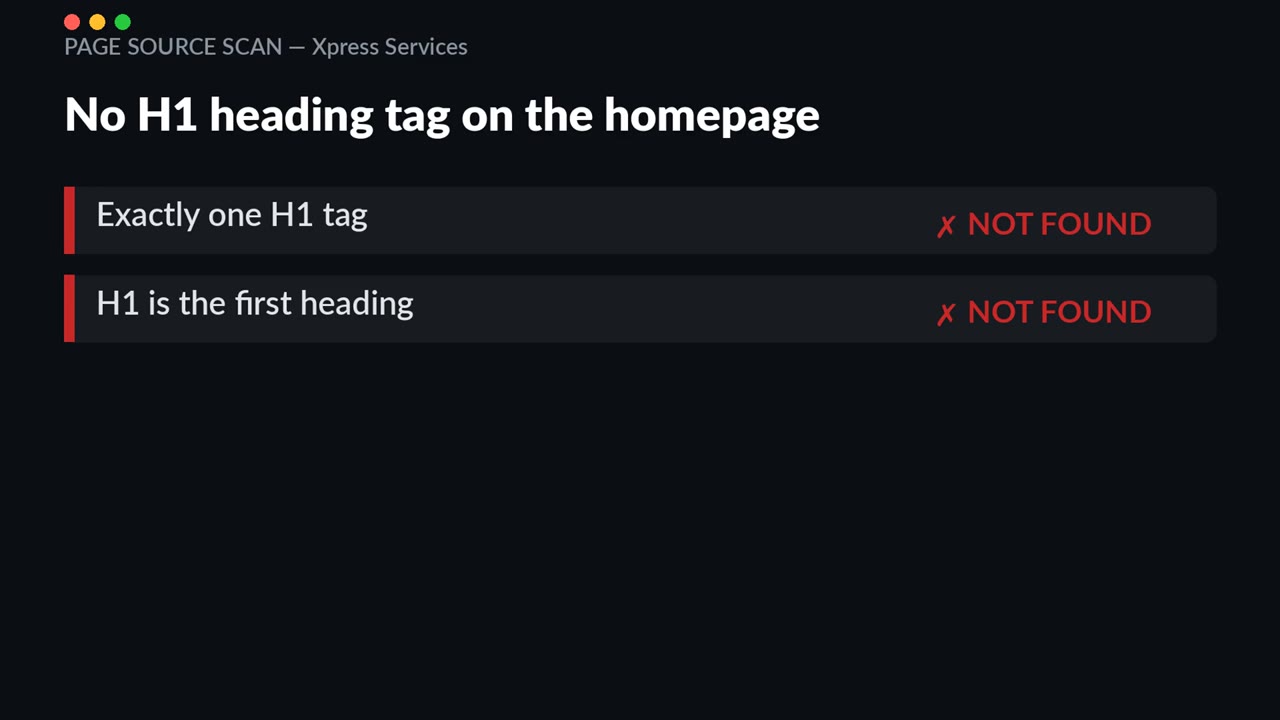
| No H1 heading tag on the homepage | Zero <h1> tags found in the page source. | The H1 is the strongest single on-page signal for what a page is about — without one, Google has to guess. |
| No LocalBusiness structured data | No JSON-LD structured data at all | Structured data is how Google reads your hours, service area, phone and rating. Without it Google guesses — and competitors who publish it get the rich result instead. |
| No analytics detected | No GA4/Google Tag Manager script found in the page source. | No way to know which marketing produces leads and which burns money. |
| No paid-ads tracking detected at all | No Google Ads conversion tag, no Meta pixel in the page source. | Either no paid acquisition, or ads running blind with no conversion measurement. |
| No Facebook/Meta pixel detected | No fbq(‘init’) / connect.facebook.net script found in the page source. | Without a pixel, there’s no way to retarget people who already visited the site — one of the cheapest ad channels available goes unused. |
The reviews are great. The review markup is missing.
Review content shows up on the website, but the page has no review markup. Review markup is a small piece of code that tells Google, “these are star ratings.” It’s what can put gold stars right next to your link in search results.
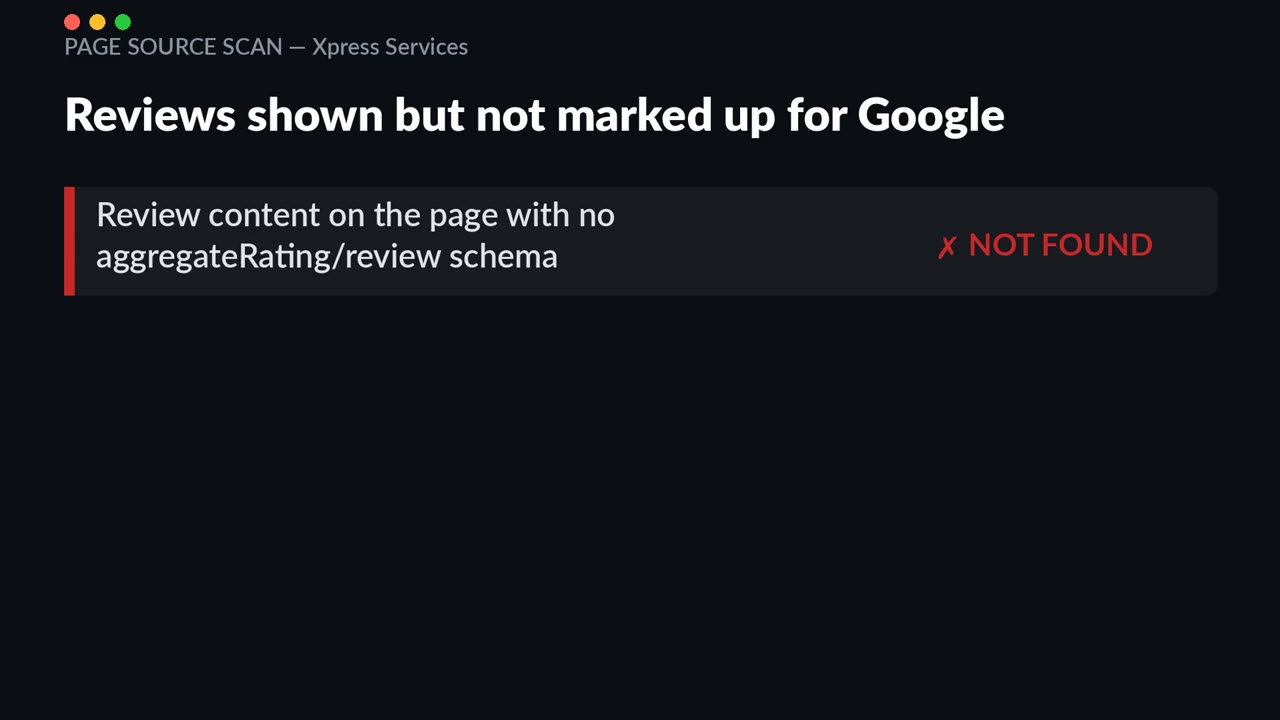
Think about what that means with 908 reviews. You’ve already done the hard work of earning them. You’re already ranking for the listing. Stars next to your link are free clicks on a listing you already have. Skipping that is leaving trust on the table that you paid for with years of good jobs.
A sitemap that points to nothing
The site’s robots file tells Google to look for a sitemap at a specific address. That address returns a 404, which just means page not found. The backup address, /sitemap.xml, returns a 404 too.
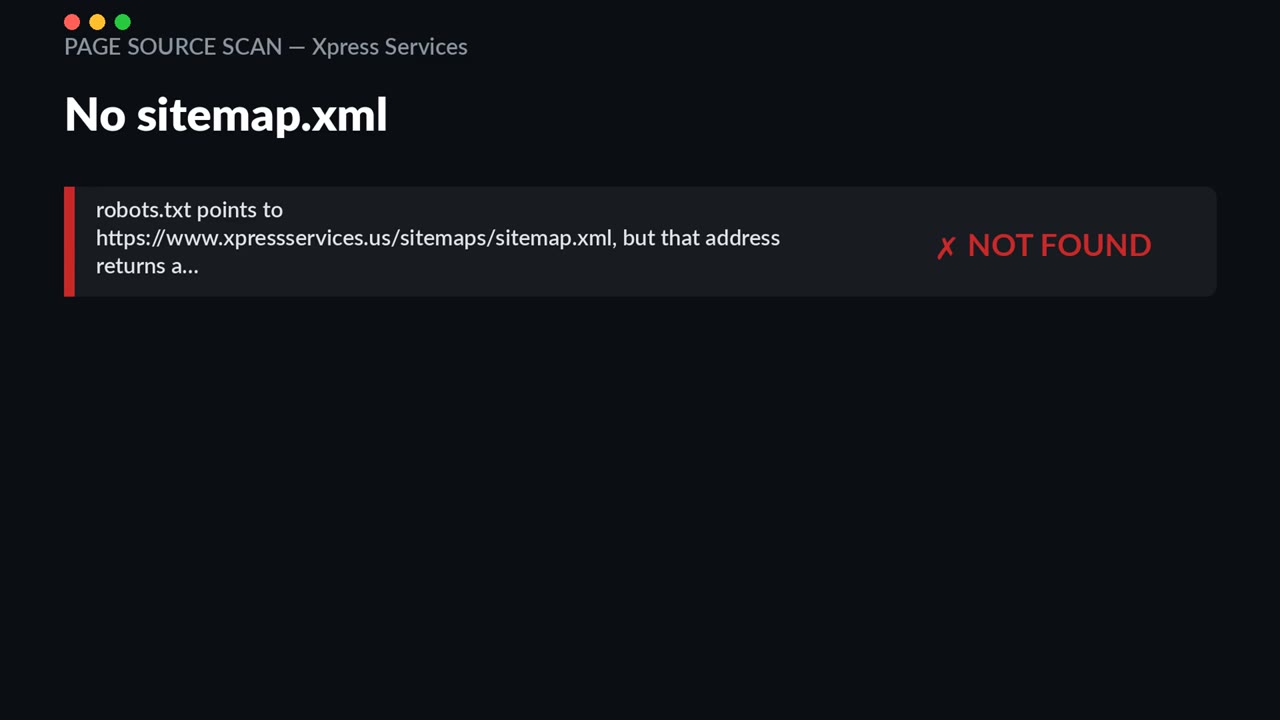
A sitemap is the map Google uses to find every page you have. Without a working one, deeper pages can sit undiscovered for months. You can build a great page, and if Google never finds it, it does nothing for you.
No service-in-city pages
This is the one that hits closest to how customers actually behave. Picture someone standing in front of the problem with their phone in their hand. They are not typing the name of your company.
When we looked for service-in-city pages, we found no internal links following that pattern. If there’s no page built for that search, Google has nothing of yours to rank for it. And it gets worse if you run paid ads. Paid clicks land on a page that’s too generic to convince anyone to book you for a job. You pay for the click and lose the customer on arrival.
No H1 and no structured data
Zero H1 tags on the homepage
The H1 is the main headline label Google reads to understand what a page is about. The homepage had zero of them. Without one, Google has to guess what the page is for, and you never want Google guessing about your most important page.
No JSON-LD at all
Same story with structured data. There’s no JSON-LD, which is the code format Google reads for your hours, service area, phone and rating. Competitors who publish it are the ones who get the rich result instead of you. It’s a quiet advantage, and right now it belongs to everyone else.
None of these problems are about the quality of the work. They’re about how clearly the website talks to Google. A business can be excellent and still be hard to find.
Where it starts costing real money: no tracking
Everything so far costs you clicks and visibility. This is where it starts costing real money.
No Google Analytics, no Tag Manager
We found no Google Analytics and no Google Tag Manager script in the page source. That means there’s no clear way to see which marketing brings in jobs and which marketing just burns cash. You’re spending without a scoreboard.
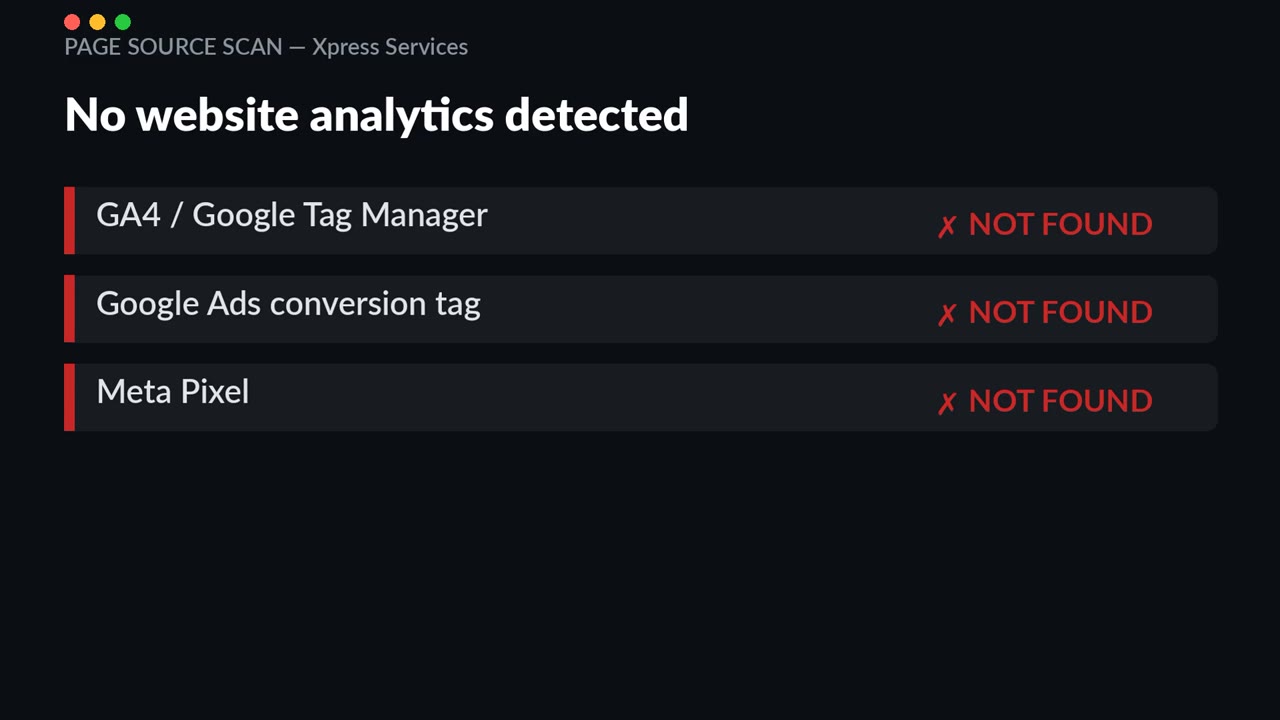
No ads conversion tag, no Meta pixel
There’s also no Google Ads conversion tag and no Meta pixel. So either no paid ads are running, or they’re running blind with nothing measuring results. Neither is good.
Without a pixel, you also can’t retarget people who already visited your site. That’s one of the cheapest ad channels out there. Maybe someone checked the site, got pulled away by the kids, and never came back. I’d want a way to show up in front of that person again. Right now there isn’t one.
Why the basics get missed
After reviewing hundreds of local service accounts, I call these basics. If someone is being paid to run this marketing, they should have caught them. A sitemap that 404s, a missing H1 and a missing tracking tag are not subtle problems.

So why do they slip through? In my experience, most agencies collect a monthly retainer while a junior staffer juggles 80 accounts, and nobody actually looks. A typical home service marketing agency is built on volume, not on someone opening your page source and checking what’s there. The owner pays every month and assumes somebody is watching. Often, nobody is.
What AI changes for service business owners
Most owners don’t know this yet: with AI, these exact fixes can now run automatically. The tedious technical work that used to justify a retainer, like markup, sitemaps, page structure and tracking, doesn’t have to be handed off any more.

With a bit of guidance, you can bring your marketing in-house and own the whole thing without ever depending on an agency again. That’s the direction I’d push any local service business, whether you clean carpets, fix furnaces or unlock doors.
If someone’s being paid to run your marketing, they should have caught the basics.
If you want a second set of eyes on your own setup, the team at Local Service Mastery goes through accounts exactly like this one. The approach to marketing for home service businesses starts with the basics, because that’s where the money leaks first.