 Local Service Mastery
A perfect five-star rating across 228 Google reviews. Most businesses would kill for that. It means a lot of happy customers, and it’s the hardest thing to fake in local service marketing.
So when I broke down this carpet cleaning company’s marketing, I set the reputation aside and looked only at what sits around it. That’s where the leaks are. The reviews are great. The setup built around them is not.
| Finding | What the audit found | Why it matters |
|---|---|---|
| Reviews shown but not marked up for Google | Review content on the page with no aggregateRating/review schema | Marked-up reviews can show star ratings directly in search results, which lifts click-through on a listing you already rank for — free clicks you’re currently leaving behind. |
| YouTube channel inactive (179 months since last upload) | Their YouTube channel’s most recent video was uploaded 5378 days ago. | An inactive channel signals to both viewers and Google that the business isn’t actively investing in content. |
| No LocalBusiness structured data | No LocalBusiness schema in the page’s JSON-LD | Structured data is how Google reads your hours, service area, phone and rating. Without it Google guesses — and competitors who publish it get the rich result instead. |
| No paid-ads tracking detected at all | No Google Ads conversion tag, no Meta pixel in the page source. | Either no paid acquisition, or ads running blind with no conversion measurement. |
| No Facebook/Meta pixel detected | No fbq(‘init’) / connect.facebook.net script found in the page source. | Without a pixel, there’s no way to retarget people who already visited the site — one of the cheapest ad channels available goes unused. |
The reviews are on the page, but Google can’t read them properly
The reviews are displayed on the site, but they aren’t marked up for Google. Markup is a small piece of code that hands Google your rating directly. Without it, Google has to work out what your reputation is on its own.
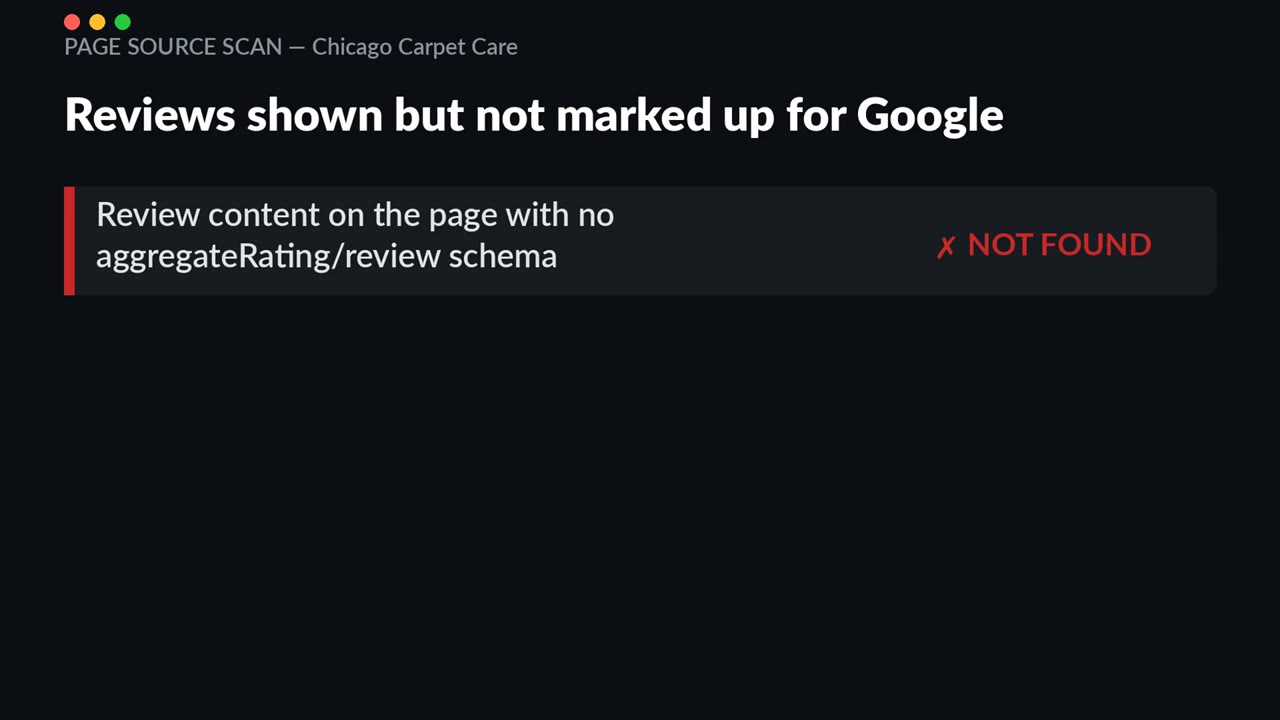
Marked-up reviews can put stars right in the search results. With 228 five-star reviews, that’s free clicks sitting on the table. If this were my account, it would be the first fix. It’s cheap, it’s fast, and it makes the strongest asset the business has visible before anyone even lands on the site.
A YouTube channel that went quiet almost 15 years ago
We checked the channel, and the most recent video went up 5,378 days ago. That’s about 179 months, so close to 15 years.
Picture someone with a red wine stain on a cream rug looking you up before they pick up the phone. They’re stressed and they want to know who they’re trusting. They land on a channel that went quiet a long time ago. That tells them, and Google, that nobody’s really home.
A dead channel doesn’t just look neglected. It’s a trust signal working against you at the exact moment someone is deciding whether to call.
No video anywhere on the homepage
The channel isn’t the only gap. We found no video embed anywhere in the page source, so the homepage has no video at all.
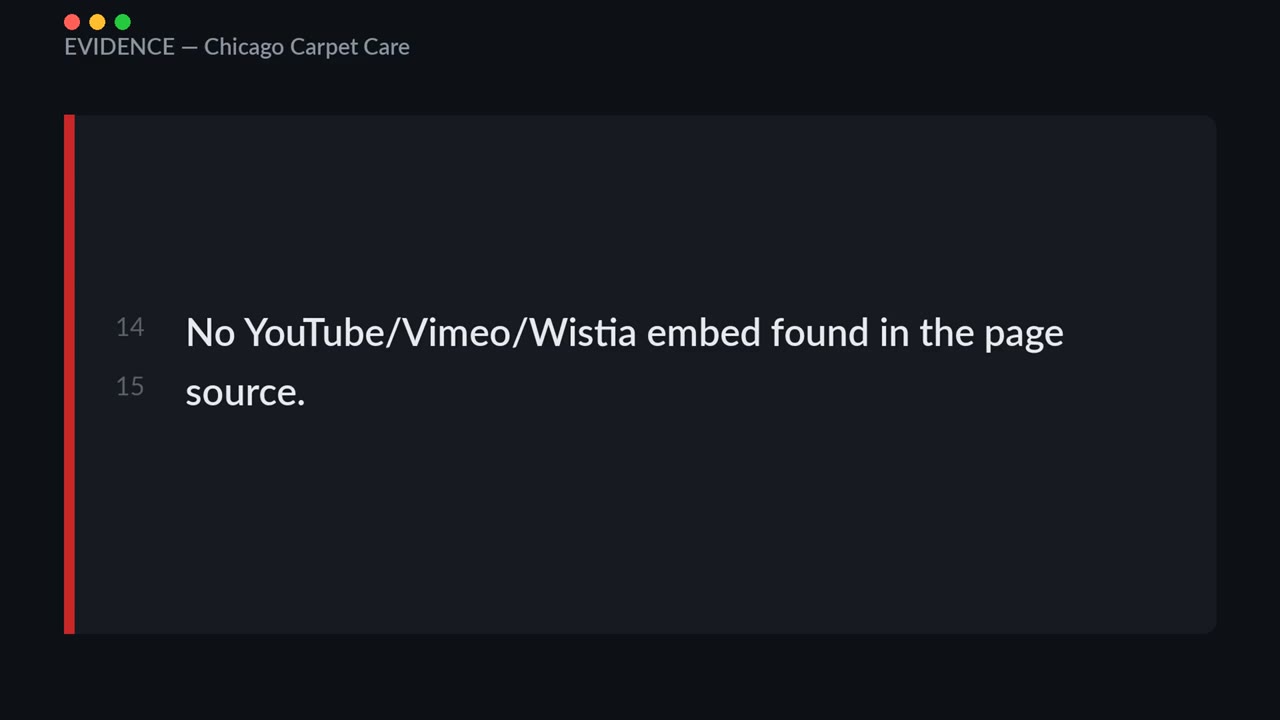
I’d want to see even one short clip of the crew walking through a job. It doesn’t need to be polished. Video builds trust faster than any paragraph, and it keeps people on the page long enough to actually book you. For a service where a stranger is coming into someone’s home, seeing real people at work does a lot of the selling for you.
No local business structured data
There’s also no local business structured data on the site. That’s a small block of code that spells out your hours, service area, phone and rating for Google.
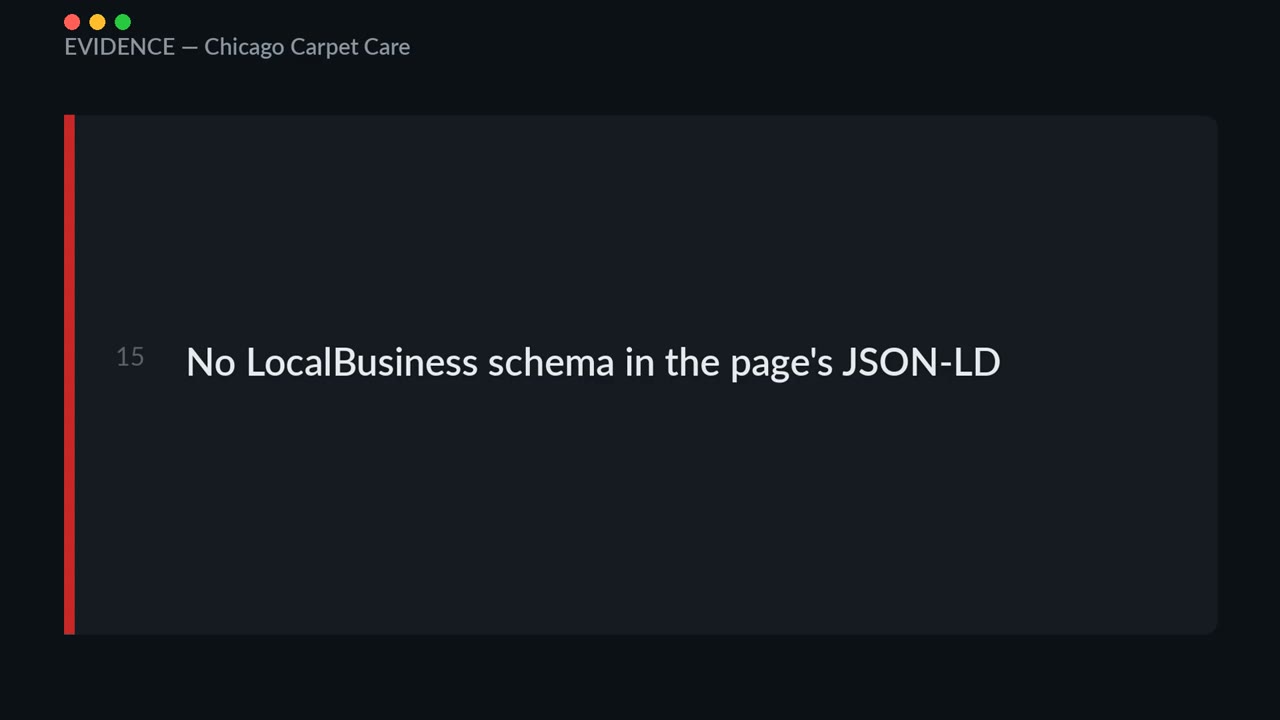
Without it, Google has to guess. A competitor who spells it out can end up with the richer listing. You can be the better company with the better reviews and still lose the visibility fight because the other side gave Google cleaner information. This is the same idea as the review markup: make it easy for Google to understand and display your business.
No tracking means no idea what’s working
We also found no Google Ads conversion tag and no Meta pixel in the page source. A pixel is a tracking snippet for Facebook and Instagram ads.
That leaves two possibilities. Either there’s no paid advertising running right now, or any ads are running without measuring what turns into a booking. Neither is good.
Why retargeting matters
Without a pixel, there’s no way to show ads to people who already visited the site and left. That’s one of the cheapest ways to win a customer back. Someone who looked at your site and got distracted is far warmer than a cold stranger, and with no tracking you can’t reach them at all.
Tracking isn’t an advanced tactic. It’s the foundation. If you can’t see which clicks become bookings, you can’t tell which marketing is paying for itself.
Why basics like these slip through
None of this is advanced. After reviewing hundreds of local service accounts, I can tell you these are basics that any home service marketing agency should catch. So why don’t they?

In my experience, most agencies collect a monthly retainer while a junior person juggles 80 accounts and nobody really looks. If someone’s being paid to run your marketing, they should have caught these gaps. When they don’t, you’re paying for attention you’re not getting.
What owners don’t know yet: this can run automatically
Here’s what most owners haven’t realized. With AI, fixes like these can now run automatically. And with a bit of guidance, you can run your marketing in-house, own the whole thing, and never depend on an agency again.

That’s the whole idea behind what we do at Local Service Mastery. We coach service business owners to master lead generation themselves. If you’d rather have a team that understands the trades, a home services marketing company built around ownership instead of retainers is a very different thing from the 80-accounts-per-person model.
The takeaway for any service business owner
Strong reviews are the hardest part to build, and this company already has them. What’s missing is the plumbing: markup, structured data, video, and tracking. Each one is small. Together they decide whether a great reputation turns into calls or just sits there.