Full video review — Montgomery Law, Dallas TX.
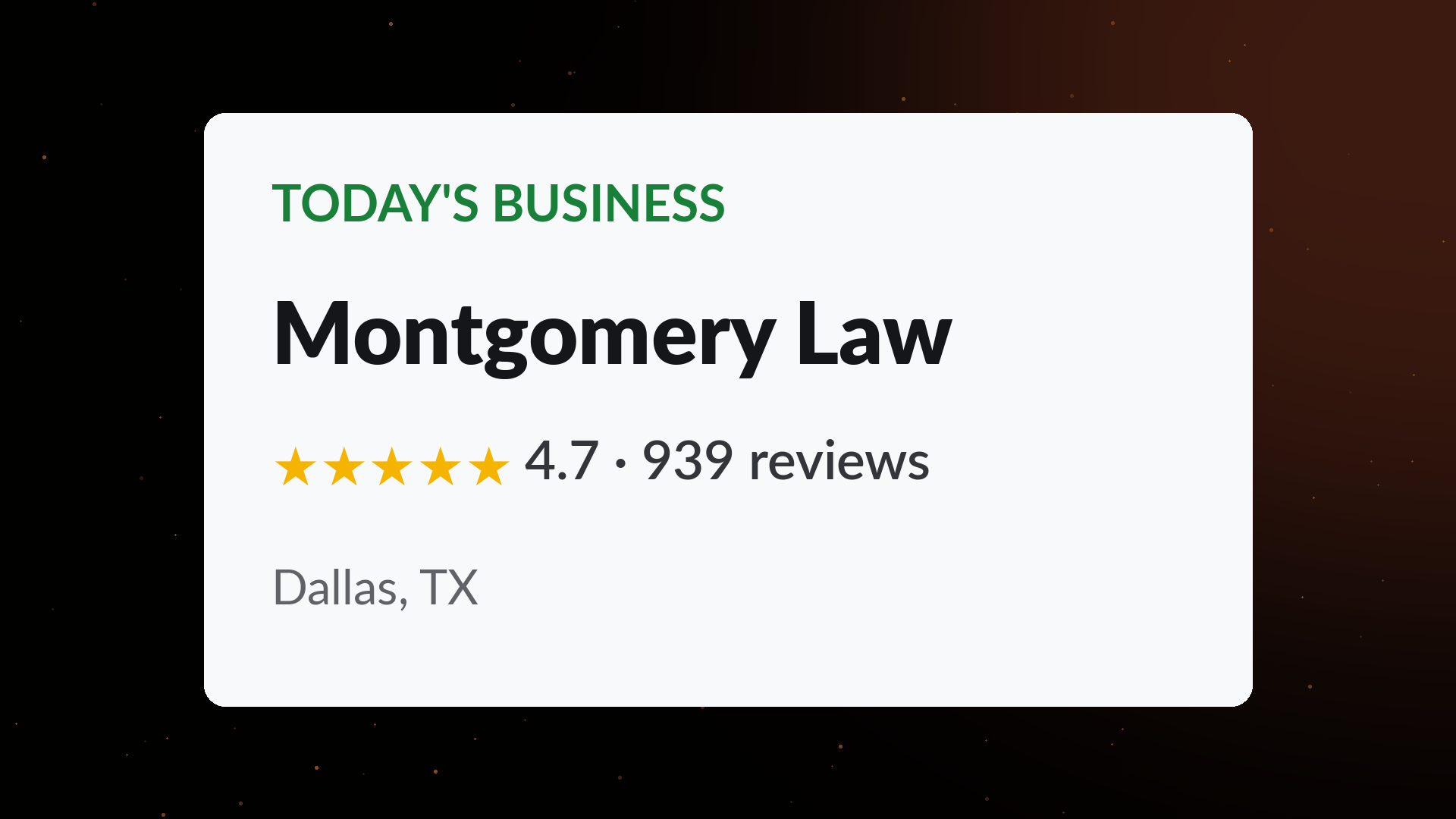
Start with what Montgomery Law has built: a 4.7-star rating across 939 Google reviews. Personal injury clients leave reviews after some of the worst weeks of their lives — holding 4.7 across that many cases says the firm delivers when it counts. Nothing in this review questions that.
What we audited is strictly the public marketing footprint — the firm's own website source code and their public Google listing, checked on August 11, 2026. Six gaps came back, and each one is on the standard checklist Local Service Mastery runs before a client spends anything on growth.
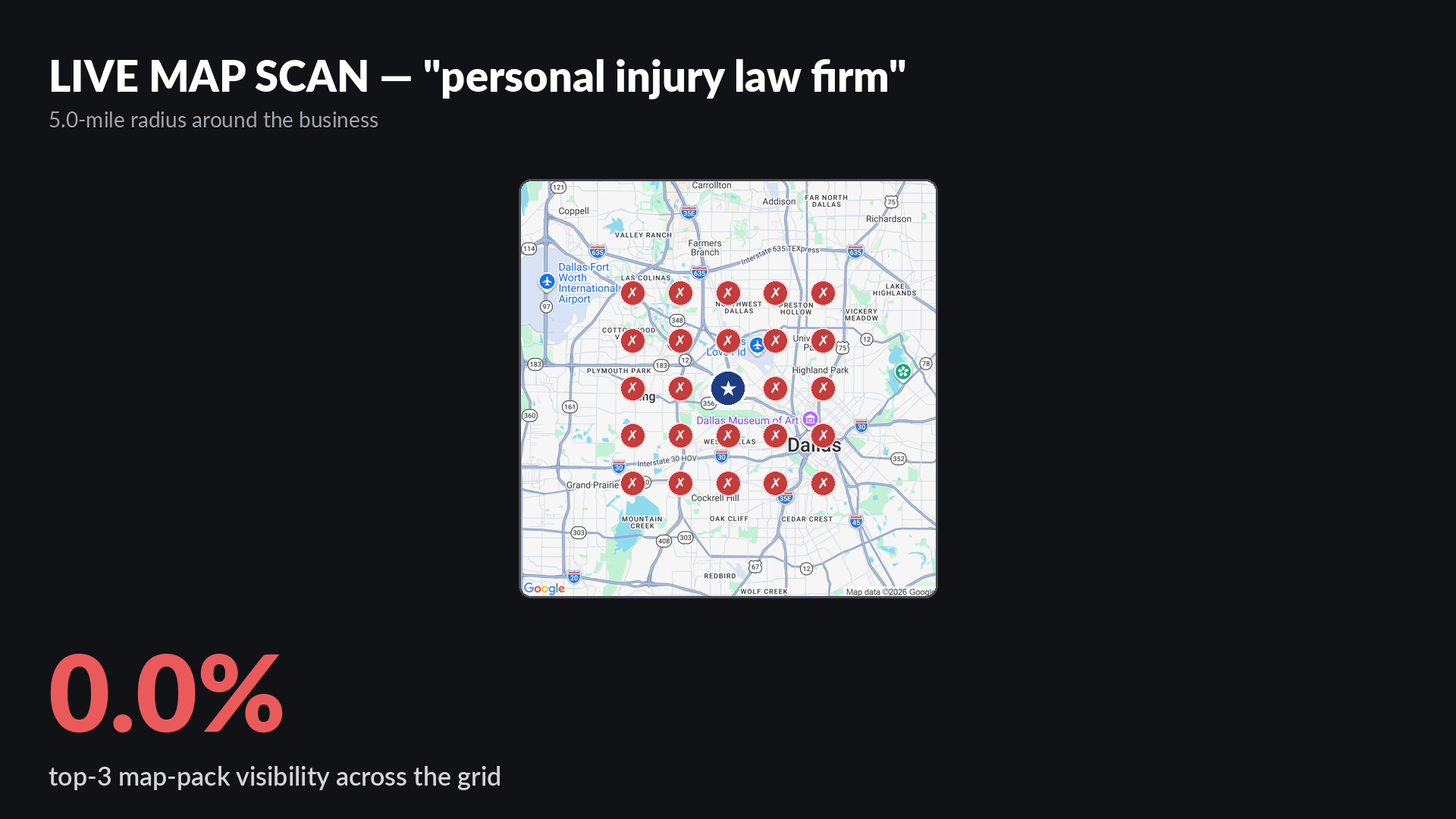
Verified with a live map-grid scan on August 11, 2026.
What's visible
We ran live "personal injury law firm" searches at 25 points in a five-mile radius around their Dallas office. Montgomery Law made the top-three map pack at zero of them — 0% of the grid, with an average rank outside the top 20.
Why it costs cases
Dallas personal injury is one of the most contested local searches in the country, and the overwhelming majority of searchers pick from the three names the map pack shows first. A 939-review, 4.7-star profile is exactly the raw material map rankings reward — which makes 0% coverage an optimization gap on their Google Business Profile, not a reputation gap. Across every scanned point in their own backyard, the firm simply isn't in the consideration set.
Verified from the page source on August 11, 2026.
What's visible
The site carries a live Google Ads conversion tag — so money is going into ads — but no call-tracking script exists anywhere in the source.
Why it costs cases
Law-firm leads don't fill out forms; they pick up the phone. Without call tracking, Google's own algorithm can't see which keywords and ads produce the calls that actually sign cases — so budget drifts toward whatever is measurable instead of whatever is working. The first fix we'd put in is call tracking software — click here for the one we recommend — so every ad dollar finally traces back to a ringing phone.
Verified from the page source on August 11, 2026.
What's visible
Alongside the Google Ads tag, no click-fraud protection script was found anywhere in the page source.
Why it costs cases
In a niche where a single click can cost what dinner for four costs, bots and competitor clicks aren't a rounding error — they typically burn 10–20% of a local-service ad budget with zero leads to show for it. On a personal-injury budget in Dallas, that's real money evaporating silently, month after month. This is the tool we'd put in front of that spend — click here.
Verified from the page source on August 11, 2026.
What's visible
The homepage does have an H1 — but a lower-level heading (H2/H3) appears before it in the HTML, out of outline order.
Why it costs cases
Search engines read headings like a document outline: the H1 is the title, everything else nests under it. When a subheading shows up first, the main headline is structurally demoted — a weakened relevance signal on the single most competitive page the firm owns. It's a small code change with an outsized footprint, and it's the kind of thing any routine technical check catches.
Verified from the page source on August 11, 2026.
What's visible
The homepage contains no video embed of any kind — no YouTube, Vimeo, or Wistia player anywhere in the source.
Why it costs cases
Nobody hires a personal injury firm from a bullet list — they hire the lawyer they trust with the worst day of their year. Trust is exactly what video builds fastest: an attorney speaking to camera for sixty seconds out-converts any paragraph on the page. For a firm whose whole product is credibility, the homepage currently has its single strongest trust format missing.
Verified from the public channel on August 11, 2026.
What's visible
Montgomery Law's YouTube channel exists — but its most recent upload was 5,618 days ago, back in 2011. Fifteen years of silence.
Why it costs cases
Legal questions are among the most-searched video topics there are — "what to do after a car accident in Dallas," "how long does an injury case take" — and every one of those searches is a potential client meeting a competing firm instead. An abandoned channel also reads as a closed sign to viewers and to Google's freshness signals. The asset exists, the brand is attached to it, and a firm with 939 client stories has more material than it could ever film — it's just sitting idle.
| Hiring an agency | DIY, unaided | Local Service Mastery (LSM AI) | |
|---|---|---|---|
| Map-pack coverage across the whole metro | Reported as a single "rank," not a true grid scan | You'd have to know grid scanning exists to run one | Measured on a live grid, then improved point by point |
| Knowing which ads produce signed cases | Clicks and impressions reported; calls guessed at | The phone rings, nobody knows which ad caused it | Call tracking in place — every lead traced to its source |
| Protecting the ad budget from junk clicks | Rarely mentioned — wasted spend still bills | Invisible until you audit the bill | Click-fraud protection watched continuously |
| Technical page structure (heading order, embeds) | Set at build, then forgotten | Invisible unless you read the source | Re-checked automatically — drift gets flagged |
| Who owns the account & the data | Varies — get it in writing before you sign | You, by definition | You. In your name from day one, kept if you cancel |
These findings describe Montgomery Law's own public website and public Google Business Profile, reviewed August 11, 2026 — they are not a claim about who manages their marketing; we don't know, and make no claim either way. The "hiring an agency" and "DIY" columns describe general patterns observed across the local-service marketing industry over 15 years — opinions and generalizations, not statements about Montgomery Law or any named provider. Local Service Mastery is not affiliated with, endorsed by, or sponsored by Montgomery Law.





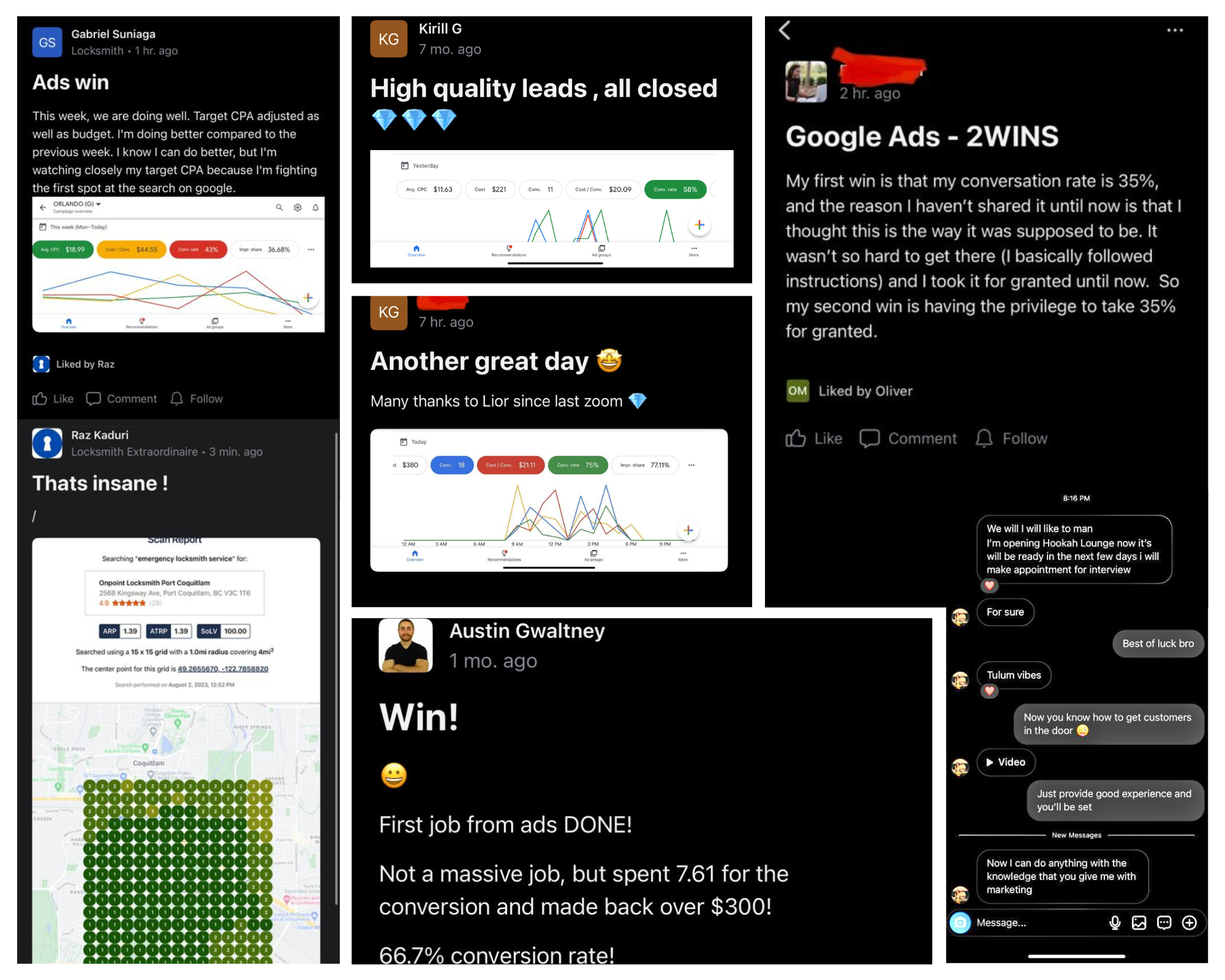

I built Local Service Mastery because I watched too many great contractors get burned by agencies — overcharged, locked out, left with nothing. So I flipped the model: your accounts, your data, your asset. We build it. You own it.
Peace,
Lior Vaknin
No. This is independent, educational commentary based entirely on publicly available information — the firm's own website source code and their public Google Business Profile, reviewed August 11, 2026. We are not affiliated with, endorsed by, or sponsored by Montgomery Law.
Because reputation and visibility are two separate systems. The 939 reviews describe what clients experienced after they found the firm; the map pack decides who finds it next. Review quality is one of the strongest inputs into map rankings — which is precisely why a 0% visibility score is so striking. The trust is earned; the listing just hasn't been tuned to convert that trust into placement across Dallas.
Ads buy placement; they don't fix what the placement lands on. Without call tracking, the firm can't tell which ads produce the calls that sign cases, so budget can't flow toward what works. Without click-fraud protection, a slice of every month's spend goes to bots and competitor clicks. And ads stop the moment the budget does — the map pack, once earned, keeps working for free. The two channels solve different problems, and right now both are leaking.
It's a small signal with a compounding effect. Search engines read headings as an outline — the H1 is the page's main declaration of topic, and when a subheading precedes it, that declaration is structurally weakened. On the most contested search terms in Dallas personal injury, every relevance signal counts, and this one is a five-minute fix once someone looks at the source.
More than for almost any other trade. The entire purchase decision is trust: someone hurt, overwhelmed, and choosing a stranger to fight for them. An attorney speaking plainly to camera for sixty seconds builds more of that trust than any page copy — and legal-question searches on YouTube are exactly where anxious future clients go first. A channel last touched in 2011 is a trust asset sitting in a drawer.
Yes — attorneys, medical practices, HVAC, plumbing, roofing, restoration and cleaners all run on the same system. One service area, a fully optimized Google Business Profile, a fast dedicated page, and clean tracking — the same discipline behind our coaching program, applied to every gap on this page during onboarding.
To be clear about what we do and don't know: we have no idea who maintains the Montgomery Law website or marketing, or whether anyone outside the firm touches it. Nothing in this review claims otherwise.
Speaking about the industry in general, not this firm — this is my opinion, formed over fifteen years inside local-service accounts. A monthly retainer gets paid whether or not anyone re-opens the account. A junior manager juggling sixty or eighty clients isn't grid-scanning one Dallas firm's map coverage or asking why ad spend runs with no call tracking behind it. If someone is being paid to run this marketing, a 0% map-pack scan and an unprotected ad budget are the kinds of things that should have been caught in week one.
Here's what has genuinely changed. Grid-scanning map coverage as rankings shift, watching ad accounts for missing tracking and unprotected spend, re-checking page structure for silent drift — this is repetitive, rules-based work, and AI now runs it every day, automatically, no retainer attached. Owners never handed marketing to agencies because agencies knew a secret formula. They handed it over because of the hours. AI has the hours now.
And that flips the ownership question on its head. With a bit of guidance, an owner can run all of this in-house and hold the whole thing outright: the Google Business Profile, the ad account, the site, the history that compounds month after month. Everything in your name — nobody can hold it hostage, and nobody takes it with them when a relationship ends. That's the wedge behind Local Service Mastery: done for you, owned by you.
If you would rather own this knowledge than rent it back from an agency every month, that trade is what our coaching program is built around.
Everything above came from public information in a single afternoon. If you run a local service business and want to know what's leaking in your own marketing, we'll run the same audit on you at no cost.
Book a live demo →This review's video uses AI-generated narration.
This review is independent educational commentary, produced for informational purposes under fair use. All observations are based on publicly available information — Montgomery Law's own public website source code and their public Google Business Profile — reviewed on August 11, 2026. We are not affiliated with, endorsed by, or sponsored by Montgomery Law. Nothing here is a criticism of their legal work; their 4.7-star rating across 939 reviews speaks for itself. Marketing setups change — anything described here may have been updated since the review date.
Some links on this page are affiliate links — we may earn a commission at no extra cost to you.
Music in the video: "Deliberate Thought" by Kevin MacLeod (incompetech.com), licensed under Creative Commons: By Attribution 4.0 License — creativecommons.org/licenses/by/4.0/
 Local Service Mastery